10 Best Tire Inflators for Slow Leaks: Portable Pumps That Actually Help

A slow tire leak does not always leave you stranded immediately. It slowly lowers your tire pressure, forcing you to refill the tire again and again. A portable tire inflator gives you a quick way to restore the lost air at home, in your driveway, or on the roadside.
The best tire inflator for a slow leak should have an accurate digital gauge, automatic shutoff, enough airflow for your tire size, and a reliable power source. For most drivers, the Fanttik X8 Apex is a strong overall choice because it combines cordless operation, fast inflation, preset PSI settings, and automatic shutoff.
Keep in mind, a tire inflator does not repair the leak. It only restores tire pressure. If your tire keeps losing air, you still need to find the source of the leak and repair or replace the tire when necessary.
Best Tire Inflators for Slow Leaks
| Tire Inflator | Best For | Key Feature |
|---|---|---|
| Fanttik X8 Apex | Overall | Fast cordless inflation |
| DEWALT 20V MAX | Heavy-Duty | Multi-power operation |
| Slime Digital | Budget | 12V car power |
| AstroAI | Digital Use | Preset PSI |
| VIAIR 88P | Trucks | High airflow |
| Avid Power | Cordless Value | Rechargeable battery |
| TEROMAS | Dual Power | AC/DC operation |
| Milwaukee M18 | Professional | Heavy-duty cordless |
| Kensun AC/DC | Versatility | AC/DC power |
| EPAuto 12V | Emergency Use | Compact 12V design |
1. Fanttik X8 Apex
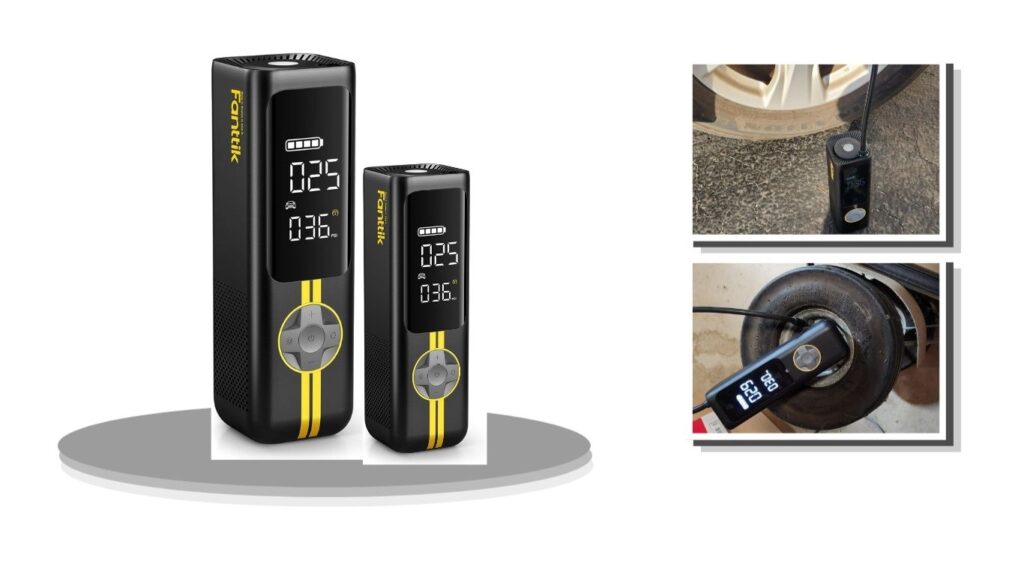
The Fanttik X8 Apex is a convenient cordless tire inflator for drivers who want a compact pump that is always ready to use. Its rechargeable battery powers the compressor, so you do not need to keep the vehicle running or connect the pump to a 12V outlet every time you need air.
The digital display makes checking tire pressure straightforward, while the preset PSI feature lets you choose your desired pressure before inflation. Once the tire reaches that setting, the auto-shutoff stops the compressor automatically. This is especially useful for routine tire top-offs and roadside emergencies.
Its compact design makes it easy to keep in a trunk, and the built-in LED light can be helpful when checking a tire at night.
Key Features
- Rechargeable battery
- Cordless operation
- Digital pressure display
- Preset PSI function
- Automatic shutoff
- Fast inflation
- Compact, portable design
- Built-in LED light
Pros
- Easy to use without a power cable
- Convenient for roadside emergencies
- Digital pressure reading is easy to monitor
- Preset PSI reduces the chance of overinflation
- Compact enough for trunk storage
- LED light is useful in low-light conditions
Cons
- Battery eventually needs to be recharged
- Less suitable for repeated heavy-duty inflation
- Battery runtime can vary depending on tire size and pressure
Best for: Daily tire top-offs, emergency use, slow leaks, sedans, and SUVs.
2. DEWALT 20V MAX Cordless Tire Inflator
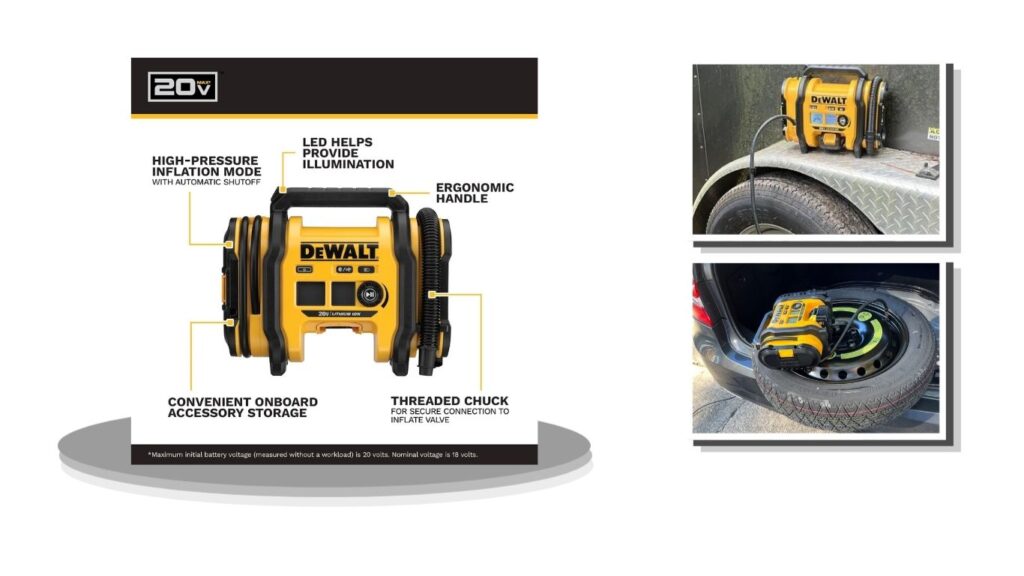
The DEWALT 20V MAX Cordless Tire Inflator is aimed at drivers who need more power and flexibility than a basic portable inflator provides. Its major advantage is its ability to work with multiple power sources, depending on the configuration.
A DEWALT 20V battery provides cordless operation, while 12V DC and AC power options can make it useful in a vehicle or garage. This gives you more flexibility when inflating tires at home, at a workshop, or on the roadside.
The digital gauge helps you monitor pressure accurately, and the automatic shutoff can stop inflation once the selected pressure is reached. Its heavy-duty construction also makes it a better option for frequent use.
Key Features
- 20V MAX battery operation
- 12V DC power capability
- AC power capability
- Digital pressure gauge
- High-pressure inflation
- Automatic shutoff
- Heavy-duty construction
- Suitable for frequent use
Pros
- Multiple power options
- Strong choice for frequent inflation
- Convenient cordless operation
- Useful for trucks and SUVs
- Digital gauge is easy to read
- Good option for garage and roadside use
Cons
- Larger and heavier than basic portable pumps
- Can be more expensive
- Battery may need to be purchased separately depending on the package
Best for: Trucks, SUVs, frequent tire inflation, workshops, garages, and roadside use.
3. Slime Digital Tire Inflator
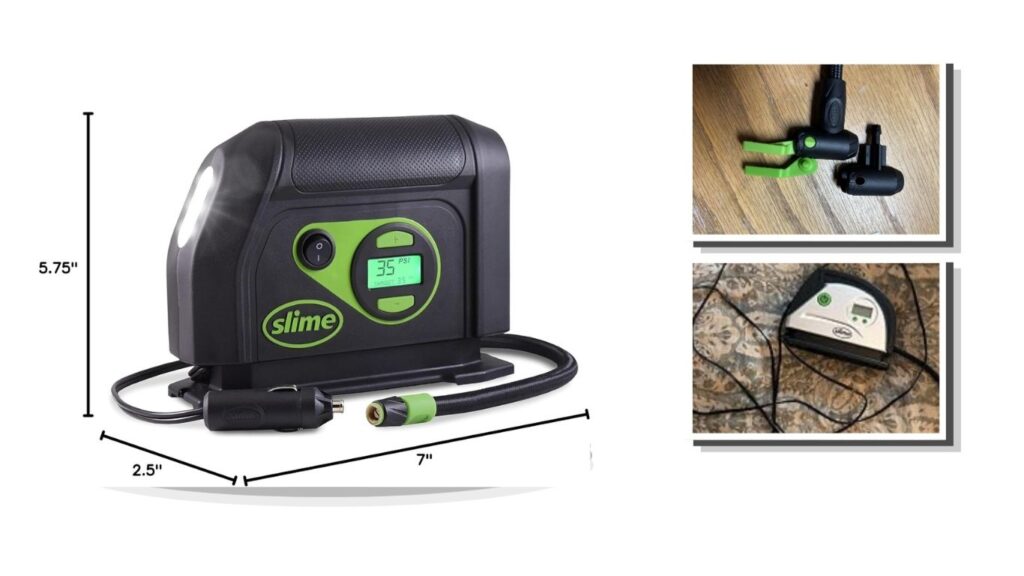
The Slime Digital Tire Inflator is a simple option for drivers who mainly need a reliable pump for occasional tire maintenance. It uses a 12V vehicle power connection, making it particularly suitable for keeping in an emergency kit.
Its compact body does not take up much space, while the digital display allows you to see the tire pressure during inflation. You can select a target PSI, and the auto-shutoff feature stops the pump when the selected pressure is reached.
For passenger cars and routine top-offs, this type of inflator can be a practical alternative to carrying a larger compressor.
Key Features
- 12V vehicle power connection
- Digital pressure display
- Preset PSI
- Automatic shutoff
- Compact design
- Portable construction
Pros
- Simple to operate
- Easy to keep in an emergency kit
- Compact and portable
- Digital pressure display
- Preset pressure makes inflation easier
- Suitable for everyday passenger vehicles
Cons
- Requires access to a 12V power outlet
- Not designed for demanding heavy-duty applications
- Less convenient than a rechargeable cordless model
Best for: Passenger cars, emergency kits, occasional use, and slow-leak top-offs.
4. AstroAI Portable Tire Inflator
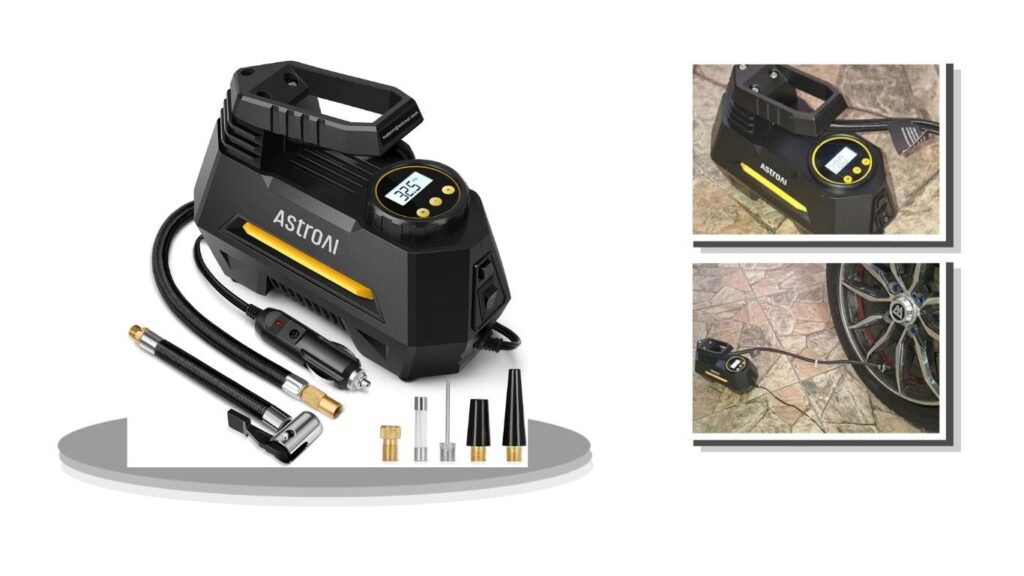
The AstroAI Portable Tire Inflator is designed around convenience and simple pressure management. Its digital gauge lets you see the current tire pressure, while the preset function allows you to select the PSI you want.
Instead of continuously watching the gauge, you can set the desired pressure and allow the pump to work toward that target. The auto-shutoff feature then stops inflation when the selected pressure is reached.
Its portable design makes it useful for keeping at home or carrying in your vehicle. It is particularly appealing to everyday drivers who want a straightforward solution for maintaining tire pressure.
Key Features
- Digital pressure gauge
- Preset pressure function
- Automatic shutoff
- Portable design
- Multiple inflation modes
- Easy-to-read controls
Pros
- User-friendly operation
- Convenient digital pressure monitoring
- Automatic shutoff helps prevent overinflation
- Portable enough for vehicle storage
- Useful for regular tire maintenance
- Good choice for home and emergency use
Cons
- May not be the best choice for very large tires
- Inflation speed depends on tire size and starting pressure
- Portable construction is better suited to occasional rather than continuous heavy-duty use
Best for: Everyday drivers, home use, routine tire top-offs, and roadside emergencies.
5. VIAIR 88P
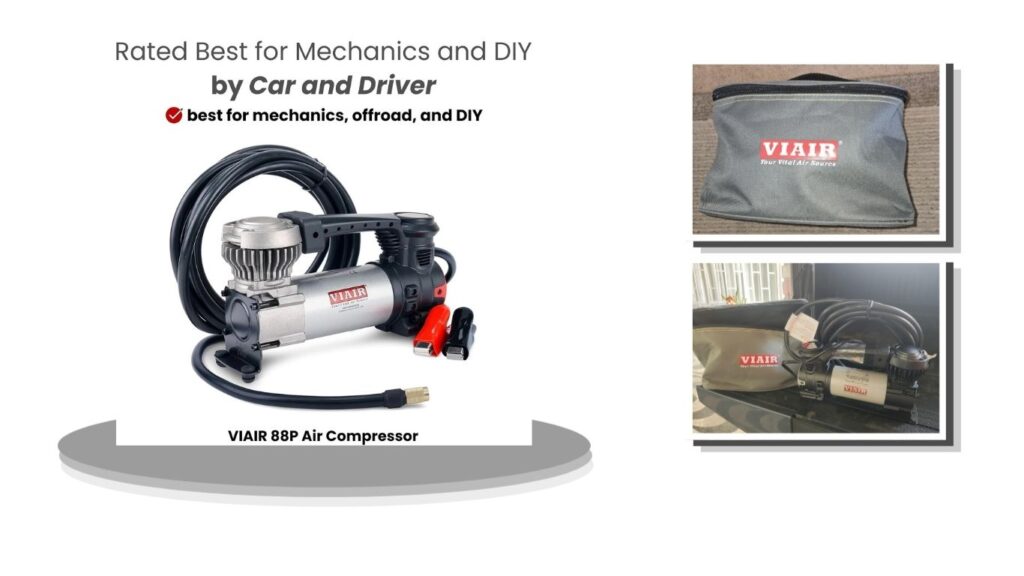
The VIAIR 88P is a more capable 12V compressor designed with larger vehicles in mind. It is particularly useful for trucks, SUVs, and off-road vehicles, where a small emergency inflator may take longer to fill the tires.
Its higher airflow helps reduce inflation time, while the long power cable and air hose make it easier to reach tires without constantly moving the compressor. The heavy-duty construction is another advantage for drivers who regularly deal with larger tires or off-road conditions.
Pressure monitoring can vary depending on the specific version or setup, so buyers should check the exact model before purchasing.
Key Features
- 12V operation
- Higher airflow
- Long power cable
- Long air hose
- Heavy-duty construction
- Designed for larger tires
- Suitable for trucks and SUVs
- Pressure monitoring depending on model
Pros
- Well suited to larger tires
- Good choice for trucks and SUVs
- Higher airflow can reduce inflation time
- Long cables improve reach
- Durable design
- Useful for off-road applications
Cons
- Less compact than small cordless inflators
- Requires a 12V power source
- May be more than a passenger-car driver needs
- Pressure gauge configuration varies by model
Best for: Trucks, SUVs, larger tires, off-road vehicles, and drivers who need a more capable 12V compressor.
6. Avid Power Tire Inflator
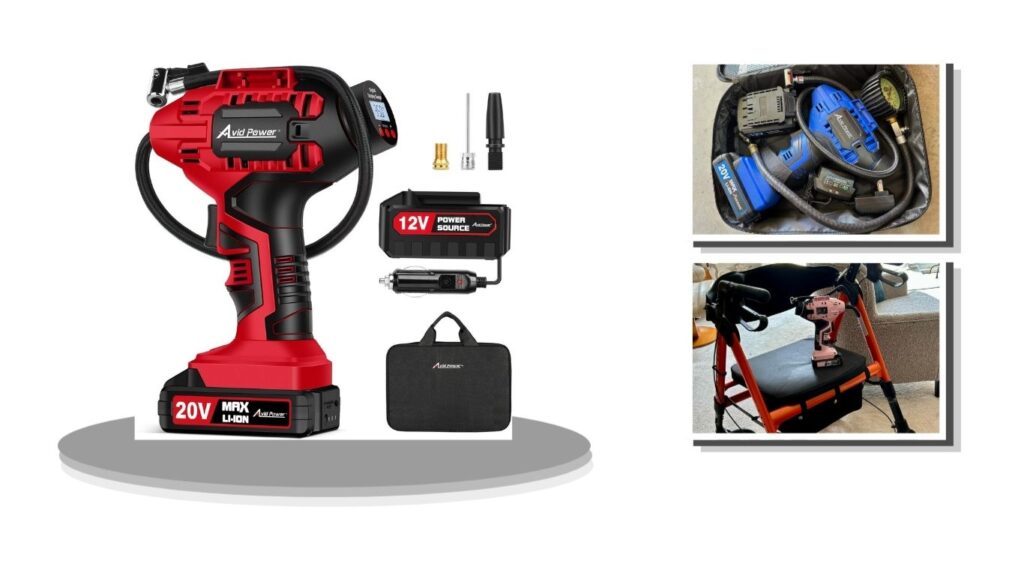
The Avid Power Tire Inflator is a practical choice for drivers who want the convenience of cordless inflation without spending too much. Its rechargeable battery powers the compressor, allowing you to inflate a tire without being connected to the car.
It also includes a 12V power option, which gives you a backup when the battery runs low. The digital display makes it easy to monitor tire pressure, while the preset pressure function and auto-shutoff help make inflation more convenient.
Because of its portable body, you can keep it in the trunk and use it whenever you need to top off a tire or deal with a roadside emergency.
Key Features
- Rechargeable battery
- Cordless operation
- 12V backup power
- Digital pressure display
- Automatic shutoff
- Portable design
- Preset pressure function
Pros
- Convenient cordless operation
- 12V option provides backup power
- Easy-to-read digital display
- Compact and easy to store
- Useful for regular tire top-offs
- Handy for roadside emergencies
Cons
- Battery requires regular charging
- Not intended for continuous heavy-duty use
- Inflation speed can vary with tire size
Best for: Drivers who want cordless convenience, emergency tire inflation, and regular tire top-offs.
7. TEROMAS Tire Inflator
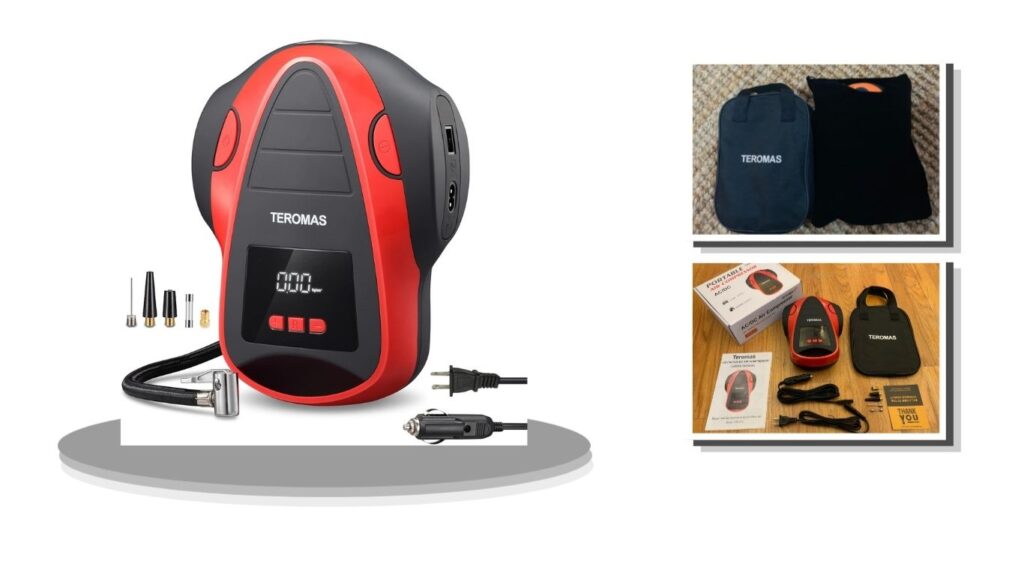
The TEROMAS Tire Inflator stands out because of its AC/DC power versatility. You can use AC power at home or connect it to a vehicle’s 12V outlet when you’re away from the garage.
This makes it particularly useful for drivers who want one inflator for both home maintenance and roadside emergencies. The digital display shows the tire pressure, while the preset function and auto-shutoff make it easier to reach the desired PSI without constantly monitoring the pump.
Multiple adapters also make the inflator suitable for more than just car tires, adding some versatility for household and recreational items.
Key Features
- AC power operation
- 12V DC vehicle connection
- Digital pressure display
- Preset pressure function
- Automatic shutoff
- Multiple inflation adapters
- Portable design
Pros
- Works at home and in the vehicle
- Multiple power options
- Easy digital pressure monitoring
- Automatic shutoff adds convenience
- Multiple adapters increase versatility
- Useful for emergency situations
Cons
- Requires a power connection
- Not as convenient as a fully cordless pump
- Better suited to occasional use than demanding commercial applications
Best for: Home and vehicle use, emergency inflation, and drivers who want multiple power options.
8. Milwaukee M18 Tire Inflator
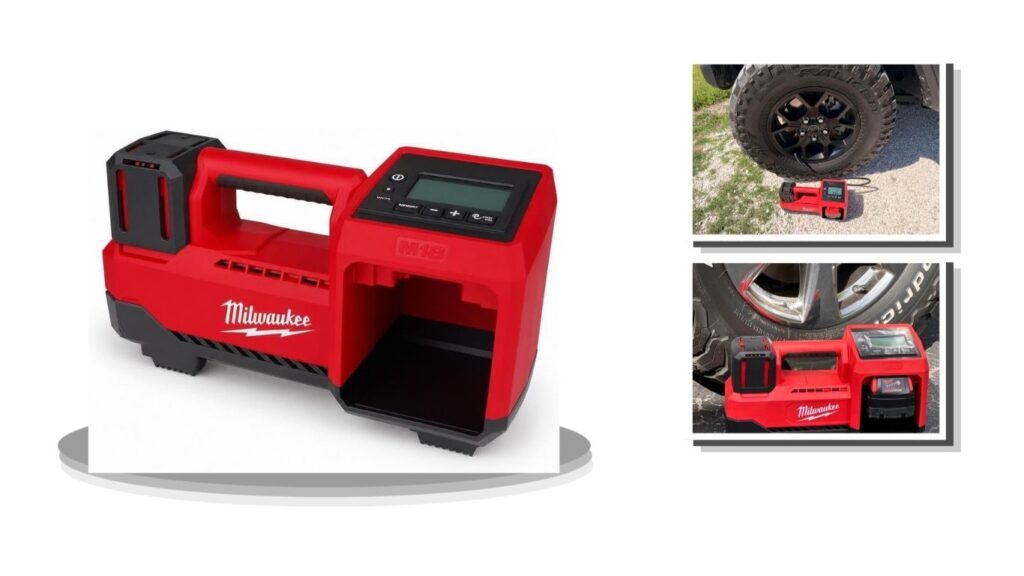
The Milwaukee M18 Tire Inflator is built for users who want professional-level cordless performance. It runs on the M18 battery platform, making it especially attractive to people who already own other compatible Milwaukee tools and batteries.
The digital gauge allows you to monitor tire pressure, while the preset PSI function lets you select the target pressure before inflation. The auto-shutoff then stops the compressor when the desired pressure is reached.
Its heavy-duty construction and high-pressure capability make it a stronger option for frequent users, truck owners, and people who regularly work around vehicles.
Key Features
- M18 battery platform
- Cordless operation
- High-pressure inflation capability
- Digital pressure gauge
- Preset PSI function
- Automatic shutoff
- Heavy-duty construction
Pros
- Strong cordless performance
- Excellent option for frequent use
- Convenient for existing M18 tool owners
- Digital gauge is easy to monitor
- Preset PSI simplifies inflation
- Durable construction
Cons
- Battery and charger may be sold separately
- Heavier than basic portable inflators
- Less attractive if you do not already use the M18 platform
- Higher cost than many basic emergency pumps
Best for: Frequent users, contractors, truck owners, and existing Milwaukee M18 tool users.
9. Kensun AC/DC Rapid Performance Inflator
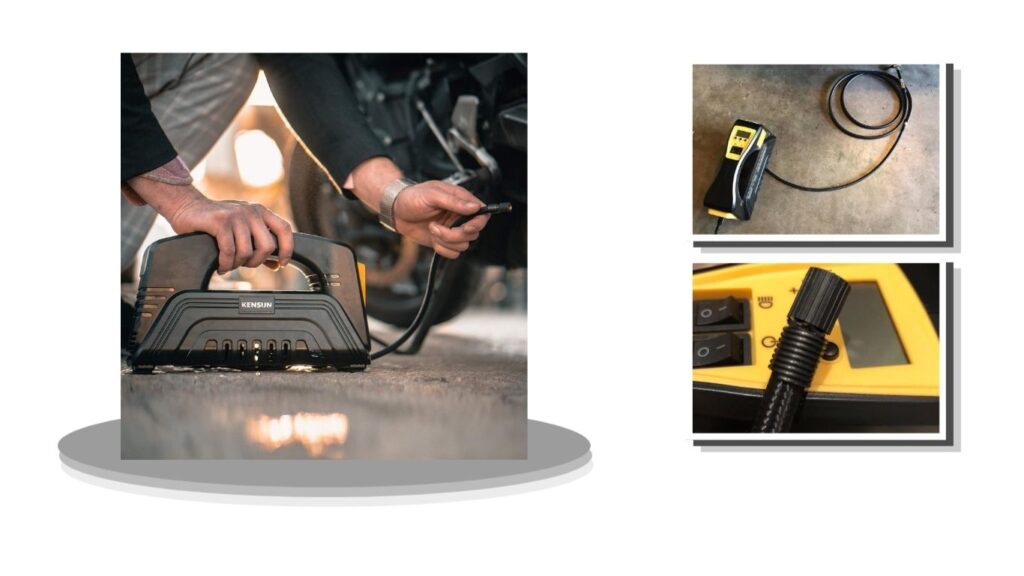
The Kensun AC/DC Rapid Performance Inflator is designed for drivers who want to use the same compressor both at home and on the road. Its AC power allows convenient garage use, while the DC connection lets you power it from a vehicle during roadside emergencies.
Its portable design makes it easy to move between vehicles, and the pressure gauge lets you keep an eye on inflation progress. Because of its dual-power setup, it can be useful for households with multiple cars or drivers who want a flexible backup inflator.
Key Features
- AC power operation
- DC vehicle power
- Portable design
- Pressure gauge
- Dual-power capability
- Suitable for multiple vehicle applications
Pros
- Can be used at home or on the road
- AC/DC flexibility
- Useful for multiple vehicles
- Easy to transport
- Good emergency backup
- Convenient for garage maintenance
Cons
- Requires access to a power source
- Not as compact as some cordless inflators
- May be unnecessary for drivers who only need occasional tire top-offs
Best for: Home garages, roadside emergencies, and households with multiple vehicles.
10. EPAuto 12V DC Portable Air Compressor
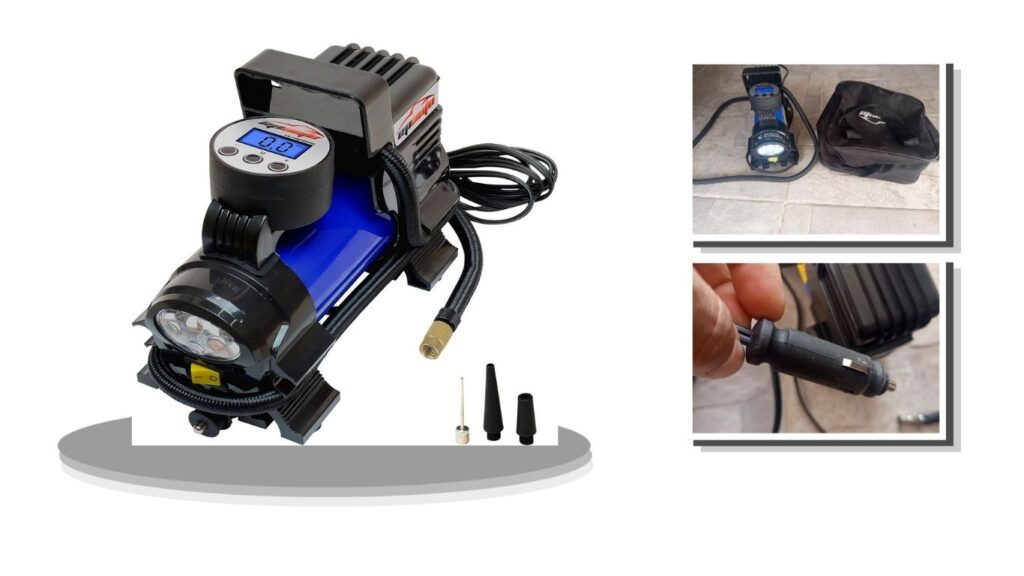
The EPAuto 12V DC Portable Air Compressor is a straightforward and affordable option for drivers who want an emergency tire pump without investing in a larger compressor. It connects directly to a vehicle’s 12V outlet, making it convenient to keep in the trunk.
Its digital display lets you monitor tire pressure while the compressor is running. The preset pressure feature and auto-shutoff make routine inflation easier because the pump can stop when the selected PSI is reached.
The compact design and included adapters also make it useful for occasional inflation beyond standard car tires, although its main purpose is everyday vehicle tire maintenance.
Key Features
- 12V DC power connection
- Digital pressure display
- Preset PSI function
- Automatic shutoff
- Compact portable design
- Multiple adapters
- Easy vehicle storage
Pros
- Affordable emergency backup
- Compact and easy to carry
- Simple 12V operation
- Digital pressure monitoring
- Automatic shutoff
- Useful for sedans and small SUVs
- Multiple adapters add versatility
Cons
- Requires a 12V power outlet
- Not designed for heavy-duty continuous use
- Inflation can take longer on larger tires
- Less convenient than cordless models
Best for: Sedans, small SUVs, emergency kits, and occasional tire inflation.
Quick Comparison: Auto Air Pumps 6–10
| Model | Main Strength | Power | Best For |
|---|---|---|---|
| Avid Power | Cordless value | Battery + 12V | Everyday drivers |
| TEROMAS | AC/DC versatility | AC + 12V DC | Home and vehicle use |
| Milwaukee M18 | Professional performance | M18 battery | Frequent and heavy use |
| Kensun | Dual-power operation | AC + DC | Garages and emergencies |
| EPAuto | Affordable backup | 12V DC | Sedans and small SUVs |
What Makes the Best Tire Inflator for a Slow Leak?
A tire inflator can be extremely useful when a tire is losing air slowly, but not every inflator is equally convenient for the job. The best model should make it easy to check the current PSI, add the right amount of air, and stop automatically at the pressure you need. Features such as power source, inflation speed, battery capacity, and hose length also matter depending on how and where you use the pump.
Auto-Shutoff
Auto-shutoff is one of the most useful features when dealing with a slow leak. You can set the desired tire pressure, start the compressor, and let it run until the target is reached.
The relationship is simple: auto-shutoff → detects → target PSI. Once the inflator reaches the selected pressure, it stops automatically.
This is especially helpful when topping off a leaking tire because you may need to add air frequently. Instead of standing beside the tire and watching the gauge the entire time, you can rely on the preset pressure feature to stop inflation at the selected level.
It also helps reduce the risk of accidentally overinflating the tire.
Digital Pressure Gauge
A good digital pressure gauge makes tire inflation much easier because you can clearly see how much air is currently in the tire.
The gauge → measures → tire pressure, usually displayed in PSI. Look for a model with a readable digital screen, reliable pressure measurement, and a preset-pressure function.
Important features include:
- PSI accuracy: Helps you reach the correct tire pressure.
- Readability: A large, clear display is easier to check in poor lighting.
- Digital display: Gives you a quick pressure reading.
- Preset pressure: Allows you to select the desired PSI before inflation.
For a slow leak, a reliable gauge is particularly important because the goal is not simply to add air. You want to restore the tire to the vehicle manufacturer’s recommended pressure.
Power Source
The power source affects how portable and convenient your tire inflator will be.
A rechargeable battery provides the most freedom because you can use the compressor without connecting it to the vehicle. This is convenient for roadside emergencies or checking tires in a driveway.
A 12V DC inflator draws power from the vehicle, usually through a 12V accessory connection or directly from the vehicle’s electrical system, depending on the model. It can be a good choice for keeping in the trunk.
An AC-powered inflator is more convenient for garage or home use where a household electrical outlet is available.
Some models offer multi-power operation, combining battery, 12V DC, and/or AC power. These provide greater flexibility when moving between home and roadside use.
The key relationship is:
Power source → determines → portability and operating flexibility.
Inflation Speed
Inflation speed becomes more important when you regularly need to top off a tire.
The main factors include:
- Airflow
- Maximum pressure
- Tire size
- Starting tire pressure
- Inflation time
The basic relationship is airflow → affects → inflation speed. A compressor capable of moving more air can generally inflate a tire faster, assuming other specifications are comparable.
Tire size also matters. A small passenger-car tire requires less air than a large truck or SUV tire. Therefore, a compressor that works well for a sedan may take considerably longer with a large off-road tire.
For occasional slow-leak top-offs, extreme inflation speed may not be necessary. However, if the tire loses pressure regularly, a faster compressor can save considerable time.
Battery Capacity
For cordless inflators, battery capacity determines how many tires you can inflate before recharging.
Important battery specifications include:
- Voltage: Indicates the electrical system used by the compressor.
- Ah capacity: Gives an indication of how much energy the battery stores.
- Recharge time: Determines how quickly the inflator is ready for another use.
- Number of tire top-offs: Shows how many inflation tasks you can reasonably complete per charge.
The relationship is battery capacity → affects → runtime.
A larger battery does not automatically mean faster inflation, but it can provide more operating time. This matters if you’re dealing with multiple tires or repeatedly topping off a tire with a persistent leak.
Hose and Power Cord Length
Hose and power-cord length may seem like small details, but they can make a portable inflator much easier to use.
A longer hose → improves → valve access. You can reach the tire valve without having to position the compressor directly beside the wheel.
Likewise, a longer power cable → increases → vehicle positioning flexibility. This is especially useful with 12V compressors because you may need to reach all four tires from the vehicle’s power outlet.
For larger vehicles, SUVs, and trucks, extra hose and cable length can make a noticeable difference.
Can a Tire Inflator Fix a Slow Leak?
No. A tire inflator does not repair a slow leak. It only replaces the air that has escaped from the tire.
The distinction is important:
- Inflator → restores → PSI
- Tire plug → repairs → puncture
- Tire patch → seals → damaged area
- Valve replacement → fixes → valve leak
For example, if a nail has punctured the tread, an inflator can temporarily restore the lost air, but the nail hole remains. Likewise, if the valve stem is leaking, repeatedly adding air does not solve the underlying problem.
A tire that repeatedly loses pressure should be inspected and properly repaired or replaced as appropriate. Driving for extended periods on an underinflated tire can also cause additional tire damage.
How to Use a Tire Inflator for a Slow Leak
If the tire is still safe to inflate, the process is straightforward.
1. Check the Tire Pressure
Start by checking the tire’s current PSI using the inflator’s gauge. This tells you how much pressure has been lost.
2. Find the Recommended PSI
Look at the vehicle’s door-jamb label for the manufacturer’s recommended tire pressure.
Do not use the maximum PSI printed on the tire sidewall as your normal inflation target. The sidewall figure is generally the tire’s maximum allowable pressure under specified conditions, not the vehicle’s recommended everyday pressure.
3. Connect the Hose
Remove the valve cap and attach the inflator hose firmly to the tire valve. Make sure the connection is secure so air does not escape while you’re inflating.
4. Set the Target PSI
If the inflator has a digital preset function, enter the recommended PSI. This allows the compressor to work toward the selected pressure automatically.
5. Inflate the Tire
Turn on the compressor and allow it to inflate the tire until it reaches the target pressure. If the compressor becomes excessively hot, follow the manufacturer’s recommended duty cycle and allow it to cool when necessary.
6. Check for Air Loss
After inflation, check the pressure again later. If the tire has lost pressure again, the problem has not been solved.
A repeated pressure drop → indicates → an unresolved leak that should be inspected.
How Often Should You Inflate a Tire With a Slow Leak?
There is no safe universal schedule for repeatedly inflating a leaking tire. Leak severity → determines → inflation frequency.
If a tire loses only a small amount of pressure over a long period, you might notice the change during routine pressure checks. However, a tire that loses noticeable pressure every day needs much more attention.
Consider these situations:
- Daily pressure loss: Indicates a significant problem that should be inspected promptly.
- Weekly pressure loss: Still suggests an air leak or another tire-related issue that needs investigation.
- Temperature changes: Cold weather can lower tire pressure even without an actual puncture.
- Puncture-related leakage: Nails, screws, or other objects can allow air to escape gradually.
- Valve leakage: A damaged valve stem or valve core can cause persistent pressure loss.
If the tire is becoming visibly low or losing pressure rapidly, don’t treat repeated inflation as a permanent solution. Rapid PSI loss → indicates → the need for immediate inspection.
How to Find a Slow Tire Leak
Finding the source of a slow leak can sometimes be simple, especially when the problem is caused by a visible nail or screw. Other leaks can be harder to identify and may occur around the valve or where the tire meets the wheel.
Common areas to inspect include the tread, sidewall, valve stem, valve core, and bead.
Visual Inspection
Start with a careful visual inspection of the tire.
Look for:
- Nails
- Screws
- Other embedded objects
- Damaged valve components
- Cracks
- Cuts or unusual damage
Pay particular attention to the tread because punctures from nails and screws often occur there. Do not automatically remove an embedded object, as doing so can cause the tire to lose air more quickly.
Soapy Water Test
A soapy water solution can help reveal a small leak that isn’t obvious during a visual inspection.
The relationship is:
Soapy water → reveals → escaping air
Apply the solution around suspected areas, including the tread, valve, and bead. If air is escaping, you may see bubbles forming or growing at the leak location.
Bubbles → indicate → leak location.
This method can be useful for finding very slow leaks that are difficult to hear or see.
Check the Valve Stem
The valve stem is the connection point used to inflate the tire, and it can become damaged or develop a leak over time.
The relationship is:
Valve stem → connects → tire to inflation system.
A damaged valve stem or valve core can allow air to escape gradually, even when the tread looks perfectly normal.
If bubbles appear around the valve during a soapy-water test, the valve area may be responsible for the pressure loss.
Inspect the Bead
The bead → seals → tire against wheel rim. If the bead or the area where the tire meets the rim has a sealing problem, air can slowly escape.
Bead-related leaks can be more difficult to identify than a simple tread puncture. Corrosion, damage, contamination, or problems with the tire-to-wheel seal can contribute to air leakage.
If you cannot identify the leak yourself, especially when the leak appears to come from the bead or sidewall, having the tire inspected by a qualified tire professional is the safer option.
Tire Inflator vs Air Compressor
The terms tire inflator and air compressor are often used interchangeably, especially when talking about portable automotive equipment. However, there is a practical difference in how they are designed and what they are best suited for.
A tire inflator is generally designed primarily to add air to tires. It is usually compact, portable, and easy to keep in a vehicle. A larger air compressor is typically designed to supply compressed air for a wider range of jobs, such as operating pneumatic tools, blowing debris, or powering other air-operated equipment.
| Attribute | Tire Inflator | Air Compressor |
|---|---|---|
| Main use | Tire inflation | Multiple pneumatic tasks |
| Portability | Usually high | Varies by size |
| Tire top-offs | Excellent | Excellent |
| Air tools | Limited | Better suited |
| Emergency use | Excellent | Depends on size |
For simply maintaining tire pressure or dealing with a roadside low tire, a portable tire inflator is usually more convenient. If you also need compressed air for tools and workshop tasks, a dedicated air compressor is the better choice.
Cordless vs 12V Tire Inflator
Choosing between a cordless and 12V tire inflator mostly comes down to how you plan to use it. Both can work well for slow-leak top-offs, but they offer different types of convenience.
Cordless
A cordless inflator runs from a rechargeable battery, so you don’t need to connect a power cable to your vehicle. This makes setup particularly quick when you’re standing beside a tire.
Advantages:
- No power cable during inflation
- Fast setup
- Easy roadside use
- Highly portable
- Convenient for checking multiple vehicles
The main drawback is that the battery needs to be charged. Runtime is also limited, especially when inflating larger tires or repeatedly topping off a tire with a slow leak.
12V
A 12V tire inflator gets its power from the vehicle, usually through a 12V accessory outlet or another vehicle power connection, depending on the model.
Advantages:
- Uses vehicle power
- No separate battery to maintain
- Useful for roadside emergencies
- Can be stored in the vehicle for long periods
The main limitations are the need for a suitable power outlet and dealing with the power cable while moving around the vehicle.
Dual-Power
A dual-power inflator can provide the best of both options. The combination of a rechargeable battery + 12V connection → provides → power redundancy.
If the internal battery is empty, you may still be able to use vehicle power. For someone who regularly manages a slow leak, that backup can be especially valuable because you are less likely to be left without a way to restore tire pressure.
Best Tire Inflator by Vehicle
The best inflator depends partly on the size of your tires and how frequently you expect to use it.
Sedan
For a typical sedan, you usually don’t need an oversized compressor. A compact model that is easy to store and quick to set up is often the most practical choice.
Prioritize:
- Compact size
- 12V or cordless operation
- Digital pressure gauge
- Auto-shutoff
- Easy storage
A cordless or compact 12V inflator can handle routine pressure checks and top-offs without taking much trunk space.
SUV
SUV tires are generally larger than sedan tires, so inflation speed and compressor capacity become more important.
Prioritize:
- Higher airflow
- Longer hose
- Larger battery
- Faster inflation
- Reliable pressure monitoring
A slightly more powerful inflator can save time, particularly if you regularly check all four tires.
Truck
Truck owners should look for an inflator capable of handling larger tires without excessive strain.
Prioritize:
- High airflow
- Heavy-duty motor
- Longer duty cycle
- 12V or battery power
- Durable construction
A basic emergency inflator may work for occasional top-offs, but a higher-capacity compressor is more practical for frequent truck-tire inflation.
RV
RV tires can be substantially larger and require more air than typical passenger-car tires. Compressor capacity therefore matters even more.
Prioritize:
- High airflow
- High-duty-cycle compressor
- Long air hose
- Strong power source
- Suitable maximum pressure
For an RV, don’t choose an inflator based only on its advertised maximum PSI. Make sure its airflow, duty cycle, and power requirements are appropriate for the actual tire size and pressure you need to maintain.
What PSI Should You Use After a Slow Leak?
After dealing with a slow leak, inflate the tire to the vehicle manufacturer’s recommended cold tire pressure.
The easiest place to find this specification is usually the driver-side door-jamb label. The owner’s manual may also provide the recommended pressure.
The important distinction is:
Vehicle manufacturer → specifies → recommended cold tire pressure
while:
Tire sidewall → specifies → maximum pressure limit
These numbers are not interchangeable.
The pressure printed on the tire sidewall is generally the tire’s maximum allowable pressure under specified conditions. It is not necessarily the correct pressure for your particular vehicle.
For the most accurate reading, check tire pressure when the tires are cold or have not been driven enough to heat up significantly. If you’ve just driven the vehicle, the pressure reading may be temporarily higher because of heat.
How Long Can You Drive With a Slow Tire Leak?
There is no reliable number of miles that is safe for every slow leak. The answer depends on how quickly the tire is losing pressure, its current PSI, the location and severity of the leak, vehicle speed, road conditions, and tire temperature.
A tire that loses a small amount of pressure over several days is very different from one that becomes noticeably low within a few hours.
Low tire pressure increases → heat buildup and handling problems. Underinflation can affect steering, braking, stability, and tire wear.
If you discover a slow leak, the safer approach is to restore the tire to the recommended pressure and arrange an inspection as soon as possible rather than planning to drive indefinitely while repeatedly adding air.
If the tire is losing pressure quickly, looks damaged, or cannot maintain the correct PSI, avoid driving on it and have it inspected.
When to Stop Using a Tire Inflator
A tire inflator is useful for restoring air pressure, but there are situations where repeatedly adding air is no longer an appropriate solution.
Do not keep relying on the inflator when:
- Pressure drops rapidly
- The sidewall is damaged
- The tire has a large puncture
- The tire is visibly deformed
- The bead is leaking badly
- The tire has been driven severely underinflated
A compressor can restore pressure, but it cannot make structural tire damage safe.
The key relationship is:
Severe tire damage → requires → professional inspection or replacement.
If you notice a bulge, major cut, exposed cords, significant sidewall damage, or other serious deformation, don’t attempt to solve the problem by simply adding more air.
FAQ
What is the best tire inflator for a slow leak?
The best tire inflator for a slow leak should have a reliable pressure gauge, preset PSI, automatic shutoff, and a convenient power source. For roadside use, cordless and 12V models are both practical.
Can a tire inflator fix a slow leak?
No. A tire inflator only replaces the air that has escaped. It does not repair the puncture, valve, bead, or other source of the leak.
How often should I inflate a tire with a slow leak?
It depends on the leak rate. If you’re adding air every day or the tire loses pressure quickly, the tire should be inspected rather than repeatedly topped off.
What PSI should I inflate my tire to?
Use the vehicle manufacturer’s recommended cold tire pressure, normally found on the driver’s door-jamb label or in the owner’s manual. Don’t use the tire sidewall’s maximum PSI as the normal target unless the vehicle manufacturer specifically calls for it.
Is a cordless or 12V tire inflator better?
A cordless model offers greater portability and faster setup, while a 12V model can draw power directly from the vehicle. A dual-power model provides additional flexibility if you want both options.
How fast should a portable tire inflator fill a tire?
Inflation time depends on airflow, starting pressure, tire size, and compressor capacity. Larger tires generally require more air and therefore take longer to inflate.
Can I use a tire inflator on a truck tire?
Yes, provided the inflator is rated for the truck tire’s required pressure and size. For frequent truck use, choose a higher-airflow, heavy-duty model rather than a small emergency inflator.
How do I find a slow tire leak?
Start with a visual inspection for nails, screws, cuts, or damaged components. You can also use soapy water around the tread, valve, and bead. Growing bubbles can reveal where air is escaping.
Can a slow leak be caused by a nail?
Yes. A nail or screw penetrating the tread can create a small puncture that allows air to escape gradually.
Can a valve stem cause a slow tire leak?
Yes. A damaged valve stem or leaking valve core can allow air to escape even when the tire tread appears undamaged.
How long can you drive with a slow tire leak?
There is no universal safe distance. A tire that continues losing pressure should be inspected as soon as practical. Driving on a significantly underinflated tire can create heat buildup and handling problems.
Should I plug a tire with a slow leak?
If the leak is caused by a repairable tread puncture, a proper tire repair may be possible. However, not every puncture is safely repairable. Sidewall damage and certain larger or improperly located punctures generally require professional assessment rather than a simple plug.
Do tire inflators have automatic shutoff?
Many modern portable inflators have an automatic shutoff feature. You set the target PSI, and the compressor stops when it reaches that pressure. Always verify the feature on the specific model.
Does battery size matter in a cordless tire inflator?
Yes. Battery capacity affects how long the inflator can operate between charges. A larger battery can generally provide more runtime, which is useful when inflating several tires or working with larger tires.
Do I need an air compressor if I have a tire inflator?
Not necessarily. If your main job is maintaining vehicle tire pressure, a tire inflator may be all you need. A larger air compressor becomes more useful when you also want to operate pneumatic tools or perform other compressed-air tasks.

- Top 10 Best Battery Tester Automotive 2026 - October 20, 2026
- Top 10 Best Battery Tender For Motorcycle Battery 2026 - October 20, 2026
- Top 10 Best Battery Rotary Tool 2026 - October 20, 2026