12V Tire Inflator: How It Works, Uses, PSI, and Buying Guide

A 12V tire inflator is a compact air compressor designed to inflate vehicle tires using 12V DC power. Most models connect to a car’s cigarette lighter or 12V accessory outlet, making them useful for routine tire pressure checks, low-pressure situations, and roadside emergencies.
The main advantage is simple power access. You do not need a separate wall outlet when the inflator is designed for vehicle use. The compressor draws electricity from the vehicle, converts it into mechanical power, and pushes compressed air through a hose into the tire.
When choosing a 12V tire inflator, focus on more than maximum PSI. Airflow, power consumption, gauge accuracy, automatic shutoff, duty cycle, hose length, and tire compatibility affect real-world performance.
A 12V inflator also does not repair a damaged tire. If a tire keeps losing air, the inflator restores the lost pressure while you identify and repair the source of the leak.
1. What Is a 12V Tire Inflator?
A 12V tire inflator is an electric air compressor built to inflate tires from a 12V DC power source. It typically includes a compressor motor, air hose, tire valve connector, power cable, and pressure gauge.
The basic operating relationship is:
12V DC power → runs → compressor motor
Compressor motor → drives → pump
Pump → produces → compressed air
Compressed air → enters → tire
Tire pressure → increases → as air enters
Most vehicle-focused models use a 12V cigarette lighter plug. Some heavy-duty models use battery clamps for a direct connection to the vehicle battery.
A 12V tire inflator is different from a manual hand pump because the electric motor performs the pumping work. It is also different from a large workshop air compressor, which usually provides a larger air reservoir and supports pneumatic tools.
For everyday drivers, the main purpose is maintaining the recommended tire pressure without relying on a gas station air machine.
2. How Does a 12V Tire Inflator Work?
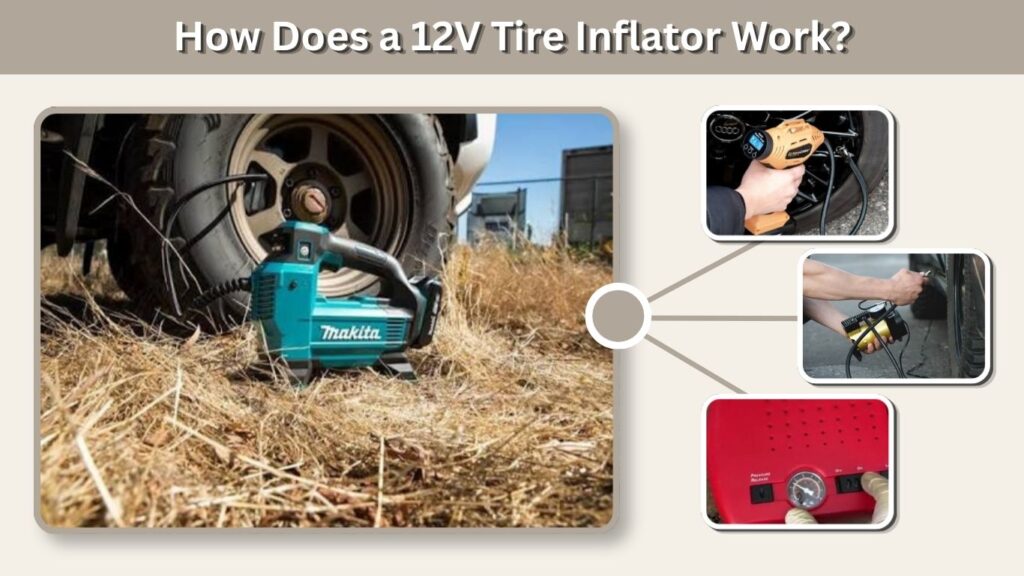
A 12V tire inflator follows a straightforward process. Electrical energy from the vehicle powers the compressor, and the compressor forces air into the tire through the connected hose.
Connect to a 12V Power Source
First, connect the inflator to a compatible 12V DC power source.
The most common connection is a cigarette lighter or 12V accessory outlet.
Vehicle 12V outlet → supplies → electrical power
Electrical power → runs → compressor
Check the inflator’s current requirement before use. Some models draw more current than a vehicle accessory socket is designed to provide.
Connect the Air Hose
Attach the air hose to the tire valve. Most passenger vehicle tires use Schrader valves.
Air hose → connects to → valve stem
Compressor → sends → compressed air
Compressed air → enters → tire
A secure connection matters. A loose connector allows air to escape and reduces inflation efficiency.
Check or Set the Tire Pressure
Many 12V inflators include a pressure gauge. Digital models often let you select a target pressure before inflation.
The gauge → measures → tire pressure
Target PSI → defines → desired pressure
Use the vehicle manufacturer’s recommended cold tire pressure rather than the maximum pressure printed on the tire sidewall.
Start Inflation
Once the hose and power connection are secure, start the compressor. The motor drives the pump, which forces air into the tire.
Inflation speed depends on several attributes:
- Tire size
- Starting pressure
- Target pressure
- Compressor airflow
- Power supply
- Compressor design
Larger tires generally require more air volume, so the same inflator will take longer to fill them.
Automatic Shutoff
Some 12V tire inflators include automatic shutoff. You select a target pressure, and the compressor stops when the measured pressure reaches that setting.
Target PSI → triggers → automatic shutoff
Auto shutoff → reduces → continued inflation
This feature is useful when you want consistent pressure without manually switching the compressor off at the exact moment the tire reaches the target.
3. Why Use a 12V Tire Inflator?
A 12V tire inflator gives you an independent way to restore tire pressure using your vehicle’s electrical system.
Common uses include:
- Correcting low tire pressure
- Routine tire top-offs
- Roadside emergencies
- Seasonal pressure changes
- Maintaining recommended PSI
- Managing pressure loss from a slow leak
The relationship is:
Low tire pressure → requires → additional air
12V inflator → supplies → additional air
Additional air → restores → tire pressure
A slow leak needs special attention. The inflator helps restore pressure, but it does not seal a puncture, repair a valve, or fix bead damage.
Slow leak → causes → gradual air loss
Inflator → restores → lost pressure
Tire repair → addresses → leak source
If the tire repeatedly loses pressure after inflation, inspect it rather than relying on repeated top-offs.
4. Types of 12V Tire Inflators
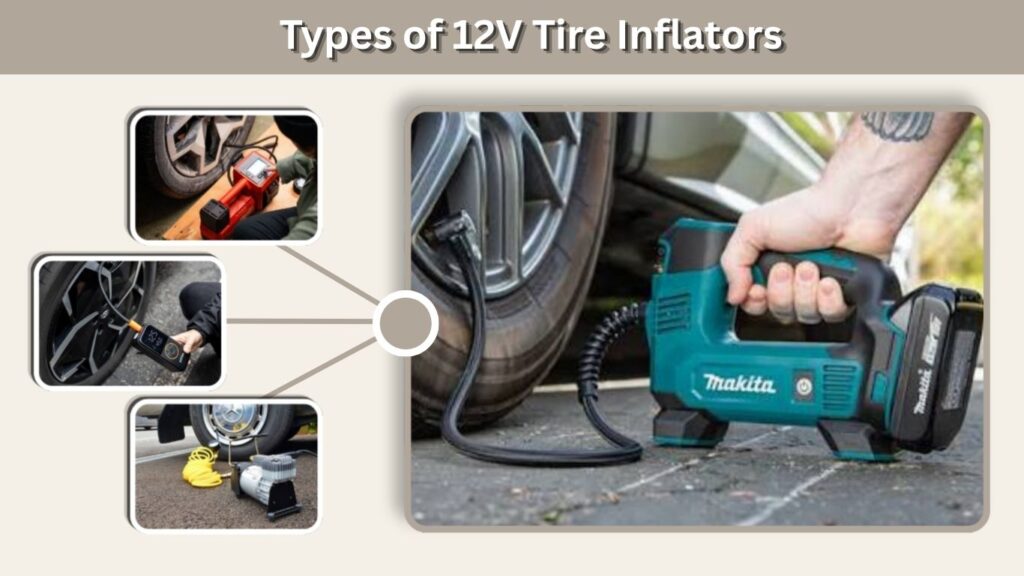
Not every 12V tire inflator uses the same power connection or has the same operating design. The main differences involve how the compressor gets electricity, how portable it is, and what type of tires it is built to handle.
Cigarette Lighter 12V Inflator
The most common type connects directly to a vehicle’s 12V cigarette lighter or accessory outlet. It is convenient for passenger cars because you can keep the compressor in the trunk and use it when needed.
This design works well for:
- Sedans
- Cars
- Crossovers
- Midsize SUVs
- Emergency tire kits
Its main limitation is the power outlet. If your vehicle has a low-rated accessory socket or a damaged outlet, the compressor might not operate correctly.
Battery Powered Inflator
Some portable inflators use a rechargeable battery instead of a power cable. These models offer more freedom because you do not need to stay close to the vehicle’s 12V socket.
The battery powers the compressor directly.
Battery → powers → compressor
This design is useful when you need to inflate a tire away from the vehicle or prefer a cable-free setup.
However, runtime depends on battery capacity, tire size, starting pressure, and the compressor’s power demand.
Direct Battery 12V Compressor
Some larger 12V compressors connect directly to the vehicle battery using clamps. These models often target larger tires and applications requiring higher current.
Direct battery connection → supplies → higher electrical current
This type is more suitable for demanding applications when the manufacturer’s specifications support the tire size and inflation requirements.
5. 12V Tire Inflator Power Requirements
Power requirements are one of the most important specifications to check before buying a 12V tire inflator.
A model might be labeled as 12V, but its current requirement still matters. The vehicle’s electrical system must support the compressor’s demand.
Three specifications are especially relevant:
- Voltage
- Amperage
- Wattage
Voltage describes the electrical operating level. Amperage describes how much current the compressor draws. Wattage represents its electrical power consumption.
The relationship is:
Voltage × Current → determines → Power
For example, a compressor drawing 10 amps at 12 volts uses roughly 120 watts.
You should also check the vehicle’s accessory socket rating and the manufacturer’s instructions. Avoid using an outlet or adapter that is not rated for the compressor’s electrical demand.
6. 12V Tire Inflator vs Cordless Tire Inflator
The biggest difference between these two designs is the power source.
| Feature | 12V Inflator | Cordless Inflator |
|---|---|---|
| Power source | Vehicle 12V | Rechargeable battery |
| Power cable | Required | Not required |
| Runtime | Vehicle power dependent | Battery dependent |
| Portability | Good | Excellent |
| Emergency use | Good | Good |
| Charging | Vehicle outlet | Battery charger |
A 12V model makes sense if you normally inflate tires near your vehicle and want a simple power source.
A cordless model is more convenient when you want to move around freely or inflate a tire without keeping the compressor connected to the vehicle.
The better option depends on your use case rather than the label alone.
7. Important 12V Tire Inflator Features
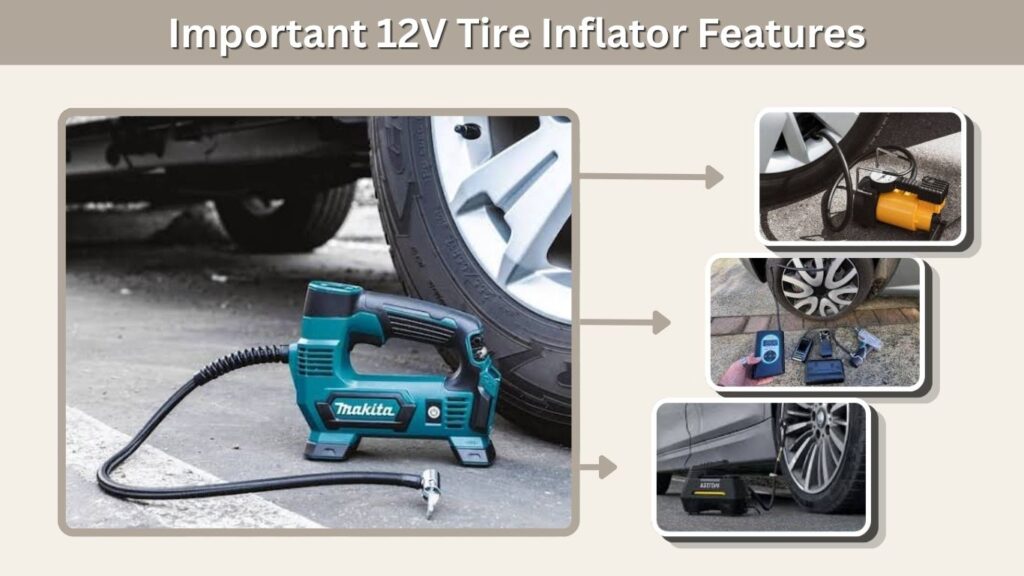
A good 12V tire inflator should match your vehicle and your inflation needs. Several specifications affect how useful it will be in practice.
Digital Pressure Gauge
A digital gauge shows the measured tire pressure on a display. Many models support common units such as PSI, KPA, and BAR.
Digital gauge → measures → tire pressure
Clear pressure readings help you compare the tire’s current pressure with the recommended level.
Automatic Shutoff
Automatic shutoff allows you to select a target pressure before inflation.
Target PSI → controls → stopping point
When the measured pressure reaches the selected value, the compressor stops automatically.
This reduces the need to watch the gauge continuously.
Airflow
Airflow affects how quickly a compressor can add air to a tire.
Higher airflow → generally reduces → inflation time
However, you should not judge a compressor by maximum airflow alone. Tire size, starting pressure, power supply, and operating conditions also affect actual performance.
Maximum Pressure
Maximum PSI indicates the highest pressure level the compressor is designed to reach under its stated conditions.
Do not confuse maximum PSI with inflation speed.
Maximum PSI → indicates → pressure capability
Airflow → affects → inflation speed
A compressor with a high maximum PSI rating is not automatically faster.
Duty Cycle
Duty cycle describes how long the compressor should run before it needs a cooling period.
Compressor operation → generates → heat
Longer operation → increases → heat buildup
A compressor with a suitable duty cycle is important if you regularly inflate multiple tires or larger tires.
Hose and Power Cable Length
Longer hoses make it easier to reach the tire valve. A longer power cable also gives you more flexibility when positioning the compressor around the vehicle.
Hose length → affects → valve accessibility
Cable length → affects → operating range
These details become more important when your vehicle has a large body or when the 12V socket is far from a particular wheel.
8. What PSI Can a 12V Tire Inflator Handle?
The appropriate inflator depends on the tire and the compressor’s specifications.
Passenger cars, SUVs, motorcycles, bicycles, and trucks have different inflation requirements. A small portable compressor designed for passenger tires should not automatically be assumed to support heavy-duty truck tires.
Tire size → affects → required air volume
Tire pressure → affects → compressor workload
Compressor specifications → determine → supported applications
Before buying, compare the manufacturer’s stated maximum pressure, airflow, duty cycle, and recommended tire applications with your vehicle.
For routine passenger-car use, a compact 12V inflator often provides enough capability for pressure maintenance. Larger tires require more air volume, so a higher-capacity compressor is often more appropriate.
9. Can a 12V Tire Inflator Inflate a Completely Flat Tire?
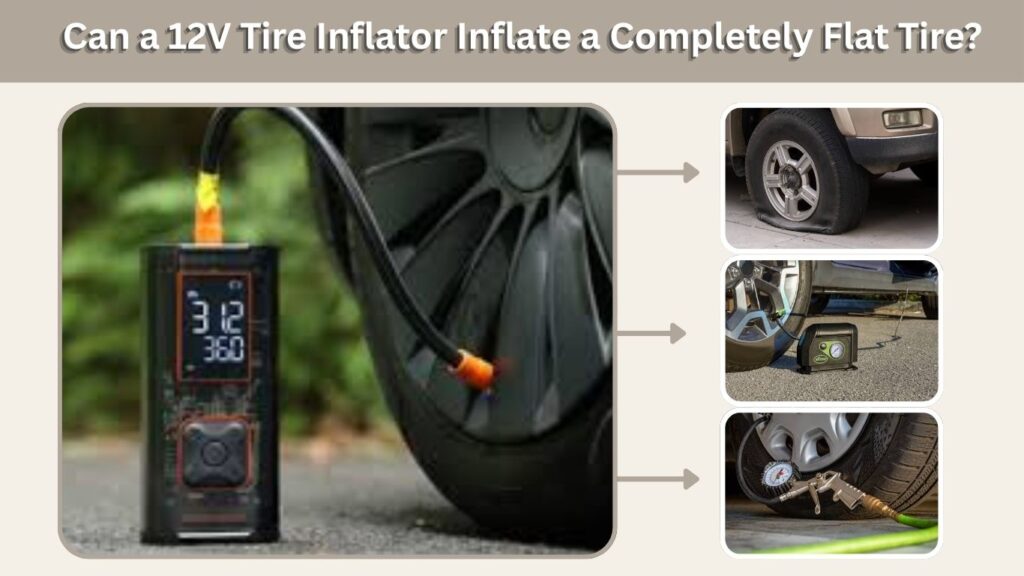
A 12V tire inflator might restore pressure to a severely deflated tire, but the time required depends on the compressor and tire.
There is an important difference between a tire that is slightly low and one that is completely flat.
Low tire → needs → pressure correction
Completely flat tire → requires → substantially more air
Larger tire → requires → more air volume
Compressor airflow → affects → inflation time
If the tire became flat because of a puncture or another leak, inflation does not solve the underlying problem. The tire should be inspected before normal driving.
Do not assume a portable inflator is suitable for every completely flat tire. Check its specifications and consider the tire’s size and condition.
10. 12V Tire Inflator for a Slow Leak
A 12V tire inflator is useful for restoring pressure when a tire slowly loses air.
A slow leak might result from a nail, screw, damaged valve, bead problem, or another source of air loss. The inflator addresses the pressure problem, not the physical leak.
Slow leak → causes → gradual pressure loss
12V inflator → restores → lost pressure
Tire repair → fixes → leak source
If you inflate the same tire repeatedly, investigate why the pressure keeps falling.
A useful approach is to record the tire pressure and check it again later. A repeated pressure drop is a reason to inspect the tire and valve rather than continuously adding air.
11. How to Use a 12V Tire Inflator
Using a portable 12V compressor is straightforward, but following the correct sequence improves safety and accuracy.
Check the Recommended Tire Pressure
Find the recommended cold tire pressure specified by your vehicle manufacturer. The value is usually listed on the vehicle’s tire information label or in the owner’s manual.
Do not use the maximum PSI printed on the tire sidewall as your normal target pressure.
Park Safely
Move the vehicle to a safe location away from moving traffic when possible. Engage the parking brake and make sure the vehicle is stable before working around the tire.
Connect the Power
Plug the compressor into the appropriate 12V outlet or connect it to the battery if the model is designed for direct battery use.
Attach the Hose
Remove the valve cap and securely attach the compressor’s connector to the tire valve.
A poor connection can cause air leakage and inaccurate readings.
Set the Target Pressure
If the compressor has a digital preset function, enter the recommended pressure.
Target PSI → controls → automatic stopping point
Start Inflation
Turn on the compressor and allow it to inflate the tire. Monitor the process according to the manufacturer’s instructions.
Verify the Final Pressure
Once inflation stops, check the final pressure. Disconnect the hose and replace the valve cap after reaching the correct level.
12. How Long Does a 12V Tire Inflator Take?
There is no single inflation time for every 12V tire inflator.
The main variables are:
- Tire size
- Starting PSI
- Target PSI
- Airflow
- Compressor design
- Power supply
- Temperature
- Duty cycle
For example, adding a small amount of air to a passenger tire should require less work than inflating a large tire from a severely deflated state.
Starting pressure → affects → required inflation work
Tire volume → affects → required air
Airflow → affects → inflation time
When comparing models, look at airflow and manufacturer-tested inflation times alongside maximum PSI.
13. 12V Tire Inflator Safety
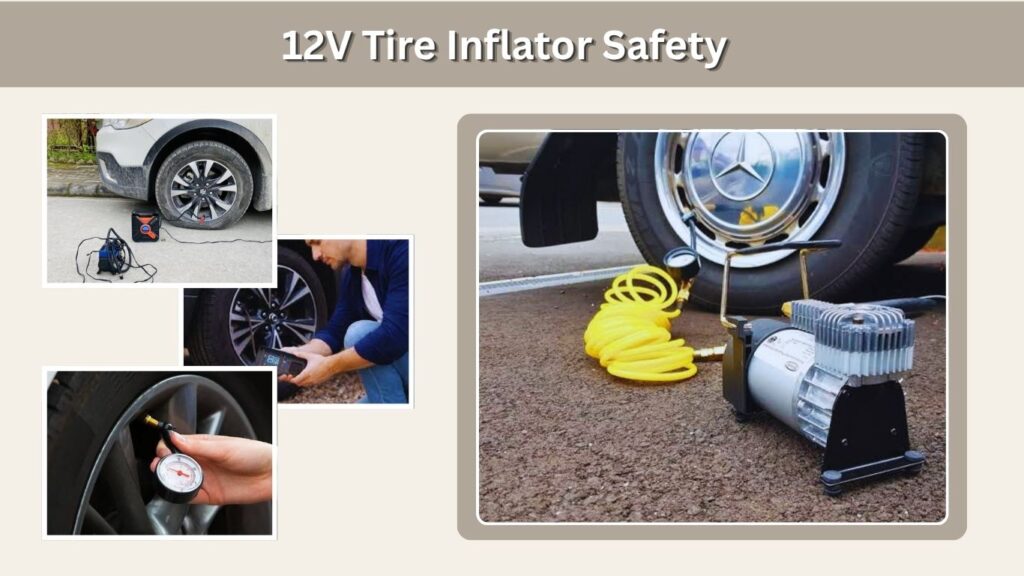
Correct operation matters because tire pressure affects vehicle handling, braking, tire wear, and heat generation.
Follow these basic practices:
- Use the vehicle manufacturer’s recommended pressure.
- Check pressure when tires are cold when possible.
- Use a compressor rated for your tire type.
- Do not exceed the manufacturer’s stated pressure limits.
- Follow the compressor’s duty cycle.
- Stop if the unit shows signs of overheating.
- Keep the compressor’s ventilation openings clear.
- Inspect the power cable and connector before use.
- Do not ignore a tire that repeatedly loses pressure.
Overinflation → changes → tire operating pressure
Incorrect pressure → affects → tire performance
Overloading the compressor → increases → heat buildup
14. 12V Tire Inflator Troubleshooting
Inflator Does Not Start
Check the 12V connection first. Inspect the vehicle outlet, fuse, power cable, and compressor switch.
Possible relationship:
Power failure → prevents → compressor operation
Inflator Runs but Does Not Build Pressure
Check the hose connection and tire valve. A loose connection can allow compressed air to escape.
Also inspect the tire for a significant puncture or damage.
Inflator Keeps Shutting Off
Automatic shutoff might be working as designed if the target pressure has been reached.
If the compressor stops before reaching the target, check for overheating, excessive load, or a duty-cycle limitation.
Inflator Overheats
Turn the unit off and allow it to cool. Follow the manufacturer’s recommended operating and cooling periods.
Continuous operation → increases → compressor temperature
Cooling period → reduces → heat buildup
Pressure Reading Seems Incorrect
Check that the connector is firmly attached and that you are using the correct pressure unit.
Compare the reading with a reliable tire pressure gauge if you suspect the built-in gauge is inaccurate.
15. 12V Tire Inflator Maintenance
Basic maintenance helps keep a portable compressor ready for emergency use.
Store the compressor in a dry location. Keep the air hose and power cable protected from sharp bends and damage. Keep ventilation openings free from dirt and debris.
Before a long trip, inspect:
- Power cable
- Plug
- Air hose
- Valve connector
- Pressure display
- Adapters
- Storage case
Proper storage → protects → compressor components
Regular inspection → helps identify → connection or cable problems
16. 12V Tire Inflator vs Larger Air Compressor
A portable 12V tire inflator and a workshop air compressor serve different purposes.
| Feature | 12V Tire Inflator | Larger Air Compressor |
|---|---|---|
| Primary use | Tire inflation | Tools and inflation |
| Portability | High | Lower |
| Power | 12V DC | Usually AC |
| Air capacity | Limited | Higher |
| Roadside use | Excellent | Less practical |
A 12V tire inflator is designed around portability and vehicle use. A larger compressor is better suited to extended operation, pneumatic tools, and demanding workshop applications.
Choose according to your actual workload rather than buying based on maximum pressure alone.
17. Who Should Buy a 12V Tire Inflator?
A 12V tire inflator is a practical choice if you want portable equipment for maintaining tire pressure.
It suits:
- Daily drivers
- Sedan owners
- Car owners
- SUV owners
- Road-trip drivers
- Emergency vehicle kits
- Drivers who regularly check tire pressure
A larger compressor is more appropriate if you regularly inflate large tires, operate pneumatic tools, or need extended continuous operation.
The decision depends on:
Vehicle type → determines → tire requirements
Tire size → determines → air volume requirements
Usage frequency → determines → compressor capacity needs
Power source → determines → operating flexibility
18. Frequently Asked Questions
What is a 12V tire inflator?
A 12V tire inflator is a portable electric air compressor designed to inflate tires using 12V DC power, commonly from a vehicle’s accessory outlet.
Does a 12V tire inflator need the car running?
It depends on the vehicle and its electrical system. Follow the vehicle and inflator manufacturer’s instructions regarding accessory power use.
Can a 12V tire inflator fix a slow tire leak?
No. It restores lost air pressure but does not repair the source of the leak.
Is a 12V inflator better than a cordless inflator?
Neither is universally better. A 12V model offers vehicle-based power, while a cordless model offers greater freedom from power cables.
Can a 12V tire inflator inflate SUV tires?
Many models support passenger vehicles and SUVs, but you should verify the manufacturer’s specifications for your specific tire size.
Can a 12V tire inflator inflate truck tires?
Some heavy-duty 12V compressors support truck tires, but smaller passenger-car inflators often do not. Always check the stated application range.
What does maximum PSI mean?
Maximum PSI indicates the highest pressure the compressor is designed to reach under its specified conditions. It does not indicate how quickly the compressor inflates a tire.
What is duty cycle on a tire inflator?
Duty cycle indicates how long a compressor should operate before it needs a cooling period. It is especially important for repeated or extended inflation.
Why does a 12V tire inflator overheat?
Extended operation, high load, poor ventilation, or exceeding the recommended duty cycle can increase compressor heat. Follow the manufacturer’s operating limits.

- Top 10 Best Battery Tester Automotive 2026 - October 20, 2026
- Top 10 Best Battery Tender For Motorcycle Battery 2026 - October 20, 2026
- Top 10 Best Battery Rotary Tool 2026 - October 20, 2026