The 5 Best Rinseless Wash Concentrates for 2026: A Guide to Safe, High-Efficiency Detailing

The evolution of automotive detailing has shifted away from traditional high-volume hose washing toward precision, chemical-driven efficiency. At the center of this revolution is the rinseless wash concentrate—a hyper-engineered chemical blend designed to safely lift, suspend, and encapsulate particulate contamination without requiring a final clean-water hose rinse.
Whether motivated by urban water restrictions, apartment living, or the desire for a faster, safer maintenance wash, choosing the right concentrate requires understanding substantive polymer chemistry, lubricity metrics, and dilution ratios.
The 5 Best Rinseless Wash Concentrates of 2026
1. Optimum No Rinse Wash & Shine (ONR – Version 6)
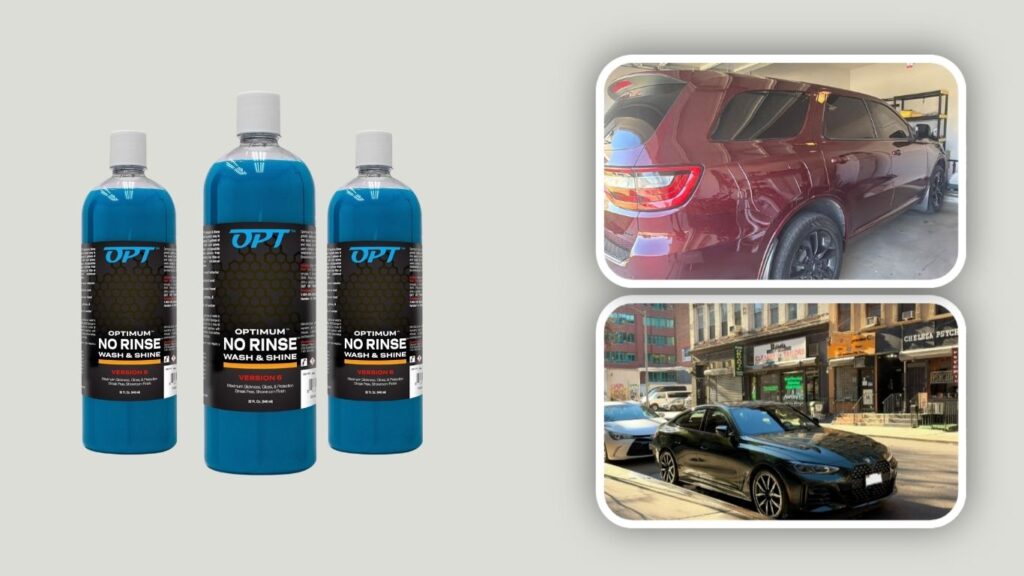
The Benchmark & Best for Polymer Encapsulation
Optimum No Rinse (ONR) is the indisputable pioneer of the rinseless detailing category, now refined into its Version 6 formulation. Invented by organic chemist Dr. David Ghodoussi, ONR utilizes a proprietary blend of high-molecular-weight zwitterionic polymers that bond to automotive paint while actively repelling dirt.
| Feature | Details |
|---|---|
| Size | 32 Fl Oz |
| Type | Rinseless Car Wash |
| Surface | Paint, Glass, Plastic |
| Features | No Rinse, Streak Free |
| Price | $27.98 |
- Primary Chemistry: Substantive Polymer Encapsulation.
- Key Strength: Unrivaled water-softening capability; drops heavy dirt to the bottom of the wash bucket faster than any competitor.
- Versatility Score: Exceptional—dilutes into a clay lubricant (64:1), quick detailer (16:1), or interior wipe-down spray.
2. P&S Absolute Rinseless Wash
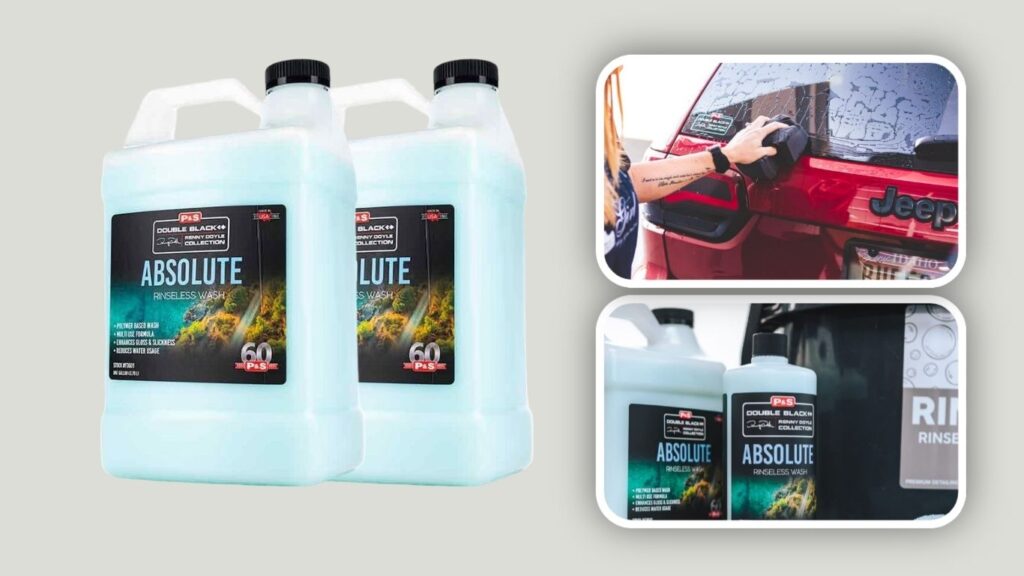
Best Overall Value & Sensory Experience
Developed in collaboration with master detailers, P&S Absolute has surged to the top of independent laboratory and field tests in 2026 for its visual cleaning power and raw surface slickness. Unlike purely polymer-based washes, Absolute uses a hybridized surfactant-polymer matrix that creates a noticeable “cushion” under the wash towel.
| Feature | Details |
|---|---|
| Brand | P & S Professional |
| Type | Rinseless Car Wash |
| Scent | Coconut |
| Surfaces | Paint, PPF, Leather, Plastic |
| Key Feature | No Rinse, Water Softening |
| Dilution | 1 oz / 2 gal water |
- Primary Chemistry: Hybrid Surfactant & Polymer Emulsion.
- Key Strength: Outstanding slickness during towel glide and zero chemical residue left behind on trim or glass.
- Value Proposition: At roughly $0.59 per ounce in gallon format, it delivers one of the lowest cost-per-wash metrics in professional detailing.
3. DIY Detail Rinseless Wash
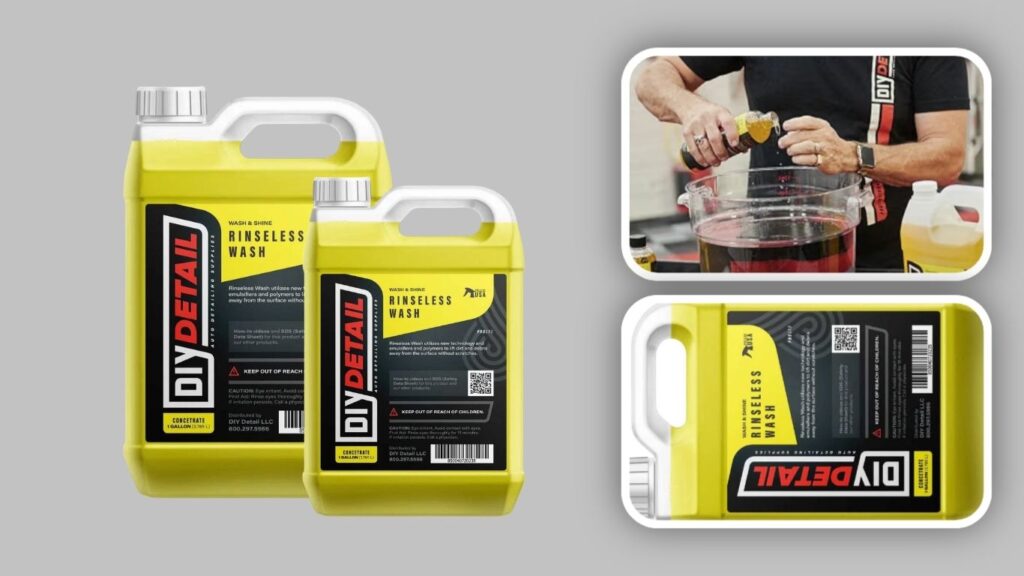
Best Heavy-Duty Cleaning & Surface Versatility
For vehicles facing heavy contamination, mud, or winter road salt, DIY Detail Rinseless Wash offers superior cleaning strength. While many rinseless washes struggle with dried, caked-on soils without mechanical scrubbing, DIY Detail’s formula utilizes advanced wetting agents that penetrate and soften organic and inorganic grime on contact.
- Primary Chemistry: Advanced Wetting Surfactants.
- Key Strength: Outperforms traditional polymer washes in independent “dried mud weight-reduction” testing.
- Best Used For: Daily drivers, off-road vehicles, and pre-soaking heavily soiled lower body panels before agitation.
4. Armour Detail Supply Hero Rinseless Wash
Best Modern High-Lubricity Surfactant Blend
Armour Detail Supply’s Hero represents the new school of chemical formulation, engineered specifically to complement modern SiO2 (silicon dioxide) ceramic coatings and elastomeric PPF. Hero generates slight functional suds during agitation—a rarity in rinseless washes—giving visual confirmation of chemical lubrication.
- Primary Chemistry: High-Foaming Modern Surfactant Matrix.
- Key Strength: Excellent ability to break down oily road film and light brake dust on wheels without harsh acids or alkalines.
- Finish Profile: Leaves a crisp, hyper-clean, unmodified surface that allows underlying ceramic beads to perform at 100% capacity.
5. Koch-Chemie Rapid Rinseless Wash (RRW)
Best Professional-Grade German Engineering
Koch-Chemie brings legendary German industrial detailing standards to the rinseless arena with RRW. Designed to meet strict European environmental and wastewater regulations, RRW is optimized for rapid evaporation and zero-streak flash-drying, making it ideal for mobile detailers working in direct sunlight or high-humidity environments.
- Primary Chemistry: Professional Amphoteric Surfactants.
- Key Strength: Exceptional anti-static properties and superior performance on glass, gloss-black piano trim, and delicate vinyl wraps.
- Pro Feature: Highly stable formulation that won’t separate or degrade when mixed with hard tap water in sprayer bottles.
2026 Rinseless Concentrate Comparison
| Product | Primary Technology | Standard Dilution | Cost Est. (Per Oz.) | Best Use Case |
| Optimum (ONR v6) | Substantive Polymer | 256:1 (0.5 oz / gal) | ~$0.62 | All-around benchmark & clay lube |
| P&S Absolute | Hybrid Surfactant | 256:1 (0.5 oz / gal) | ~$0.59 | Maximum slickness & best value |
| DIY Detail | Wetting Surfactant | 256:1 (0.5 oz / gal) | ~$1.06 | Heavy dirt, mud, & winter salt |
| Armour Hero | Foaming Surfactant | 256:1 (0.5 oz / gal) | ~$0.80 | Ceramic coatings & wheel cleaning |
| Koch-Chemie RRW | Amphoteric Surfactant | 256:1 (0.5 oz / gal) | ~$0.65 | Sun-washing & streak-free glass |
Buying Criteria: What Defines a Tier-1 Concentrate?
Evaluating a rinseless wash means looking beyond marketing claims and analyzing the underlying chemical mechanics that prevent paint marring and clear-coat swirling:
- Encapsulation vs. Emulsification: High-performance concentrates rely on substantive polymers or hyper-surfactants. These molecules wrap around dirt particles (encapsulation) or break down oily road grime (emulsification), creating a physical barrier between abrasive debris and your vehicle’s clear coat.
- Lubricity & Friction Reduction: The single most critical metric in scratch prevention is the hydrodynamic lubrication layer the fluid provides between your wash media (microfiber or ultra-soft sponge) and the paint surface.
- Dilution Ratio Economics: Most industry-standard concentrates operate at a 256:1 dilution ratio (1 ounce of concentrate per 2 gallons of water). A higher concentration density dramatically reduces the true cost-per-wash.
- Residue Profile & Coating Compatibility: Modern formulations must be “panel-safe,” meaning they dry without leaving gummy surfactants or interference layers that could clog or degrade paint protection films (PPF), ceramic coatings, or graphene sealants.
Best Practice: The 4-Step Safe Rinseless Wash Method
To extract maximum performance from these concentrates without inflicting micro-scratches, follow the industry-standard Modified Gary Dean Method:
- The Pre-Soak Phase: Dilute your chosen concentrate at 256:1 in a pump sprayer or trigger bottle. Generously mist the entire vehicle (or panel by panel) to initiate chemical encapsulation and soften surface grime before physical contact.
- The Wash Media Setup: Fill a single 3-to-5-gallon bucket with 2 gallons of water and 1 ounce of rinseless concentrate. Submerge 6 to 8 plush, high-GSM microfiber towels (or a dedicated foam rinseless sponge) into the solution.
- The Single-Pass Wipe: Gently glide a soaked microfiber towel across a single body panel in straight, overlapping lines. Never apply downward pressure—let the liquid weight and lubricity do the work. Once a towel face is soiled, flip to a fresh, clean side. Never return a dirty towel into your clean solution bucket.
- The Immediate Dry: Because there are no free-floating mineral salts from a hose rinse, immediately dry the cleaned panel using a dedicated twisted-loop drying towel or a plush microfiber misted with a dedicated drying aid/quick detailer.
Mastering Rinseless Chemistry
What is the difference between a waterless wash and a rinseless wash?
A waterless wash comes ready-to-use (or lightly diluted) in a spray bottle and relies purely on chemical lubrication for spot-cleaning lightly dusty vehicles without any buckets. A rinseless wash is a highly concentrated formula diluted into a bucket of water (typically 1–2 gallons). Rinseless washing provides significantly higher water volume and hydrodynamic lubrication, making it much safer for moderately dirty vehicles.
Can a rinseless wash scratch my ceramic coating or clear coat?
If performed correctly on a vehicle with light-to-moderate contamination, rinseless washing is often safer than a traditional hose wash. The specialized polymers and surfactants encapsulate dirt particles so they cannot dig into the clear coat or ceramic resin during the wipe. However, if the vehicle is covered in caked-on mud, thick gravel, or abrasive off-road clay, a thorough high-pressure water pre-rinse is mandatory before touching the paint.
Can I use tap water with rinseless wash concentrates?
Yes. Premium concentrates like ONR and P&S Absolute contain built-in water softeners and chelating agents that bind to calcium, magnesium, and iron minerals found in hard municipal tap water. This neutralizes the minerals, preventing them from inducing water spots during the drying phase.

- Best Bug And Bird Poop Remover For Cars 2026 - September 15, 2026
- Can Vaseline Work As Wd-40? - September 15, 2026
- Best Bug Remover For Bumper 2026 - September 15, 2026