How to Fix a Bike Chain That Keeps Falling Off Complete Guide(2026)

To fix a bike chain that keeps falling off, start by identifying your bike type. For single-speed, cruiser, and BMX bikes: loosen the rear axle nuts, slide the rear wheel backward in the dropouts until the chain has about half an inch of up-and-down play, then retighten the nuts while keeping the wheel centered.
For geared bikes with a derailleur: adjust the H (high) and L (low) limit screws on the front and rear derailleur to stop the chain from overshooting the gears, use the barrel adjuster to fine-tune cable tension, and check that the derailleur hanger is not bent.
For all bikes: clean and lubricate the drivetrain with a degreaser, check the chain for stretch using the ruler method or a chain wear tool, and replace the chain and cassette together if teeth appear pointed or shark-fin shaped. A chain that repeatedly falls off always has a root cause this guide covers every one.
1. Quick Diagnosis: What Type of Bike Do You Have?
Before anything else, identify your bike type — applying the wrong fix to the wrong bike type is the main reason riders stay stuck in a chain-drop cycle.
| Bike Type | How to Identify | Most Common Cause | Primary Fix Method |
|---|---|---|---|
| Single-speed / Cruiser | No derailleur, one gear only | Chain too loose | Adjust rear wheel position in dropouts |
| Fixed gear / Fixie | No derailleur, cannot coast | Chain too loose | Adjust rear wheel position (tighter than single-speed) |
| BMX | Single-speed, thick frame, small wheels | Chain tension or bent chainring | Adjust rear axle using horizontal dropouts |
| Geared bike (Shimano/SRAM) | Front and/or rear derailleur visible | Derailleur limit screws misadjusted | Adjust H and L limit screws, check derailleur hanger |
| Kids bike (under 20″) | Usually single-speed with coaster brake | Loose rear wheel or chain | Tighten rear axle nuts, adjust wheel backward |
| Kids bike (20″+) | Shimano gears, looks like small adult bike | Derailleur misalignment | Same as geared bike fix |
| E-bike | Derailleur with motor housing on frame | Higher chain wear from motor torque | Check chain stretch, adjust derailleur, replace chain sooner |
If the rear wheel has a single gear and no derailleur, you have a single-speed, cruiser, or BMX bike.
2. Why Does a Bike Chain Keep Falling Off?
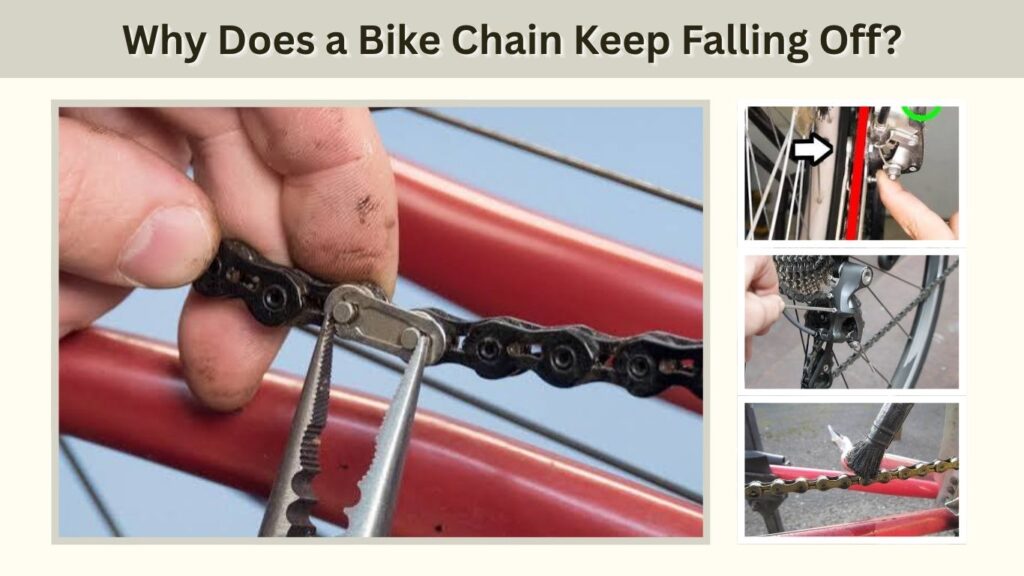
When a bike chain starts falling off repeatedly, it is usually because of one or more of three core reasons: the chain is loose, the derailleur is off, or the chainring or cassette teeth are worn out.
Cause 1 — Loose or Stretched Chain
Visual test: Grab the chain along the bottom span between the chainring and rear sprocket. If it droops noticeably, or you can lift it far off the front chainring teeth, it is too loose.
Cause 2 — Derailleur Misalignment
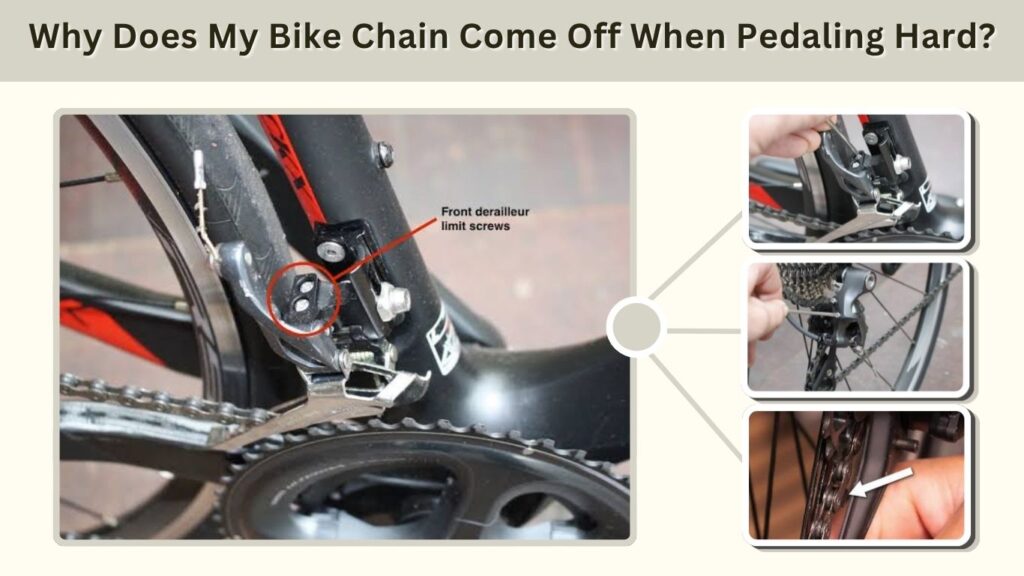
The most common cause of a dropped chain is an improperly adjusted front derailleur. The derailleur limit screws control the range of motion, and if the L screw is too loose, the chain drops toward the inside getting stuck between the chainrings and the frame. If the H screw is too loose, it overshoots the large chainring and falls outward.
A bent derailleur hanger is frequently the culprit when chain dropping continues even after adjustments. The hanger connects the rear derailleur to the frame and bends easily from impacts or crashes.
Cause 3 — Worn Chainring or Cassette Teeth
Look at the teeth on the front chainring or rear cassette. If they look pointy, uneven, or hooked like shark fins, they are worn. When the teeth can no longer grip the chain properly, the chain slips off or fails to sit securely.
What new teeth look like: Flat tops, even spacing, squared edges What worn teeth look like: Pointed tips, uneven heights, hook shapes
Cause 4 — Chain Is the Wrong Length
When the chain is too long, the derailleur cannot pick up the extra length, which allows it to easily slip off. This happens most often on new bikes or after a chain replacement. When replacing a chain, line it up perfectly against the old one and remove or add links as needed using a chain splitter.
Cause 5 — Dirty or Dry Drivetrain
Dirt, grime, and grit deposited in the drivetrain cause the chain to fall off and wear out faster. Regular cleaning and lubrication significantly extend drivetrain life and keep the chain seated properly on the sprockets.
Cause 6 — Loose Drivetrain Bolts
Loose chainring bolts can allow the chainring to wobble as it rotates, throwing the chain off sideways. Check all bolts with the appropriate wrench and ensure they are tight. This takes 30 seconds and prevents hours of frustration.
Cause 7 — Budget or Worn Shifters
Low-quality or budget shifters can fail to maintain proper cable tension during riding, causing the chain to drop. Test this by pulling the shifter cable and observing any loss in tension when you release it.
3. How to Fix a Single-Speed Bike Chain That Keeps Falling Off
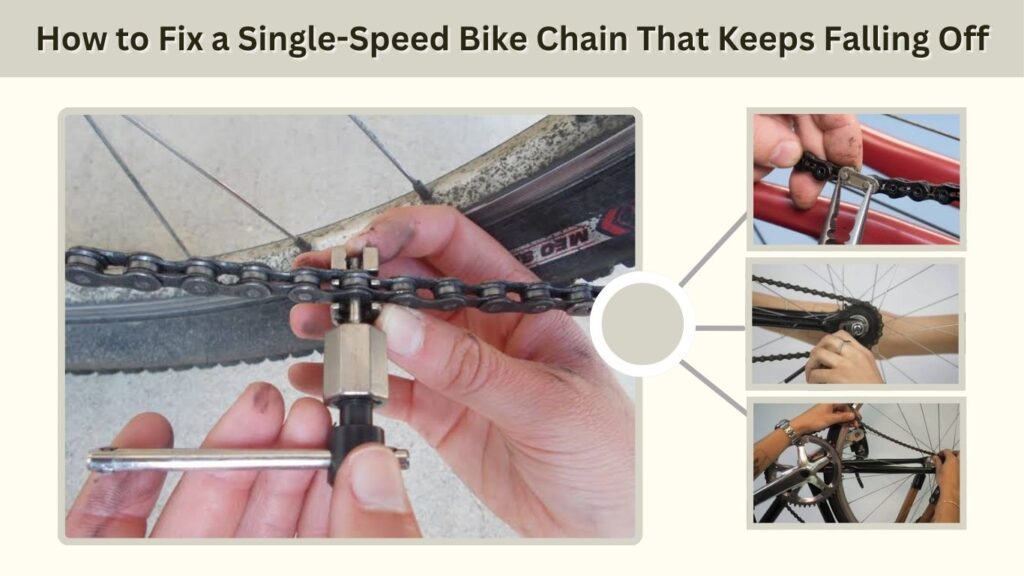
Single-speed bikes, cruisers, commuter bikes, and most bikes with coaster brakes all use the same chain tension system: the rear wheel slides backward and forward in the frame dropouts to tighten or loosen the chain.
Step-by-Step Fix for Single-Speed and Cruiser Bikes
Step 1: Flip the bike upside down and rest it on the seat and handlebars.
Step 2: Loosen the rear axle nuts on both sides of the wheel using a wrench. Do not remove them completely — just loosen enough so the wheel can slide in the dropouts.
Step 3: Slide the rear wheel backward in the dropouts to increase chain tension. Move it evenly on both sides so the wheel stays centered between the chainstays.
Step 4: Reseat the chain over the rear sprocket first, making sure at least three to four teeth are engaged, then over the front chainring.
Step 5: Check the tension by pressing down on the chain at the midpoint between the front chainring and rear sprocket. A properly tensioned chain should have a gentle play of about half an inch to one inch up and down. Too tight and the chain will bind and wear quickly. Too loose and it will fall off again.
Step 6: Tighten the rear axle nuts evenly on both sides while keeping the wheel centered. Check that the wheel is still centered by looking down from above — the tire should sit evenly between the chainstays on both sides.
Step 7: Spin the pedals by hand and confirm smooth rotation through a full revolution before riding.
Common Single-Speed Chain Problems
- Chain too tight: Pedaling feels stiff, chain makes creaking noises, rapid wear on sprockets
- Chain too loose: Chain sags visibly, rattles on bumps, falls off easily
- Wheel not centered: Bike pulls to one side, tire rubs on frame
If your chain keeps falling off even after proper tensioning, check the chainring and rear sprocket teeth for wear. Pointed or hooked teeth will not hold the chain no matter how perfectly you adjust the tension.
4. How to Fix a Geared Bike Chain That Keeps Falling Off
Geared bikes with derailleurs require a completely different approach. The chain tension is managed automatically by the rear derailleur, so the problem is almost always in the derailleur adjustment, not the chain slack.
4a. Chain Dropping Off the Front Chainring
The most common cause of a dropped chain at the front is an improperly adjusted front derailleur. The L limit screw controls inward travel and the H screw controls outward travel. When either is too loose, the chain falls off in that direction.
Front derailleur positioning: The front derailleur cage must be positioned about 2 millimeters above the outer chainring. If the gap is more than 2mm, the derailleur cannot guide the chain properly.
How to Adjust Front Derailleur Limit Screws
Step 1: Shift the chain to the smallest front chainring and smallest rear cog.
Step 2: Locate the two limit screws on the front derailleur body. They are usually marked “H” (high) and “L” (low). If they are not marked, the screw closest to the frame is usually the L screw.
Step 3: If the chain drops toward the frame (inside), tighten the L screw by turning it clockwise. This restricts how far inward the derailleur can move.
Step 4: If the chain drops away from the frame (outside), tighten the H screw by turning it clockwise. This restricts how far outward the derailleur can move.
Step 5: Shift through all the front gears slowly while pedaling and watch the chain. It should move smoothly from the small chainring to the large chainring without hesitation or overshooting.
Adjustment rule: Clockwise tightens and restricts travel. Counterclockwise loosens and allows more travel.
Adding a Chain Catcher
A chain catcher is a small arm that attaches near the front chainring and acts as a physical stop to prevent the chain from dropping toward the inside of the frame. This is especially useful for bikes ridden on rough terrain or if your front derailleur adjustment keeps drifting out of spec.
4b. Chain Dropping Off the Rear Cassette
If the chain falls off the rear cassette, the rear derailleur limit screws need adjustment.
Step 1: If the chain falls off the outside of the rear wheel (toward the spokes), adjust the high (H) limit screw. Turn it clockwise to restrict outward travel.
Step 2: If the chain falls off the inside (toward the frame), adjust the low (L) limit screw. Turn it clockwise to restrict inward travel.
Step 3: Shift through all the rear gears and watch the chain move across the cassette. It should shift cleanly to the largest and smallest cogs without overshooting.
How to Re-Index Rear Gears
If the chain drops between gears or skips during shifting, the derailleur cable tension needs adjustment.
Step 1: Shift into the smallest rear cog.
Step 2: Locate the barrel adjuster where the derailleur cable enters the rear derailleur or on the shifter itself.
Step 3: Turn the barrel adjuster counterclockwise to add cable tension if the chain is slow to shift to larger cogs. Turn it clockwise to reduce tension if it overshoots or is slow to shift to smaller cogs.
Step 4: Test by shifting through all gears. Each click of the shifter should move the chain exactly one cog.
Checking the Derailleur Hanger
A bent derailleur hanger is one of the most overlooked causes of repeated chain drops. The hanger is a small replaceable piece that connects the rear derailleur to the frame, and it bends easily from impacts, falls, or crashes.
Visual check: Stand behind the bike and look at the chain as it travels up from the bottom pulley, around the upper pulley, and over the cassette. All three contact points should form a straight, vertical line. If the line is crooked or diagonal, the derailleur hanger is bent and requires adjustment or replacement.
Professional fix: Bike shops use a derailleur hanger alignment tool to straighten bent hangers precisely. If you do not have this tool and the hanger is severely bent, replacing it is often easier and more reliable than trying to bend it back by hand.
Clutch-Equipped Rear Derailleurs
For bikes ridden on rough terrain, a clutch-equipped rear derailleur minimizes chain bounce and drops by adding extra chain tension during vibration. Shimano, SRAM, and other manufacturers offer clutch derailleurs, and they are especially effective for mountain bikes and gravel bikes.
5. How to Fix a BMX Bike Chain That Keeps Falling Off
BMX bikes use a single-speed drivetrain similar to cruisers, but they experience much higher torque loads from jumps, tricks, and hard pedaling. This means chain tension must be precise — not too tight, not too loose.
Correct BMX Chain Tension
A BMX chain must be snug enough to stay engaged with the sprockets but not so tight it feels stiff. Aim for about a quarter to half an inch of slack when you press down on the chain at the midpoint between the front sprocket and rear cog. This is slightly tighter than a cruiser bike but still allows some movement.
How to Adjust BMX Chain Tension
Step 1: Loosen the rear axle nuts on both sides of the wheel.
Step 2: Slide the rear wheel backward evenly in the horizontal dropouts to increase tension.
Step 3: Check that the wheel is centered in the frame by measuring the distance from the tire to the chainstay on both sides. It should be equal.
Step 4: Tighten the axle nuts while holding the wheel in position.
Step 5: Spin the cranks by hand and check that the chain does not hit the chainstay or bind as it rotates.
Off-Center Chainwheel Diagnosis
If the chain alternates between tight and loose throughout a single pedal rotation, the likely culprit is an off-center chainring. This happens when the chainring is not mounted perfectly in the center of the crank spindle.
Test for off-center chainring: Remove the chain and spin the cranks slowly while watching the chainring from the side. If the chainring wobbles front to back or side to side as it spins, it is off-center or bent.
Fix: Loosen the chainring bolts, reposition the chainring so it sits centered on the crank spider, and retighten the bolts evenly in a star pattern.
Check All Chainring Bolts
Loose chainring bolts allow the chainring to wobble as it spins, pushing the chain off sideways. Use the appropriate Allen key or wrench to check that all chainring bolts are tight. This is especially important on BMX bikes where hard landings can loosen bolts over time.
When to Replace vs. Adjust
If the sprocket teeth look pointy, uneven, or hooked, replace both the chain and sprocket together for optimal performance. A worn sprocket will rapidly destroy a new chain, and a new sprocket will skip and slip with a stretched chain.
6. Why Does My Bike Chain Keep Coming Off My New Bike?
A chain that keeps falling off a brand new bike is frustrating, but it is almost always caused by one of three factory setup issues: incorrect chain length, new cable stretch, or limit screws that were not properly adjusted at the factory.
Incorrect Chain Length
A chain that is too long means the derailleur cannot take up the extra slack, allowing the chain to slip off easily. Even a new bike can arrive with an incorrectly sized or installed chain.
How to size a chain correctly: Wrap the chain around the largest front chainring and largest rear cog without threading it through the derailleur. Pull the two ends of the chain together until they meet. Now add two extra links beyond where they meet — this is the correct chain length using the Big-Big method.
If your chain is longer than this, it needs to be shortened using a chain tool.
New Cable Stretch
Factory shifter cables stretch slightly in the first few rides, reducing cable tension and causing the derailleur to pull the chain toward the wrong cog. This is normal and easy to fix.
Fix: Use the barrel adjuster on the rear derailleur or shifter. Turn it counterclockwise (out) to add cable tension. This compensates for the cable stretch and restores proper shifting.
Factory Limit Screws Out of Adjustment
Factory limit screws often ship slightly out of adjustment and may need fine-tuning out of the box. Follow the front and rear derailleur adjustment steps in Section 4 above to dial in the limit screws properly.
Component Compatibility
Ensure all drivetrain components are compatible. Chain width, sprocket spacing, and derailleur specifications must match for the drivetrain to function correctly. Mixing components from different manufacturers or different speed groups (8-speed chain on a 10-speed cassette, for example) can cause shifting problems and chain drops.
Common compatibility issues:
- 8-speed chain on 9, 10, or 11-speed cassette
- Shimano derailleur with SRAM shifter (or vice versa)
- Wrong chainring spacing for the derailleur
7. Why Does My Bike Chain Come Off When Pedaling Hard?
If your chain keeps coming off specifically while pedaling hard, this is evidence that the chain has elongated and can no longer stay seated on the drivetrain under load.
Chain Stretch Under Load
A stretched chain becomes slightly longer, and under hard pedaling, the force pulls the chain taut and causes it to ride up and off the teeth. This is especially common when climbing hills or sprinting.
Fix: Replace the chain. A stretched chain cannot be tightened back to its original length and must be replaced.
Cross-Chaining Explained
Cross-chaining means using the largest front chainring with the largest rear cog, or the smallest front with the smallest rear. This creates an excessively slanted chain angle that stresses the hardware and causes chain drop under power.
Chain line visualization:
- Good chain line: Small front chainring with small rear cog, or large front with large rear
- Bad chain line (cross-chaining): Small front with large rear, or large front with small rear
Stick to intermediate gear combinations and avoid the extremes. Your drivetrain will last longer and shift more reliably.
Avoid Shifting Under Heavy Pedaling Load
Shifting to a different chainring while pedaling hard creates a massive tension spike that can throw the chain off the derailleur cage. Shift to a middle gear before changing chainrings, then resume pedaling normally.
Proper shifting technique:
- Ease off pedaling pressure slightly
- Shift to the new chainring
- Resume full pedaling pressure once the shift completes
How to Check for Chain Stretch Without a Chain Tool
The ruler method: Measure 12 complete links across the outer pins of the chain using a ruler or tape measure. Start at the center of one pin and measure to the center of the pin 12 links away.
- New chain: Exactly 12 inches (305mm)
- Worn chain (replace soon): 12.0625 inches (306mm) — about 1/16 inch over
- Severely worn chain (replace immediately): 12.125 inches (308mm) or more — about 1/8 inch over
If the distance exceeds 12.1 inches, the chain is stretched and needs replacing.
8. Why Does My Child’s Bike Chain Keep Coming Off?
Kids bike chains usually fall off because the rear wheel is not centered, the chain is too loose, or the sprocket is slightly bent. Tightening or replacing the chain usually solves the problem quickly.
Single-Speed Kids Bike Fix (Under 20″)
Most kids bikes under 20 inches use a single-speed drivetrain with a coaster brake. The fix is identical to the single-speed bike fix in Section 3.
Quick fix:
- Flip the bike upside down
- Loosen the rear axle nuts
- Slide the rear wheel backward to tighten the chain
- Center the wheel between the chainstays
- Tighten the axle nuts evenly
Correct tension for kids bikes: About half an inch of up-and-down play at the midpoint of the chain.
Geared Kids Bike Fix (20″ and Larger)
Kids bikes 20 inches and larger often have Shimano or SRAM gears with a front and rear derailleur. The fix is the same as the geared bike fix in Section 4 — adjust the front and rear derailleur limit screws and check cable tension.
Why Kids Bikes Drop Chains More Often
Kids are harder on bikes than adults. They ride over curbs, crash more frequently, pedal backward repeatedly on coaster brake bikes (which loosens the rear wheel), and rarely perform any maintenance. All of this accelerates chain and drivetrain wear.
Prevention tips:
- Check rear axle bolts after every few rides
- Teach children not to pedal backward repeatedly on coaster brake bikes
- Inspect the chain and sprockets monthly for wear
- Keep the chain clean and lubricated
9. How to Clean and Lubricate a Bike Chain to Prevent It Falling Off
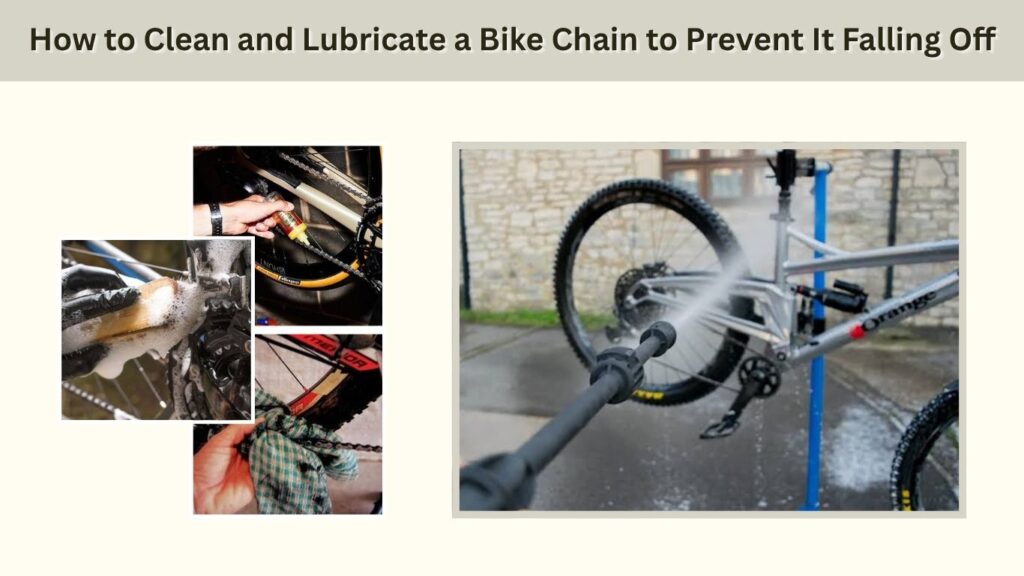
A well-lubricated chain reduces friction and wear, improving shifting performance and chain retention on sprockets. A dirty chain accelerates wear and causes the chain to fall off more easily.
How to Clean a Bike Chain
Step 1: Use an old toothbrush or bicycle-specific brush to scrub the chain, chainrings, and rear cassette. Focus on the areas where dirt and grime build up between the chain links.
Step 2: Apply a bicycle-specific degreaser to the chain and scrub thoroughly. Let it sit for a few minutes to break down the grime.
Step 3: Rinse the chain with water or wipe it clean with a rag. Make sure all the degreaser is removed.
Step 4: Dry the chain completely using a clean rag. A wet chain will not accept lubricant properly.
Step 5: Apply bicycle chain lubricant to each link while slowly rotating the pedals backward. Apply the lube to the inside of the chain where it contacts the sprockets, not the outside.
Step 6: Wipe off any excess lubricant with a rag. Excess lube attracts dirt and accelerates wear.
Choosing the Right Lube
- Wet lube: For rainy, muddy, or wet conditions. Wet lube is thicker and stays on the chain longer but attracts more dirt.
- Dry lube: For dry, dusty conditions. Dry lube is thinner and does not attract as much dirt but washes off more easily in wet conditions.
Lube Frequency
- After every wet ride
- Every 100 to 150 miles in dry conditions
- Any time the chain looks dry, makes squeaking noises, or feels rough when you pedal
A well-maintained chain lasts two to three times longer than a neglected one.
10. How to Know When to Replace the Chain Instead of Fixing It
Sometimes a chain cannot be adjusted back into working condition because it is simply too worn. Replacing the chain and related components is the only permanent fix.
Signs to Replace Rather Than Adjust
Teeth on the chainring or cassette look pointy, uneven, or hooked: This is the clearest sign of worn teeth. New teeth have flat tops and even spacing. Worn teeth look like shark fins — pointed, uneven, and hooked. Replace the chain and gears together as a set.
Chain skips under load even after adjustment: If the chain skips or jumps when you pedal hard, the chain has stretched too much to mesh properly with the sprockets.
Visible rust or stiff links: Rust indicates the chain has been exposed to moisture for too long. Stiff links that do not flex smoothly will not shift properly and should be replaced.
Using a Chain Wear Indicator
A chain wear indicator is a small metal tool that measures how much a chain has stretched. It has two sides — one marked 0.5% and one marked 0.75%.
How to use it:
- Place the tool on the chain so the teeth drop into the links
- If the 0.5% side of the tool slots fully into the chain links, the chain has stretched enough to require replacement on 11-speed or 12-speed drivetrains
- If the 0.75% side slots in, replace the chain immediately on any drivetrain
Replacement guidelines by drivetrain:
- 11-speed and 12-speed: Replace at 0.5% wear
- 10-speed and below: Replace at 0.75% wear
Replace Chain and Cassette Together
If the chain, chainrings, or cassette are worn out, they will not hold the chain regardless of how well everything else is adjusted. A worn cassette will rapidly destroy a new chain, and a new cassette will skip and slip with a stretched chain.
Best practice: Replace the chain and cassette together as a set whenever wear indicators show the chain is stretched.
Recommended Chain Replacement Interval
Chain replacement interval is every 1,000 to 2,500 miles depending on riding conditions and maintenance frequency. Bikes ridden in wet, muddy, or dusty conditions wear chains faster. Bikes with regular cleaning and lubrication last much longer.
11. How to Prevent a Bike Chain From Falling Off Again
Once you have fixed the chain, a few simple maintenance habits will keep it from falling off again.
Check Chain Tension Before Every Ride
On single-speed, cruiser, and BMX bikes, checking chain tension takes 10 seconds. Press down on the chain at the midpoint and confirm it has about half an inch of play. If it feels loose, tighten it before riding.
Inspect the Chain for Wear Monthly
Use a chain wear indicator to check the chain monthly and replace it before excessive stretch occurs. This prevents the chain from damaging the cassette and chainrings, which are much more expensive to replace.
Tighten All Drivetrain Bolts
Check that all chainring bolts, rear axle nuts, and derailleur mounting bolts are tight as part of routine monthly checks. Loose bolts allow components to shift position and cause chain drops.
Shift Smoothly
Avoid shifting under heavy load, especially when climbing hills, to minimize derailleur misalignment and chain drops. Ease off the pedals slightly before shifting, then resume full power once the shift completes.
Consider a Chain Guide or Chain Catcher
For bikes that repeatedly drop chains on technical terrain, a chain guide or chain catcher acts as a physical barrier to prevent the chain from falling off. These are especially useful for mountain bikes and bikes ridden on rough roads.
Check Rear Axle Bolts for Tightness
On single-speed and BMX bikes, check the rear axle bolts for tightness every few rides. Hard pedaling and impacts can loosen these bolts over time, allowing the rear wheel to shift forward and the chain to loosen.
12. When to Take It to a Bike Shop
Some chain drop problems are beyond a DIY fix and require professional tools or expertise.
Signs It’s Beyond a DIY Fix
- Persistent dropping after all adjustments: If you have adjusted the derailleur limit screws, checked cable tension, replaced the chain, and the chain still drops repeatedly, the problem may be a bent frame, damaged dropout, or incompatible components.
- Visible frame damage at the dropout: Cracks, dents, or bends in the frame where the rear wheel attaches indicate structural damage that requires professional repair or frame replacement.
- Severely bent derailleur hanger that snaps back: If the derailleur hanger bends back into the wrong position every time you try to straighten it, it needs to be replaced or aligned with a professional alignment tool.
- Cracked chainring: A cracked chainring is unsafe and must be replaced immediately. Do not ride the bike until the chainring is replaced.
- Complete drivetrain replacement needed: If the chain, cassette, chainrings, and derailleur are all worn out, replacing everything at once requires more tools and expertise than most home mechanics have.
Upgrading Components to Prevent Future Drops
Upgrading the derailleur or cassette to quality Shimano, SRAM, or microSHIFT components often permanently solves repeated chain drop issues on budget bikes where low-grade parts lose alignment easily.
What to Expect at a Bike Shop
- Derailleur hanger alignment tool check: The shop will use a precision tool to measure and straighten the derailleur hanger.
- Full drivetrain inspection: The mechanic will check the chain, cassette, chainrings, derailleur, and cables for wear and compatibility.
- Cable tension service: New cables will be installed if the old cables are stretched or frayed.
Typical cost: Derailleur adjustment and tuning usually costs $20 to $40. Full drivetrain replacement can cost $100 to $300 depending on component quality.
Frequently Asked Questions
Why does my bike chain keep falling off on the inside?
The chain is dropping toward the frame because the L (low) limit screw on the front derailleur is adjusted too loose, allowing the derailleur cage to move too far inward. Tighten the L screw by turning it clockwise to restrict inward travel. Also check that the chain is not too long and that the front derailleur is positioned about 2mm above the outer chainring.
Why does my bike chain keep falling off on the outside (front)?
The chain is overshooting the large chainring and falling outward because the H (high) limit screw on the front derailleur is adjusted too loose. Tighten the H screw by turning it clockwise to restrict outward travel. Also check for a bent chainring or cross-chaining (using extreme gear combinations).
Why does my cruiser bike chain keep falling off?
Cruiser bikes are almost always single-speed, so the chain is falling off because the rear wheel has shifted forward in the dropouts, creating too much slack. Loosen the rear axle nuts, slide the rear wheel backward to tighten the chain, center the wheel, and retighten the nuts. Also check that the sprocket teeth are not worn.
Why does my BMX chain keep falling off?
BMX chains fall off because of loose chain tension, an off-center chainring, or a misaligned rear wheel. Adjust the rear wheel backward in the horizontal dropouts to tighten the chain to about a quarter to half an inch of slack. Check that all chainring bolts are tight and that the chainring does not wobble when you spin the cranks.
Why does my brand new bike chain keep falling off?
New bikes often have chains that are slightly too long, factory limit screws that need fine-tuning, or new shifter cables that stretch during the first few rides. Check the chain length using the Big-Big method, adjust the front and rear derailleur limit screws, and use the barrel adjuster to compensate for cable stretch.
How tight should a bike chain be?
For single-speed, cruiser, and BMX bikes, the chain should have about half an inch to one inch of vertical movement at the midpoint between the front chainring and rear sprocket. For geared bikes with derailleurs, the rear derailleur automatically manages chain tension, so the chain should have slight tension without sagging when in the smallest front and smallest rear gears.
Should I replace the chain and cassette at the same time?
Yes. A worn cassette will rapidly destroy a new chain and vice versa. When the chain wear indicator shows the chain is stretched, replace both the chain and cassette together for optimal performance and longevity.
Can I fix a chain that keeps falling off without tools?
You can reseat a chain that fell off once without tools, but a recurring problem requires at minimum a wrench to adjust the rear axle nuts on single-speed bikes or a screwdriver to adjust derailleur limit screws on geared bikes. Proper diagnosis and repair require basic tools.
14. Final Thoughts
The three universal root causes are loose chain, misaligned derailleur, and worn components. Every other cause traces back to one of these. A chain that keeps falling off is almost always fixable, and in most cases you can identify the cause with a quick visual inspection of the drivetrain.
Do a 60-second drivetrain check right now: chain tension, derailleur alignment, and tooth condition. Most chain-drop problems reveal themselves in that one minute. Once you know what is causing the problem, the fix is straightforward — tighten the chain, adjust the derailleur, or replace the worn parts.
Fix it properly once, and you will not be dealing with it again for thousands of miles.

- Top 10 Best Helmet For A Running Back 2026 - September 16, 2026
- Best Bug Remover For Car Wash 2026 - September 16, 2026
- Best Bug And Bird Poop Remover For Cars 2026 - September 15, 2026