7 Different Types of Motorcycle Helmets Explained with Safety Use

Different types of motorcycle helmets offer different levels of safety, comfort, and riding use.
Riders often search for helmet categories to compare protection styles, shell designs, and safety purpose before choosing one.
This guide explains motorcycle helmet types, safety purpose, half shell helmets, open face helmets, helmet colors, and how motorcycle helmets differ from sports and historical helmets.
Types of Motorcycle Helmet Safety
Motorcycle helmet safety is defined by two factors: coverage area and energy management. While all street-legal helmets must meet basic impact standards, the style determines which parts of your skull and face are shielded during a slide or collision.
1. Coverage Level and Head Protection
Safety is generally measured by the percentage of the head protected.
- High Coverage: Protects the skull, temples, ears, and jaw (Full-face).
- Partial Coverage: Protects the skull and ears but leaves the face exposed (Open-face).
- Minimal Coverage: Protects only the top of the skull (Half-helmet).
2. Impact Protection Basics
A helmet does not just “stop” a hit; it manages the energy. During a crash, the helmet performs two critical jobs in milliseconds:
- Deflection: The hard shell prevents sharp objects from penetrating your skull.
- Deceleration: The internal liner slows your head’s movement down gradually to prevent the brain from slamming against the inside of the skull.
3. Helmet Shell and Liner Purpose
A helmet is a two-part system designed to “sacrifice” itself for your safety:
- Outer Shell: Made of polycarbonate, fiberglass, or carbon fiber, it spreads the force of an impact over a larger surface area and allows you to slide rather than “grip” the pavement, which protects your neck.
- EPS Liner: The inner layer of Expanded Polystyrene (EPS) foam is essentially a “crumple zone.” It crushes upon impact, absorbing kinetic energy that would otherwise reach your brain.
Full-Face Motorcycle Helmet Types
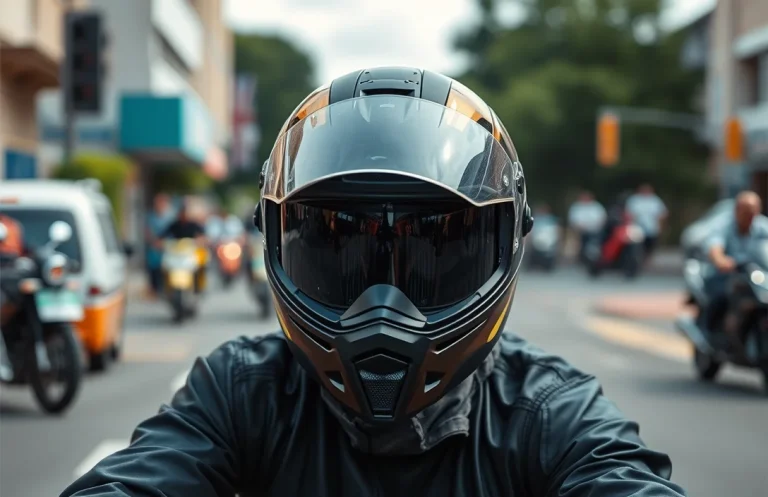
The full-face helmet is widely considered the safest type of motorcycle helmet because it provides a monolithic structure with no moving parts to fail during an impact.
1. Full Head and Chin Coverage
Unlike other styles, the full-face helmet includes an integrated chin bar. This is critical because traffic safety studies show that approximately 35% of all motorcycle helmet impacts occur in the chin and jaw area.
2. High Protection Level
Because the shell is a single continuous piece, it offers the highest structural rigidity. This design is the only one permitted for professional racing (MotoGP, WorldSBK) because it manages high-speed impacts and rotational forces most effectively.
3. Common Road and Highway Use
For highway riding, a full-face helmet is the standard. Beyond impact safety, it provides:
- Eye Protection: The integrated visor shields you from wind, insects, and road debris at 60+ mph.
- Fatigue Reduction: Its aerodynamic shape reduces wind buffeting and neck strain.
- Noise Insulation: It is the quietest helmet style, protecting your hearing from long-term wind noise damage.
Flip-Up Motorcycle Helmets
Also known as Modular helmets, these offer a compromise between the safety of a full-face and the convenience of an open-face design.
1. Movable Chin Bar Design
Modular helmets feature a hinge that allows the entire front section (chin bar and visor) to flip up. This is incredibly useful for touring riders who want to speak to a passenger, grab a drink, or look at a map during a stop without removing their helmet.
2. Urban and Touring Use
These are favorites for “commuter” and “adventure” riders. In slow-moving city traffic, flipping the bar up provides instant relief from heat. However, most modular helmets are only safety-certified to be worn in the closed position.
3. Protection Comparison
- The Hinge Factor: The hinge and locking mechanism introduce a potential “weak point” compared to a solid full-face shell.
- Safety Ratings: Look for P/J dual homologation (common in ECE 22.06 ratings). “P” means it is certified as a protective full-face, while “J” means it is safe to ride with the chin bar in the open position.
Motorcycle Helmet Open Face
The open-face (or 3/4) helmet is popular among cruiser riders and city commuters who prioritize visibility and a “connected” feeling to the environment.
1. Side and Rear Head Coverage
An open-face helmet provides excellent protection for the top, sides, and back of the head—matching a full-face helmet in those specific areas. It is far superior to a “half-helmet” or “brain bucket.”
2. Face Exposure Benefits
The most obvious benefit is the unrestricted field of vision. Without a chin bar in the way, checking blind spots and seeing the instrument cluster is effortless. It also eliminates the “claustrophobic” feeling some riders experience in full-face lids.
3. Visibility and Airflow
- Airflow: Natural ventilation is unmatched, making it the top choice for riding in extreme heat or slow urban traffic.
- The Trade-Off: The lack of a chin bar means there is zero protection for the lower face. In a “face-plant” scenario, the rider is fully exposed to dental and jaw injuries.
| Feature | Full-Face | Modular | Open-Face |
| Chin Protection | Maximum | Moderate (when closed) | None |
| Noise Level | Quietest | Moderate | Loud |
| Airflow | Vents only | High (at stops) | Maximum |
| Best Use | Sport/Highway | Touring/Commute | City/Cruiser |
Half Shell Motorcycle Helmets
Half shell motorcycle helmets, commonly known as “brain buckets,” provide the minimum amount of coverage allowed by law. While they offer the most freedom and airflow, they come with significant safety trade-offs that you should consider before riding.
Minimal Head Coverage
A half shell helmet protects only the top of your head, from the forehead to the crown. It leaves your face, ears, jaw, and the base of your skull completely exposed. According to safety studies, the chin and jaw area are among the most frequent impact zones in accidents—areas where this style offers zero protection.
Legal and Safety Considerations
To be road-legal in the U.S., a half shell must meet the DOT FMVSS 218 standard.
- The “Beanie” Trap: Many ultra-thin helmets sold as “novelty” items are illegal for road use because they lack the required one-inch thick energy-absorbing liner.
- Retention: Because they cover less surface area, they are more prone to “rolling off” your head during a slide. A high-quality, securely riveted chin strap is a legal and safety must.
Usage Limits
Half helmets are best reserved for:
- Low-speed cruising: Speeds under 35 mph in familiar, low-traffic areas.
- Hot weather: They provide unmatched ventilation.
- Short commutes: For riders who prioritize ease of storage and quick on/off transitions.
Note: They are not recommended for highway riding due to wind noise, debris, and the high risk of facial injury at high speeds.
Off-Road and Dual Sport Helmets
If your riding takes you away from the pavement, specialized helmets are designed to handle the physical exertion and unique hazards of dirt trails.
Off-Road Motorcycle Helmets
Specifically built for motocross and dirt riding, these prioritize ventilation and weight.
- Design: They feature an elongated chin bar and a large “peak” (sun visor) to block roost (flying dirt) and sun glare.
- No Shield: Most lack a face shield; riders instead wear goggles for a better seal against dust and mud.
Dual Sport Motorcycle Helmets
Dual sport helmets are a hybrid, combining the features of a full-face street helmet with an off-road shell.
- Versatility: They include a built-in face shield for highway speeds and a peak for off-road use.
- Coverage: They provide a wider field of vision (eye port) than standard street helmets, which helps with situational awareness in technical terrain.
Smart Motorcycle Helmets
Smart helmets are the latest evolution in rider gear, integrating electronics directly into the protective shell to improve safety and connectivity.
Bluetooth and Communication
Most smart helmets come with integrated speakers and noise-canceling microphones. This allows you to:
- Receive turn-by-turn GPS navigation via audio.
- Use voice commands to control music or calls without taking your hands off the bars.
- Connect with other riders via Mesh Intercom systems (up to a 2km range).
Technology Integration
Beyond communication, high-end smart helmets in 2026 feature:
- Heads-Up Displays (HUD): Projecting speed and maps onto the visor.
- Crash Detection: Onboard sensors that detect an impact and automatically alert emergency services with your location.
- Rear-View Cameras: Feeding a live video stream to a small display inside the helmet to eliminate blind spots.
What Are the 4 Types of Helmets?
While specialty helmets exist, most riders choose from the four primary categories of road-legal headgear.
| Helmet Type | Best For | Protection Level |
| Full-Face | Highway & Sport | Maximum: Covers entire head and jaw. |
| Modular | Touring & Urban | High: Flip-up chin bar for convenience. |
| Open-Face | Cruisers & Scooters | Moderate: Covers ears/back; face exposed. |
| Half-Shell | Low-Speed Cruising | Minimal: Only covers top of the head. |
Types of Helmet Colour
The colour of your motorcycle helmet is more than an aesthetic choice; it is a critical safety feature that determines how quickly other drivers can spot you on the road.
Common Helmet Colors
While black and matte grey remain the most popular choices for style, manufacturers offer a wide spectrum ranging from “Hi-Viz” (High Visibility) neon to classic solid whites and metallic silvers.
- Hi-Viz (Neon Yellow/Orange): The gold standard for daytime safety.
- Solid White: Highly reflective and provides the best contrast against dark asphalt.
- Black/Dark Tones: Popular for matching gear but offer the lowest visibility.
Visibility and Safety Impact
Visibility is about contrast. Human eyes detect movement and objects through contrast against the background.
- Daytime: Fluorescent colors (neon) are the most effective because they convert UV light into visible light, making them appear “glowy” even on overcast days.
- Nighttime: Base color matters less than reflectivity. A white helmet reflects headlight beams better than black, but integrated reflective strips or LED modules are the only way to ensure 360-degree night visibility.
- Statistics: Research shows that riders wearing white helmets have a 24% lower risk of being involved in a crash compared to those wearing black helmets.
Color Preference Factors
- Heat Absorption: Darker colors absorb more thermal energy. In summer, a black helmet can be 10-15°F hotter inside than a white one.
- Maintenance: While white is safer, it shows road grime, bug splats, and scuffs much more easily than matte black or silver.
Different Types of Helmets Medieval
Medieval helmets were designed for a different kind of “road hazard”—blunt force from maces and piercing strikes from arrows or lances.
Historical Helmet Purpose
The primary goal of medieval headgear was to deflect blows rather than absorb energy (as modern helmets do). Most were made of iron or steel plates and worn over a padded “arming cap” to provide basic cushioning.
Design Comparison with Modern Helmets
| Feature | Medieval (e.g., Great Helm) | Modern (DOT Motorcycle) |
| Material | Heavy forged steel | Polycarbonate / Carbon Fiber |
| Visibility | Narrow eye slits (Limited) | Wide panoramic visors (105°+) |
| Ventilation | Small punched holes | Multi-channel intake/exhaust vents |
| Weight | 5–10 lbs (Very heavy) | 3–4 lbs (Lightweight) |
Protection Differences
Medieval helmets like the Great Helm or Sallet were built for structural rigidity to prevent a sword from cutting through. Modern helmets are “sacrificial”—they are designed to crush and break (via the EPS liner) to slow down the brain’s movement during a high-speed impact.
Different Types of Helmets Football
Football helmets are specialized athletic equipment designed for a completely different “threat model” than motorcycle gear.
Sports Helmet Structure
A football helmet consists of a tough polycarbonate shell, a distinctive metal faceguard (grill), and a complex internal padding system. Modern versions often use TPU cushioning or inflatable air bladders to customize the fit to a player’s head.
Impact Protection Role
The goal is to manage repeated, low-to-moderate speed impacts.
- Multi-Hit Design: Unlike motorcycle helmets, which must be replaced after one crash, football helmets are engineered to withstand hundreds of smaller collisions per season.
- Rotational Force: Newer models (like those using MIPS technology) focus on reducing the twisting motion of the brain, which is the leading cause of concussions in sports.
Difference from Motorcycle Helmets
Never use a football helmet for motorcycling. * Certification: Football helmets meet NOCSAE standards (for 20 mph human impacts), while bikes require DOT/ECE (for 100 mph road crashes).
- Energy Absorption: Football helmets use rebound padding; motorcycle helmets use crushable foam. A football helmet will “bounce” off the pavement, potentially causing severe neck or brain injury in a high-speed slide.
Motorcycle Helmet Types FAQ
Which helmet type offers the most protection?
The Full-Face helmet is the safest choice. It is the only style that provides a solid, integrated chin bar to protect your jaw, which accounts for nearly 35% of all impact locations in motorcycle accidents.
Are half helmets safe for highways?
Technically, they are legal if they have a DOT sticker, but they are not recommended for highway use. They offer zero protection for your face and jaw against road debris, wind fatigue, or high-speed impacts. At 60+ mph, the lack of a face shield also makes eye protection difficult.
Do helmet colors affect visibility?
Yes, significantly. Bright white and fluorescent yellow (Hi-Viz) helmets make you much more noticeable to car drivers. Switching from a black helmet to a white one can reduce your accident risk by nearly a quarter.

- 10 Best Jack For F250 Review (October 2026) - October 12, 2026
- 10 Best Jack For F150 Review (October 2026) - October 12, 2026
- 10 Best Electric Hydraulic Jack For Car Review (October 2026) - October 12, 2026