10 Types of Tire Damage and Their Causes: Signs, Severity and Prevention

Tire damage is the leading cause of roadside breakdowns and blowouts worldwide. Yet most drivers cannot identify what type of damage they are looking at or what caused it. Whether you are a daily commuter, a fleet manager, or a professional mechanic, understanding the difference between a cupped tire and a feathered one, or between a sidewall crack and a sidewall bubble, determines whether you make a safe repair decision or a dangerous one.
This guide covers all 10 types of tire damage and their causes, with visual identification tips, severity ratings, repairability guidance, a full comparison table, and a prevention checklist. Every section is based on data drawn from tire manufacturer guidelines, automotive safety research, and real-world diagnostic patterns.
What Causes Tire Damage? The Four Root Categories
Before examining each damage type individually, it helps to understand that all 10 types fall into just four root cause categories. Knowing which category a damage type belongs to tells you immediately whether the fix is a pressure correction, a mechanical repair, a driving habit change, or a simple tire replacement.
- Incorrect inflation pressure — responsible for center tread wear, edge/shoulder wear, and most heat-related blowouts
- Mechanical and suspension problems — responsible for cupping, feathering, and one-sided wear patterns
- External impact and road hazards — responsible for sidewall bubbles, bead damage, and tread punctures
- Age and environmental degradation — responsible for sidewall cracking caused by UV, ozone, and heat cycles over time
Replacing a tire without fixing the root cause means the same damage will reappear on the next set. The sections below tell you exactly what caused each damage type and what to do about it.
10 Types of Tire Damage and Their Causes
1. Even Tread Wear
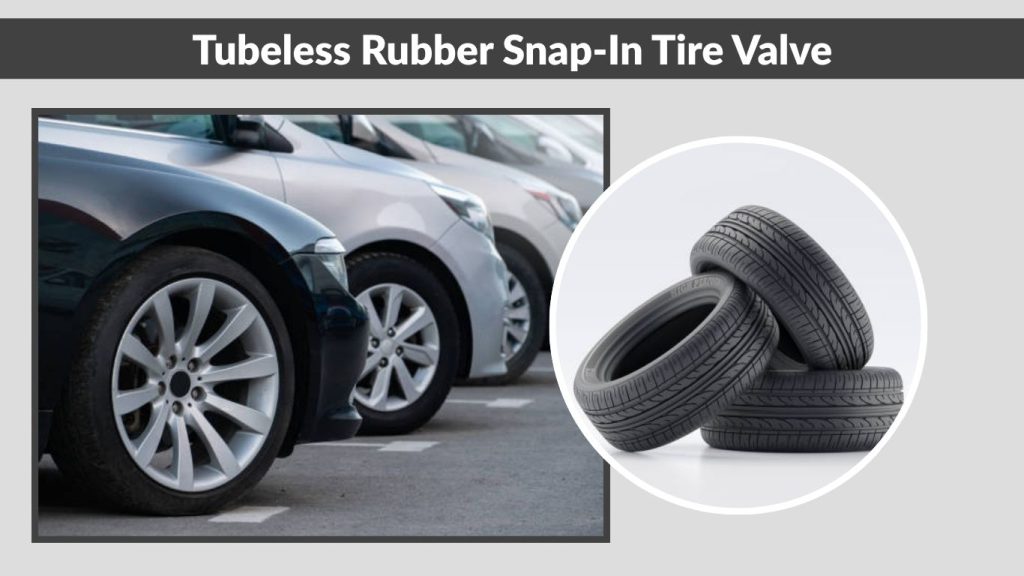
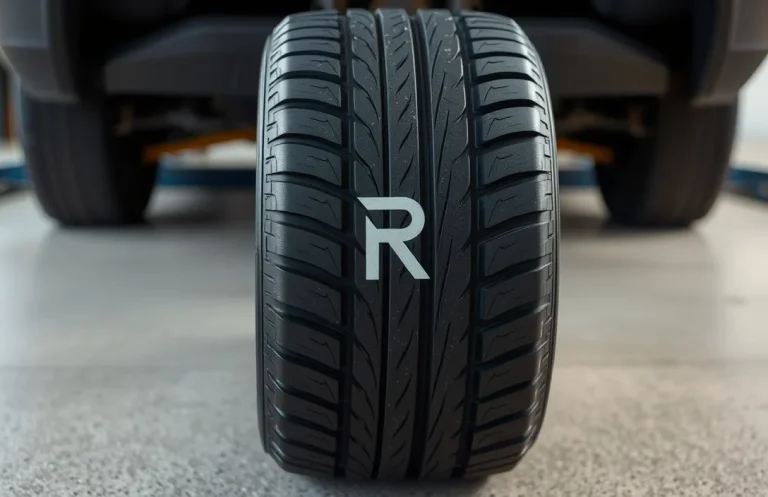
Even tread wear across the full width of the tire is the only damage type that indicates normal, healthy tire use. All tires wear down over accumulated mileage the question is always whether the wear is uniform. When it is, your inflation pressure, wheel alignment, and suspension components are all functioning correctly. The only cause is time and distance.
The legal minimum tread depth in most countries is 1.6mm (2/32″). However, safety research consistently shows that wet braking performance deteriorates significantly below 3mm (4/32″), which is the recommended replacement threshold for safe everyday driving. Use a tread depth gauge or the coin test monthly to track wear progression.
Visual sign: Uniform low tread depth across the entire width of all four tires.
Cause: Normal mileage accumulation.
Repairable: No — replace when tread reaches 3mm.
Prevention: Rotate tires every 5,000–8,000 miles to equalize wear across all four positions.
2. Center Tread Wear
When the center of the tread wears significantly faster than both edges, the cause is almost always chronic overinflation. An overinflated tire balloons outward, causing only the center strip of the contact patch to bear the vehicle’s full weight. This reduces effective grip, hardens the ride, shortens tire life, and dramatically reduces wet traction precisely when you need it most.
The most common cause of overinflation is drivers inflating to the maximum PSI printed on the tire sidewall rather than the vehicle manufacturer’s recommended pressure shown on the door jamb sticker. These are two very different numbers. The sidewall figure is the tire’s structural maximum. The door jamb figure is the optimum operating pressure for your specific vehicle’s weight and geometry.
Visual sign: Center of tread worn smooth while both edges remain relatively intact.
Cause: Chronic overinflation above the vehicle manufacturer’s recommended pressure.
Repairable: No — correct pressure immediately and replace the tire.
Prevention: Always inflate to the pressure on your vehicle’s door jamb sticker, not the tire sidewall maximum.
3. Edge and Shoulder Wear
When both outer edges of the tread wear faster than the center, the tire is chronically underinflated. An underinflated tire cannot maintain its designed shape under load it collapses slightly, causing the shoulders to take most of the vehicle’s weight instead of the full tread width. This generates excessive internal heat, accelerates rubber compound breakdown, and significantly increases blowout risk at motorway speeds.
Research shows that underinflation by just 20% below the recommended pressure reduces tire life by up to 25% and is the single most common precursor to heat-related blowout. If only one edge wears faster rather than both, the cause shifts from pressure to alignment specifically a camber or toe problem causing the tire to run at an angle to its direction of travel.
Visual sign: Both shoulder edges worn, center tread relatively intact. One-sided edge wear points to alignment rather than pressure.
Cause: Chronic underinflation (both edges) or camber misalignment (single edge).
Repairable: No — correct pressure or alignment and replace the tire.
Prevention: Check pressure monthly with a calibrated gauge, not just by eye or feel.
4. Cupping and Scalloping
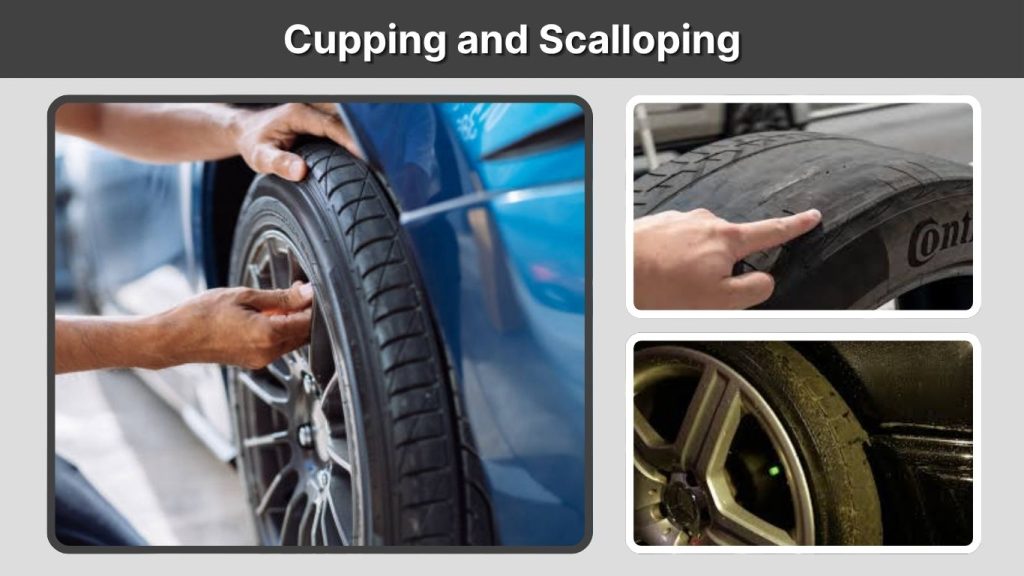
Cupping sometimes called scalloping or dipping appears as a wavy, uneven wear pattern across the tread face, with alternating high and low spots typically spaced 2–4 inches apart around the circumference of the tire. It is one of the most frequently misdiagnosed damage types, because drivers often assume it is a tire manufacturing defect when it is almost always a suspension problem.
The cause is a bouncing motion: a worn shock absorber, strut, or loose wheel bearing allows the tire to repeatedly lift off and slam back onto the road surface instead of maintaining constant rolling contact. Each impact removes a small amount of rubber from a slightly different tread position, progressively creating the distinctive scalloped pattern. Cupped tires vibrate noticeably at highway speeds and produce a rhythmic thumping or droning noise that intensifies above 50 mph.
Replacing the tires without fixing the suspension will reproduce identical cupping on the new set within a few thousand miles.
Visual sign: Wavy, uneven wear pattern across the tread face. Rhythmic thumping noise at highway speeds.
Cause: Worn shock absorbers, struts, or loose wheel bearings.
Repairable: No — suspension repair is required before fitting new tires.
Prevention: Replace shock absorbers every 50,000 miles or at any sign of excessive body bounce or poor damping.
5. Sidewall Bulge and Bubble
A sidewall bubble is one of the most dangerous tire conditions a driver can encounter — and one of the least understood. It forms when a hard impact, typically hitting a deep pothole, striking a sharp kerb, or running over a large road hazard at speed, ruptures the inner liner of the tire without visibly damaging the outer rubber wall. Once the inner liner tears, inflation pressure migrates between the liner and the outer sidewall rubber, forming a visible outward bulge or bubble.
The critical danger is structural: the outer rubber sidewall is now carrying the full inflation pressure with no cord or liner support behind it. This section of the tire has lost all structural integrity. A tire with a sidewall bubble can fail completely and without warning at any speed, including low-speed urban driving. There is no repair option. The tire must be replaced before the vehicle is driven again.
Always inspect your sidewalls visually after any significant pothole impact or kerb strike, even if the tire appears to hold pressure normally immediately afterward. Pressure retention does not indicate structural integrity when the inner liner is damaged.
Visual sign: Visible outward bulge or bubble on the sidewall, often the size of a golf ball or larger.
Cause: Impact damage pothole, kerb strike, or road hazard rupturing the inner tire liner.
Repairable: No replace immediately. Do not drive on a bubbled tire.
Prevention: Maintain correct inflation pressure, which gives the tire maximum structural resistance to impact. Avoid potholes at speed.
6. Sidewall Cracking
Fine cracks appearing in the sidewall rubber ranging from hairline surface checks to deep structural fissures are caused by rubber compound degradation over time. UV radiation, ground-level ozone, extreme temperature cycling, and long periods of inactivity all accelerate the oxidation process that causes tire rubber to harden, dry out, and eventually crack.
Sidewall cracking is an age-related failure mode that occurs regardless of tread depth or mileage. A tire with excellent remaining tread can still be dangerously cracked if it is old. This is why most tire manufacturers and safety bodies recommend replacing all tires after 6–10 years from the date of manufacture, regardless of how much tread remains. The manufacture date is encoded in the last four digits of the DOT code on the sidewall — the first two digits are the week and the last two are the year of manufacture.
Surface crazing — very fine hairline cracks — can be monitored but indicates aging rubber. Deep cracks that penetrate into the sidewall structure indicate imminent risk of catastrophic sidewall separation and require immediate replacement.
Visual sign: Fine to deep cracks or crazing on the sidewall rubber surface.
Cause: UV radiation, ozone, heat cycles, and age-related rubber oxidation.
Repairable: No — replace if cracks are deep or tire is over 6 years old.
Prevention: Store vehicles out of direct sunlight where possible. Use UV-protective tire dressings. Check DOT date codes and replace aging tires proactively.
7. Puncture
A puncture occurs when a sharp object a nail, screw, shard of glass, or piece of road debris penetrates the tread and creates a hole that allows air to escape. Punctures account for the majority of roadside tire changes and are the most common type of tire damage encountered by everyday drivers.
Whether a puncture is repairable depends entirely on its location and size. A puncture in the central tread area — within 6mm of the tire’s centerline and measuring no more than 6mm in diameter can be safely repaired using a proper patch-plug combination applied from inside the tire by a qualified technician. A plug-only repair from outside the tire is not considered a permanent or safe fix. Punctures in the shoulder area or sidewall cannot be safely repaired and require full tire replacement.
Run-flat tires can sustain a puncture and continue at reduced speed (typically 50 mph) for approximately 50 miles, but only when TPMS alerts the driver immediately to the pressure loss. Driving a standard non-run-flat tire even a short distance while completely flat destroys the sidewall structure irreparably — the rubber delaminates from the cords in seconds.
Visual sign: Embedded object in tread, rapid or gradual pressure loss, TPMS warning light.
Cause: Road debris nails, screws, glass penetrating the tread area.
Repairable: Yes tread punctures within specification only. Shoulder and sidewall punctures are not repairable.
Prevention: Maintain correct inflation pressure to maximise tread rigidity. Inspect tread regularly for embedded objects before they work deeper.
8. Bead Damage
The bead is the steel wire-reinforced inner edge of the tire that seats against the wheel rim to create the airtight seal that holds inflation pressure inside the tire. Bead damage occurs when this seal zone is deformed, cut, or compressed beyond its design tolerance.
The most common causes are improper tire mounting using tools or techniques that pinch or cut the bead wire, aggressive kerb strikes that compress the bead area hard against the rim flange, or forceful emergency tire removal during roadside changes. A damaged bead cannot form a reliable airtight seal against the rim, resulting in chronic slow leaks that often baffle drivers because the valve stem tests clean and no puncture is visible.
On TPMS-equipped vehicles, bead damage often presents as a gradual pressure drop that stabilises before reaching zero — a different pattern from a puncture, which typically continues dropping. Bead damage is not repairable. Full tire replacement is required.
Visual sign: Slow leak at the rim edge, visible distortion or scoring of the inner bead, chronic pressure loss with no visible puncture.
Cause: Improper mounting, kerb impacts, or forceful removal damaging the bead wire zone.
Repairable: No — replace the tire.
Prevention: Use professional tire mounting equipment only. Avoid parking against kerbs aggressively. Inspect the bead area whenever tires are removed from rims.
9. Heat Damage and Blowout
A tire blowout is the sudden, catastrophic loss of air pressure caused by structural failure of the tire carcass. It is almost always preceded by a period of internal heat buildup that the tire cannot dissipate fast enough. The root cause in the overwhelming majority of cases is severe underinflation combined with sustained high-speed driving.
An underinflated tire flexes excessively with every wheel rotation — the sidewalls bend and recover, bend and recover, generating frictional heat inside the rubber-to-cord bond that holds the tire together. Once internal temperatures exceed the bond’s design tolerance, the rubber begins to separate from the reinforcing cords in a process called delamination. Once delamination begins, structural collapse follows rapidly and the tire fails explosively.
Secondary causes of heat damage and blowout include overloading the vehicle beyond the tire’s rated load index, driving on a punctured tire without awareness (particularly on run-flat tires where pressure loss is not immediately felt), and using mismatched tires of different sizes or load ratings on the same axle, which creates unequal stress distribution at speed.
A blowout at motorway speed causes an immediate, dramatic loss of vehicle control. The correct response is to grip the steering wheel firmly with both hands, ease off the accelerator gradually, and steer gently toward the hard shoulder. Braking hard on a blown tire is one of the most dangerous responses a driver can make.
Visual sign: Shredded or delaminated tire carcass, exposed cords, rubber chunks separated from the structure.
Cause: Severe underinflation combined with high-speed driving generating destructive internal heat.
Repairable: No replace immediately. Inspect the wheel for damage before fitting a replacement.
Prevention: Check inflation pressure before every long motorway journey. Never exceed the tire’s load index. Respond immediately to TPMS warnings.
10. Feathering and One-Sided Wear
Feathering is a specific wear pattern where each individual tread block is worn smooth and rounded on one side while remaining sharp and squared on the other. Running your hand across a feathered tire in one direction feels smooth; in the other direction it feels sharp and jagged like the serrated edge of a saw blade. This tactile test is often more revealing than a visual inspection.
The cause of feathering is excessive toe misalignment the tire is pointing slightly inward (toe-in) or outward (toe-out) relative to the direction of travel, causing it to scrub diagonally across the road surface with every rotation rather than rolling cleanly forward. The diagonal scrubbing motion progressively rounds off one side of each tread block while leaving the other side sharp.
One-sided wear where the entire inner or outer edge of the tread wears significantly faster than the rest of the tire width is caused by camber misalignment, where the wheel leans inward or outward from vertical when viewed from the front of the vehicle. Both feathering and one-sided wear are purely alignment-related conditions. They are not tire manufacturing defects. Fitting new tires without first correcting the alignment will produce identical wear on the new set within a few thousand miles.
Visual sign: Sawtooth tread blocks (feathering) or one entire edge of the tread worn significantly faster than the other (one-sided wear).
Cause: Toe misalignment (feathering) or camber misalignment (one-sided edge wear).
Repairable: No — four-wheel alignment correction required before fitting replacement tires.
Prevention: Get a four-wheel alignment check at every tire change, after any significant pothole or kerb impact, and every 12 months as standard maintenance.
Full Comparison Table: 10 Types of Tire Damage
Use this reference table to quickly identify any damage type, its root cause, whether it can be repaired, and how urgently it needs to be addressed.
| # | Damage Type | Primary Cause | Visual Sign | Repairable? | Severity |
|---|---|---|---|---|---|
| 1 | Even tread wear | Normal mileage aging | Uniform low depth across full width | No — replace at 3mm | Moderate |
| 2 | Center tread wear | Chronic overinflation | Center worn, edges intact | No — correct pressure and replace | High |
| 3 | Edge / shoulder wear | Chronic underinflation or camber misalignment | Both edges worn, center intact | No — correct cause and replace | High |
| 4 | Cupping / scalloping | Worn shock absorbers or struts | Wavy, uneven tread pattern around circumference | No — suspension repair required | High |
| 5 | Sidewall bulge / bubble | Impact damage rupturing inner liner | Visible outward bulge on sidewall | No — replace immediately | Critical |
| 6 | Sidewall cracking | UV, ozone, heat, and age degradation | Fine to deep cracks in sidewall rubber | No — replace if deep or over 6 years old | Critical |
| 7 | Puncture | Road debris penetrating tread | Embedded object or rapid pressure loss | Yes — central tread only, within spec | High |
| 8 | Bead damage | Improper mounting or kerb impact | Chronic slow leak at rim edge | No — replace the tire | Critical |
| 9 | Heat damage / blowout | Severe underinflation at high speed | Shredded carcass, delaminated rubber | No — replace immediately | Critical |
| 10 | Feathering / one-sided wear | Toe or camber misalignment | Sawtooth blocks or single-edge wear | No — alignment correction required first | High |
How to Prevent Tire Damage: 10 Key Actions
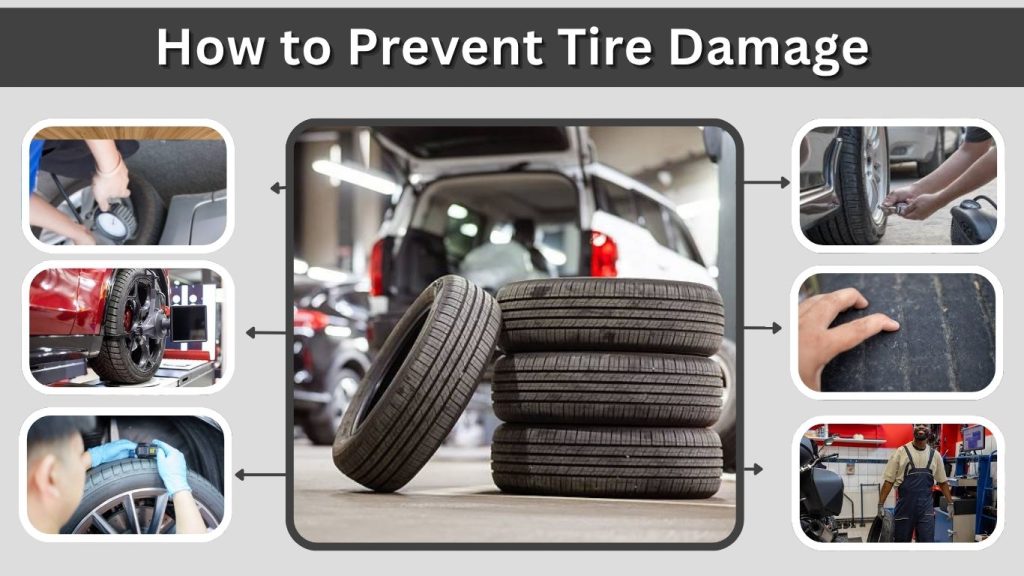
Most tire damage is preventable. These ten maintenance actions address every root cause category covered in this guide and represent the minimum routine care that keeps tires safe and extends their service life.
- Check inflation pressure monthly with a calibrated gauge — not just by eye. Use the vehicle door jamb pressure, not the tire sidewall maximum.
- Rotate tires every 5,000–8,000 miles to equalize tread wear across all four positions and extend overall tire life.
- Get a four-wheel alignment check with every new tire fitment, after any significant pothole or kerb impact, and every 12 months as standard maintenance.
- Replace shock absorbers at manufacturer-recommended intervals typically every 50,000 miles to prevent cupping and protect tires from suspension bounce damage.
- Inspect sidewalls visually after any hard impact pothole, kerb strike, or road hazard. Look for bulges, bubbles, and scruff marks even if the tire holds pressure.
- Check the DOT date code on each tire and replace any tire over 6 years old regardless of remaining tread depth.
- Respond immediately to TPMS warnings pull over safely and check pressure. Never assume TPMS warnings are false alarms or sensor errors without investigation.
- Never exceed the tire’s load index overloading increases heat buildup and dramatically raises blowout risk at motorway speeds.
- Inspect tread regularly for embedded objects nails and screws often lodge in tread without immediately causing a flat, allowing them to work progressively deeper before failure occurs.
- Use professional mounting equipment only for tire changes improper mounting is a leading cause of bead damage that produces untraceable slow leaks.
Frequently Asked Questions About Tire Damage Types and Causes
What is the most dangerous type of tire damage?
A sidewall bubble or bulge is the most immediately dangerous type. The tire can fail completely without warning at any speed and is not repairable under any circumstances.
What causes uneven wear on both edges of a tire?
Wear on both outer edges with the center intact is caused by chronic underinflation. The deflated tire collapses under load and bears the vehicle’s weight on its shoulders rather than across the full tread width.
Can a tire with sidewall cracking be repaired?
No. Sidewall cracks cannot be safely repaired regardless of depth. Surface crazing can be monitored, but deep cracking into the tire structure requires immediate replacement to prevent sudden sidewall separation.
What causes cupping or scalloping on tires?
Cupping is caused by worn shock absorbers or struts that allow the tire to bounce repeatedly off the road surface. The bouncing motion removes rubber unevenly in a rhythmic wavy pattern around the tire circumference.
Is it safe to drive on a tire with a sidewall bubble?
No. A tire with a sidewall bubble has lost all structural integrity at that point and can blow out without warning. It must be replaced before the vehicle is moved, even for a short distance.
What causes center tread wear on tires?
Center wear is caused by chronic overinflation. The over-pressurised tire balloons outward, causing only the center strip of the contact patch to bear the vehicle’s weight and wear down faster than the edges.
Can a puncture in the sidewall be repaired?
No. Sidewall and shoulder punctures cannot be safely repaired. Only punctures in the central tread area measuring no more than 6mm in diameter are repairable using a proper internal patch-plug combination.
What causes feathering on tires?
Feathering is caused by toe misalignment — the tire is pointing slightly inward or outward instead of straight ahead, causing it to scrub diagonally across the road and creating a sawtooth wear pattern on each tread block.
How do I know if my tire was damaged by a pothole?
Pothole damage typically presents as a sidewall bulge or bubble, bead distortion causing a slow leak at the rim, or visible impact scoring on the lower sidewall. Always inspect your tires visually after driving through a deep pothole at speed.
What causes tire blowouts?
Most blowouts are caused by severe underinflation combined with sustained high-speed driving. The underinflated tire flexes excessively with each rotation, generating destructive internal heat that causes the rubber-to-cord bond to fail, leading to sudden structural collapse.
How long do tires last before they crack from age?
Tire rubber begins degrading from the day of manufacture regardless of use. Most manufacturers and safety organisations recommend replacing all tires after 6 to 10 years from the DOT manufacture date, even when significant tread depth remains.
What is bead damage and what causes it?
Bead damage is deformation or cutting of the steel wire-reinforced inner edge of the tire that seals against the wheel rim. It is most commonly caused by improper tire mounting, aggressive kerb strikes, or forceful emergency roadside removal damaging the bead wire zone.
Conclusion
Tire damage is rarely random. Every wear pattern, crack, bulge, and blowout has a specific, identifiable cause and in most cases, a specific, preventable root condition that created it. The 10 damage types covered in this guide fall into four categories: incorrect inflation pressure, mechanical and suspension failure, external impact, and age-related rubber degradation. Identifying the right category tells you immediately what needs to be fixed before a replacement tire is fitted.
The four habits that prevent the majority of serious tire damage are straightforward: check your inflation pressure every month with a calibrated gauge, get a four-wheel alignment check with every new tire set, replace shock absorbers at the recommended service interval, and visually inspect your sidewalls after any significant impact. These actions require minimal time and cost, and they address the root causes of the six most dangerous damage types on this list — including sidewall bubbles, blowouts, cupping, and alignment wear.
If you identify any of the critical-severity damage types covered here a sidewall bubble, deep sidewall cracking, bead damage, or signs of internal heat delamination do not drive the vehicle further. The cost of a replacement tire is always less than the consequence of a high-speed blowout.

- Top 10 Best Helmet For Xpulse 210 Blue Colour 2026 - October 5, 2026
- Top 10 Best Helmet For Xtreme 125r 2026 - October 5, 2026
- Top 10 Best Helmet For Xpulse 200 2026 - October 5, 2026

One Comment