2 Cycle vs 4 Cycle Weed Trimmer: Complete Comparison Guide

2-cycle (2-stroke) weed trimmers are lighter, more powerful for their size, and require mixing oil with gas, while 4-cycle (4-stroke) trimmers are heavier, quieter, more fuel-efficient, and use separate oil and gas. Choose 2-cycle for lightweight power and maneuverability; choose 4-cycle for lower noise, better emissions, and easier maintenance.
2-Cycle vs. 4-Cycle: Side-by-Side Comparison
When choosing between 2-cycle and 4-cycle engines, the “best” choice depends entirely on your property size and physical comfort. If you need to clear heavy brush for hours, the lightweight power of a 2-cycle is king. If you want a quiet, “fill-and-go” experience for a small yard, the 4-cycle is your best friend.
| Feature | 2-Cycle | 4-Cycle |
| Weight | Lighter (8–12 lbs) | Heavier (12–18 lbs) |
| Power | Higher power-to-weight | Lower power-to-weight |
| Fuel | Gas/oil mix (50:1) | Separate gas and oil |
| Noise Level | Louder (95–110 dB) | Quieter (85–95 dB) |
| Emissions | Higher emissions | Lower emissions |
| Maintenance | Simple but frequent | Complex but less often |
| Price | $150–$400 | $200–$500 |
| Starting | Easy pull-start | Harder to start |
| Best For | Heavy-duty, all-day use | Residential, occasional use |
How 2-Cycle Engines Work
Understanding 2-Cycle Engine Basics
A 2-cycle (or 2-stroke) engine is designed for simplicity and speed. Because it lacks a complex valve system, it is much lighter than its 4-cycle counterpart, making it the standard choice for handheld tools like leaf blowers and chainsaws.
The Simple Two-Stroke Process
In a 2-cycle engine, every single downward movement of the piston creates power. The engine completes its entire cycle in just two movements:
- Stroke 1: Compression and Power
- The piston moves up, squeezing the fuel and air together.
- The spark plug fires, causing a mini-explosion.
- This explosion blasts the piston back down, creating the power that spins your trimmer line.
- Stroke 2: Exhaust and Intake
- As the piston moves back up, it pulls in fresh fuel while simultaneously pushing out the old exhaust.
- The process repeats hundreds of times per second.
Why this matters: Because there is a “power stroke” every single time the engine spins, these engines feel very “snappy” and powerful for their small size.
The Oil-Gas Mixture Requirement
Because 2-cycle engines don’t have an oil reservoir, they rely on the fuel itself to keep the internal parts from melting. You must mix 2-cycle oil directly into the gasoline before pouring it into the tank.
- The Standard Ratio: Most modern tools use a 50:1 ratio (50 parts gas to 1 part oil).
- The Mix Guide:
- 1 gallon of gas + 2.6 oz oil
- 2.5 gallons of gas + 6.4 oz oil
- The Golden Rule: Never run a 2-cycle engine on “straight” gas. Without the oil for lubrication, the metal parts will rub together, create extreme heat, and seize the engine permanently within minutes.
How 4-Cycle Engines Work
Understanding 4-Cycle Engine Basics
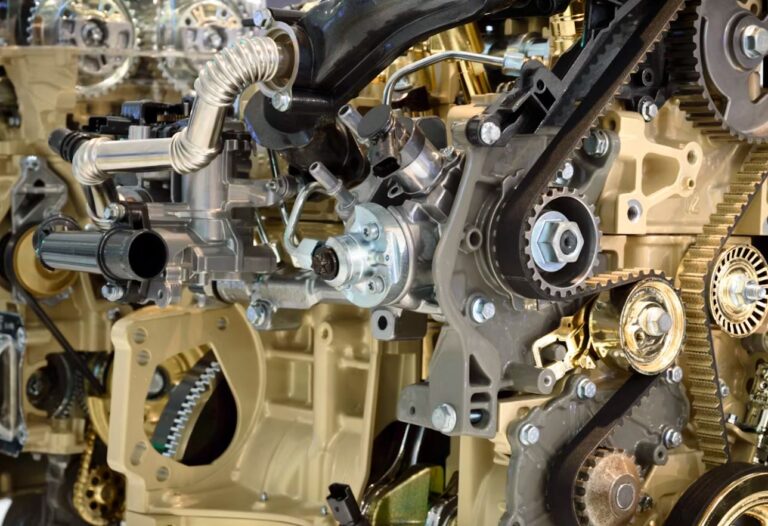
A 4-cycle engine is very similar to the engine in your car. It is more sophisticated, runs smoother, and is significantly quieter than a 2-cycle. While it is heavier due to more internal parts, many homeowners prefer it for its ease of fueling.
The Four-Stroke Process Simplified
To complete one cycle, the piston must travel up and down four times. This creates a more controlled and efficient burn.
- Intake: The piston moves down, a valve opens, and “fresh” fuel and air are sucked in.
- Compression: The piston moves up, sealing the valves and squeezing the mixture tightly.
- Power: The spark plug fires, pushing the piston down with force. This is the only stroke that creates actual power.
- Exhaust: The piston moves back up, a second valve opens, and the burned gases are pushed out the muffler.
The Result: You get a power stroke every two revolutions. This makes the engine run much more quietly and produce far fewer smelly fumes.
Separate Oil and Gas System
The biggest “pro” for the 4-cycle engine is that it eliminates the need for mixing cans.
- Separate Tanks: You fill the fuel tank with regular unleaded gasoline and the oil reservoir with engine oil.
- Recirculation: The oil stays in the engine to lubricate the parts. It does not burn away like it does in a 2-cycle.
- Maintenance: You don’t have to mix fuel, but you must check the oil level periodically and change it once or twice a season to keep the engine healthy.
How to check the oil:
- Place the trimmer on a flat, level surface.
- Remove the dipstick and wipe it clean with a rag.
- Reinsert it fully, then pull it back out to see the level.
- If the oil looks black or feels gritty, it’s time for a change.
SECTION 4: Power and Performance Comparison
Which Engine Type Delivers Better Performance?
When you’re facing a wall of thick weeds or stubborn brush, the way an engine delivers its power matters more than the number on the sticker. While both engine types are capable, they behave differently under load.
Power-to-Weight Ratio Explained
The 2-cycle engine is the heavyweight champion of “raw power.” Because it produces a power stroke every single time the piston goes down, it generates incredible speed.
- High RPM: These engines scream at 7,000–10,000 RPM, providing the high-speed “snap” needed to slice through dense overgrowth.
- Lightweight Build: A 25cc 2-cycle engine typically produces 1–1.5 HP but weighs significantly less than a 4-cycle equivalent. This makes it feel more aggressive and easier to maneuver.
The 4-cycle engine is more like a steady workhorse. It produces a power stroke every two revolutions, which results in higher torque (pulling power) rather than raw speed.
- Steady Performance: Running at 5,000–7,000 RPM, it provides a consistent, smooth cutting experience. It doesn’t “bog down” as easily when the grass gets thick, but it lacks the high-speed “zip” of the 2-cycle.
Real-World Performance: When Each Wins
- When 2-Cycle Wins: Choose this for dense overgrowth, professional landscaping, or clearing steep hillsides where you need to swing the trimmer for hours without fatigue. Its maneuverability is unmatched for heavy brush.
- When 4-Cycle Wins: Best for regular lawn maintenance, precision edging, and noise-sensitive neighborhoods. It is ideal for residential users who prefer a smoother feel and may have less upper-body strength to fight the vibration of a 2-cycle.
Performance Snapshot:
| Task | 2-Cycle Rating | 4-Cycle Rating |
| Thick Weeds | ★★★★★ | ★★★★☆ |
| Regular Grass | ★★★★☆ | ★★★★★ |
| Extended Use | ★★★☆☆ | ★★★★☆ |
| Heavy Brush | ★★★★★ | ★★☆☆☆ |
| Maneuverability | ★★★★★ | ★★★☆☆ |
Fuel Efficiency and Operating Costs
Which Engine Saves You More Money?
To find the true cost of your trimmer, you have to look past the checkout counter. Total ownership involves fuel, mixing supplies, and long-term maintenance.
Fuel Consumption Comparison
The 4-cycle engine is the clear winner in fuel economy. Because it burns fuel more completely and doesn’t consume its own lubricating oil, it uses about 25% less gasoline than a 2-cycle.
- 2-Cycle: Burns roughly 32–40 oz of fuel per hour. Since you have to buy specialized 2-cycle oil to mix in, your annual fuel cost for 20 hours of use is typically $80–$150.
- 4-Cycle: More efficient, using only 24–32 oz per hour. You use regular unleaded gas from the pump. Your annual cost drops to $50–$100.
5-Year Fuel Cost Breakdown:
| Year | 2-Cycle Cost | 4-Cycle Cost | Savings (4-Cycle) |
| Year 1 | $120 | $75 | $45 |
| Year 3 | $120 | $75 | $45 |
| Year 5 | $120 | $75 | $45 |
| Total | $600 | $375 | $225 |
Maintenance Cost Reality
While the 4-cycle saves you money at the pump, it is more expensive to maintain. A 2-cycle engine is mechanically simple—there are no valves to adjust or oil to change. You just replace the spark plug and air filter annually for about $20–$35.
A 4-cycle engine requires oil changes (about $15 twice a year) and eventually needs a valve adjustment, which can cost $30–$50 at a local shop.
The Money Verdict: Over a 5-year span, the 2-cycle’s cheaper purchase price and lower maintenance costs almost exactly balance out the 4-cycle’s superior fuel savings. Both will cost you roughly $1,000–$1,025 over their lifespan.
Noise, Emissions, and Environmental Impact
Environmental and Neighborhood Considerations
If you live in a tight-knit suburb, your choice of engine might be a topic of conversation with your neighbors. The “environmental footprint” of these tools varies wildly.
Noise Level: The Human Factor
- 2-Cycle: Known for a high-pitched, “angry” whine. At 95–110 dB, it is comparable to a motorcycle or a chainsaw. To the human ear, a 2-cycle engine sounds twice as loud as a 4-cycle, and the sound travels much further, potentially disturbing neighbors over 100 feet away.
- 4-Cycle: Produces a lower, deeper rumble at 85–95 dB—similar to a standard lawnmower. It is much less disruptive for early morning yard work and generally more “neighborhood-friendly.”
Emissions and Air Quality
The environmental difference is staggering. Because a 2-cycle engine burns oil along with its fuel, it results in incomplete combustion and visible “blue smoke.”
- The Shocking Stat: The EPA estimates that using a high-emission 2-cycle trimmer for one hour can produce as many pollutants as driving a car for 3,000 miles.
- The 4-Cycle Advantage: These engines achieve complete combustion and meet strict EPA and CARB (California) standards. They produce 50–60% fewer emissions and no visible smoke.
The Regulatory Landscape
Environmental regulations are tightening. States like California are already phasing out the sale of small off-road engines (SORE) that don’t meet strict green standards. If you want a “future-proof” tool that won’t be restricted by local ordinances or future environmental laws, the 4-cycle engine is the safer long-term investment.
Green Choice Summary:
| Factor | 2-Cycle | 4-Cycle | Winner |
| Air Quality | Poor (Visible Smoke) | Good (No Smoke) | 4-Cycle |
| Noise Pollution | High (110 dB) | Moderate (90 dB) | 4-Cycle |
| Regulations | Heavily Restricted | Compliant | 4-Cycle |
Which Engine is Easier to Use All Day?
When you are standing in the middle of a large yard under the summer sun, every extra pound of equipment feels like ten. The primary trade-off between 2-cycle and 4-cycle engines often comes down to a battle between raw weight and vibration comfort.
Weight Difference Impact
The 2-cycle engine is the undisputed champion of lightness. Because its design is inherently simpler—lacking the valves, lifters, and heavy oil sumps of its competitor—it typically weighs between 8 and 12 pounds. This makes it the preferred choice for overhead work, trimming steep embankments, or any job that requires high maneuverability.
In contrast, the 4-cycle engine is a “heavyweight,” generally scaling between 12 and 18 pounds. The dedicated oil reservoir and complex internal steel components add significant bulk. While 5 pounds might not sound like much in the store, after an hour of trimming, that 30–50% increase in weight leads to significant back and shoulder strain.
Real-World Fatigue Timeline:
| Use Duration | 2-Cycle Fatigue | 4-Cycle Fatigue |
| 15 Minutes | Minimal | Minimal |
| 30 Minutes | Light | Moderate |
| 1 Hour | Moderate | Significant |
| 2+ Hours | Significant | Very High |
Balance and Maneuverability
Because 2-cycle engines are lighter, they are generally better balanced. Professionals prefer them because they allow for quick direction changes and “flicking” the trimmer head into tight corners. 4-cycle models tend to be “front-heavy,” requiring more arm strength to keep the trimmer head level and making them slightly more cumbersome on uneven terrain.
Vibration and Comfort
While the 2-cycle is lighter, it is often more “violent.” The high-frequency vibration caused by a power stroke every revolution can lead to hand numbness and “white finger” after prolonged use.
The 4-cycle engine offers a much smoother, lower-frequency vibration profile. It hums rather than screams. For homeowners who only trim for 20 minutes at a time, the smoothness of a 4-cycle engine often makes it feel more “premium” and comfortable, despite the extra weight.
Maintenance and Durability
Long-Term Ownership Reality
A string trimmer is an investment. Whether that investment lasts 3 years or 10 depends entirely on the maintenance schedule and the inherent durability of the engine design.
2-Cycle Maintenance: Simple but Frequent
The 2-cycle engine is remarkably DIY-friendly because there are so few moving parts. However, because it burns oil with its fuel, it is prone to carbon buildup.
- The Routine: Your primary tasks are keeping the air filter clean and ensuring your fuel mix is fresh.
- The Critical Failure: If you forget to mix oil into the gas just once, the engine is “totaled.”
4-Cycle Maintenance: Complex but Robust
Maintenance for a 4-cycle engine mirrors that of a small car.
- Oil Changes: You must drain and replace the engine oil every 10–25 hours of use. This is messy but essential.
- Valve Adjustments: Every 100 hours, the internal valves may need a professional adjustment to keep the timing precise—a task most homeowners cannot do themselves.
Lifespan and Durability
Generally, a 4-cycle engine will outlast a 2-cycle engine in total operating hours. The dedicated lubrication system provides better protection for internal bearings and valves. A well-maintained 4-cycle can easily last 8 to 12 years for a homeowner, whereas a 2-cycle often reaches its limit around 5 to 8 years as the piston rings wear down.
Durability Factors:
| Factor | 2-Cycle | 4-Cycle |
| Longevity | Shorter (300-500 hrs) | Longer (500-1000 hrs) |
| Ease of Repair | Simpler | Complex |
| DIY Friendliness | High | Moderate |
| Professional Repair Cost | $50–$100 | $80–$150 |
Best Use Cases for Each Type
Which Engine Type Matches Your Needs?
Still undecided? Your choice should be dictated by your specific property and your physical comfort level with machinery.
Choose a 2-Cycle Engine If:
- You have a “wild” property: If you are clearing 2+ acres of tall grass, thick weeds, or brush, you need the high RPMs and lightweight maneuverability of a 2-cycle.
- You are a professional: If you are trimming for 4+ hours a day, the weight savings are non-negotiable for your long-term joint health.
- You are comfortable with “the mix”: If you don’t mind keeping a dedicated gas can with a 50:1 oil mixture, the 2-cycle is a simple, powerful tool.
Choose a 4-Cycle Engine If:
- You live in a quiet suburb: If you have close neighbors and a standard lot (under 1 acre), the lower noise and lack of smelly “blue smoke” make you a better neighbor.
- You value simplicity in fueling: If you hate mixing oil and gas and just want to fill up from the same can you use for your lawnmower, the 4-cycle is for you.
- You prefer a smoother experience: If high-frequency vibrations make your hands ache, the steady, low-vibration hum of a 4-cycle is worth the extra few pounds.
Buying Guide and Recommendations
How to Choose the Right Trimmer
Once you’ve settled on an engine type, you need to navigate the brands and features. Here are the top performers currently on the market.
Top Recommendations
2-Cycle Category
- Budget ($150-$200): Craftsman WS210. A solid entry-level choice that is easy to start and light enough for anyone to handle.
- Mid-Range ($200-$300): Echo SRM-225. Often cited as the “legendary” homeowner trimmer. It is professional-grade, incredibly durable, and has a straight shaft for better reach.
- Professional ($300-$400): Stihl FS 91 R. A beast for heavy clearing. It offers superior balance and the power to run thick trimmer lines through woodier stalks.
4-Cycle Category
- Budget ($200-$250): Troy-Bilt TB575 EC. A great way to get into 4-cycle trimming without breaking the bank. Features “JumpStart” technology to save your shoulder from pull-starting.
- Mid-Range ($250-$350): Honda HHT25SLTAT. Honda is the gold standard for 4-cycle engines. This model is exceptionally quiet, starts on the first pull, and runs like a dream for years.
- Premium ($400-$500): Makita MM4. A commercial-grade 4-cycle trimmer. It is heavy, but the vibration-dampening and build quality are world-class.
Critical Features to Look For
- Straight vs. Curved Shaft: Always opt for a straight shaft if you can afford it. They are more durable, offer better reach under bushes/decks, and are generally found on higher-quality engines. Curved shafts are only better if you are very short and only doing light-duty grass trimming.
- Attachment Capability: Some trimmers allow you to “split” the shaft to add blowers, edgers, or pole saws. This is a huge value-add for homeowners with limited storage space.
- Starting System: Look for “Easy Start” or “Spring-Assist” labels. 4-cycle engines can be harder to pull-start due to higher compression, so these features are a lifesaver.
Buying Checklist:
- [ ] Identify your fuel strategy: Are you ready to mix, or do you want to use “straight” gas?
- [ ] Test the weight: If possible, hold the unit in the store. Imagine holding it for 30 minutes.
- [ ] Check the warranty: 2 years is standard; 5 years (like on Echo) is exceptional.
- [ ] Safety Gear: Don’t forget to buy eye protection and earplugs—even a 4-cycle is loud enough to cause permanent hearing damage over time.
Frequently Asked Questions (FAQs)
Q: Can I use the same gas in my 2-cycle trimmer that I use for my lawnmower?
A: No. Most lawnmowers have 4-cycle engines that take straight gasoline. If you put straight gas into a 2-cycle trimmer without mixing in 2-cycle oil, the engine will “seize” (melt internally) within minutes. However, you can use the same gas for a 4-cycle trimmer.
Q: Why does my 2-cycle trimmer blow blue smoke?
A: A small amount of smoke is normal because 2-cycle engines are designed to burn oil along with the gas for lubrication. If the smoke is excessive, you may have used too much oil in your mix, or the air filter might be clogged.
Q: Is a 4-cycle trimmer too heavy for a woman or a senior?
A: It depends on the user, but at 12–18 lbs, 4-cycle trimmers can be cumbersome. If weight is a primary concern, a high-quality 2-cycle trimmer (like the Echo SRM-225) is significantly lighter and easier to maneuver for long periods.
Q: Do I really need to change the oil in a 4-cycle trimmer?
A: Yes. Unlike a 2-cycle where the oil is refreshed with every tank of gas, the oil in a 4-cycle stays in the reservoir. Over time, it breaks down and collects debris. Failing to change it at least once a season will lead to engine failure.
Q: Which engine type lasts longer?
A: Generally, 4-cycle engines have a longer lifespan (often 10+ years for homeowners) because their dedicated lubrication system reduces wear on internal parts. 2-cycle engines typically last 5–8 years before the piston rings lose compression.
Conclusion: Making Your Final Choice
Choosing between a 2-cycle and 4-cycle string trimmer comes down to a trade-off between maneuverability and convenience.
- The 2-Cycle Engine is the “Pro’s Choice.” It is lightweight, powerful, and capable of hacking through the toughest brush. It requires more effort in fuel preparation (mixing gas and oil), but its simplicity makes it easier to repair and less fatiguing for large properties.
- The 4-Cycle Engine is the “Suburban King.” It is quieter, cleaner, and allows you to skip the messy fuel mixing process. While it is heavier and requires more complex maintenance like oil changes, it provides a smoother, more neighborhood-friendly experience for standard yard maintenance.
The Bottom Line
- Buy a 2-cycle if: You have a big yard, steep hills, or heavy weeds, and you don’t mind the “whiny” noise.
- Buy a 4-cycle if: You have a small-to-medium flat lot, want to avoid mixing fuel, and prefer a quieter machine that starts easily.
Regardless of which path you choose, remember that fresh fuel is the secret to longevity. Most trimmer “breakdowns” are actually just clogged carburetors caused by old gas. Use a fuel stabilizer or buy ethanol-free canned fuel to keep your new trimmer running for years to come.

- 10 Best Electric Hydraulic Jack For Car Review (October 2026) - October 12, 2026
- 10 Best Electric Jack For Car Review (October 2026) - October 12, 2026
- 10 Best Jack For Electric Vehicle Review (October 2026) - October 12, 2026