Can You Add Coolant While Car Is Hot?

Adding coolant while a car is hot is usually unsafe. A running engine pressurizes the cooling system, so opening the radiator cap or a pressurized reservoir can release scalding coolant and steam. Turn off the engine, wait for the temperature gauge to drop, and add coolant only after the radiator and nearby components are cool enough to touch safely.
If you need to get moving, treat a hot-engine top-up as an emergency measure, not a normal fill. Never remove a hot radiator cap, and do not fill a reservoir to the brim.
Safe Coolant Top-Up Rules
- Never open a hot cap. Loosen the radiator cap only after the system has cooled enough to prevent a pressurized coolant spray.
- Use the overflow tank. Check the reservoir when the engine is cool, or only when it is safe to approach without touching hot parts.
- Wait for hand-warm temperatures. If the radiator or nearby hoses are too hot to touch briefly, keep waiting.
- Use the specified coolant. Follow the type listed in your owner’s manual. Use water only as a temporary emergency top-off.
- Top up after cooling. If you must add coolant to reach a repair shop, add the minimum needed and complete the proper fill once the engine is fully cool.
- Investigate repeated losses. Coolant that drops again usually points to a leak or overheating problem, not normal use.
Can You Add Coolant While a Car Is Hot?
No. Do not open the radiator cap while the engine is hot.
The cooling system builds pressure as the engine runs. That pressure raises the coolant’s boiling point, but it also creates a burn hazard. Loosening the cap can release hot coolant and steam violently, even when you turn it slowly. The radiator fan may also start unexpectedly while you are near the engine bay.
You can add coolant to an overflow or expansion tank only when it is safe to approach the tank and you are not opening a pressurized cap. When in doubt, turn off the engine and wait.
Why a Hot Cooling System Is Dangerous to Open
A radiator cap or pressurized reservoir cap works as a pressure valve. When the engine is hot, loosening it can make the pressure drop suddenly. Superheated coolant may flash into steam, sending liquid and vapor out through the opening.
Coolant also expands as it heats, so the level changes between hot and cold conditions. Filling based on a hot reading can overfill the system. The excess may escape through the overflow, leaving a mess, creating a strong coolant smell, and potentially causing the level to fall again after the system cools.
When It Is Safe to Add Coolant
Add coolant after the engine has cooled enough that you can safely approach the cap and surrounding components without risking a burn.
If the temperature gauge is still high, the car has just overheated, or the radiator area and hoses are too hot to touch briefly, wait. Let the engine cool until the radiator and the area around the cap are hand-warm. Do not rely on the gauge alone if you see vapor or smell a strong coolant odor.
Once the engine is cool, check the reservoir or overflow tank with the MIN and MAX marks. If the level is low, add the correct coolant slowly. If the vehicle uses only a radiator cap for level checks, wait for a full cool-down before opening it.
The safest sequence is simple: pull over, shut off the engine, wait, check the level, and then top up. If you are stranded and need to reach a repair shop, add only enough fluid to get there safely. Do not fill a hot system to the brim.
How to Check the Coolant Level Safely
Use the reservoir marks instead of opening a hot cooling system.
Most cars in the US use a clear expansion tank with “MIN” and “MAX” lines. With the engine off and cooled enough to approach safely, check where the coolant sits relative to those marks. When the system is cold, the level should typically be at or above MIN.
A completely empty reservoir or a level far below MIN should be treated as a warning condition requiring inspection. Bubbling coolant, a sweet smell from the engine bay, or white vapor that returns quickly after cooldown are additional warning signs.
If the fluid is hard to see, use a flashlight. Do not lean over or pour anything into the system while the engine bay remains dangerously hot.
What Coolant to Add
Use the coolant type specified for your vehicle, and use water only as a temporary emergency top-off if you need to reach a shop.
Your owner’s manual may specify conventional green coolant, OAT coolant that is often orange or red, HOAT coolant that is often yellow, or an approved universal coolant. Do not assume that color alone identifies the chemistry. Mixing incompatible types can shorten service life or cause deposits to form.
If you are stranded and need to add fluid, many manufacturers allow water temporarily in an emergency. That does not make straight water a suitable long-term coolant. Have the system drained and refilled with the correct coolant mix as soon as possible.
If you do not know what coolant is already in the vehicle, do not guess. Add only a verified compatible coolant, or use water for the emergency trip and have the system serviced afterward.
How to Top Off Coolant After the Engine Cools
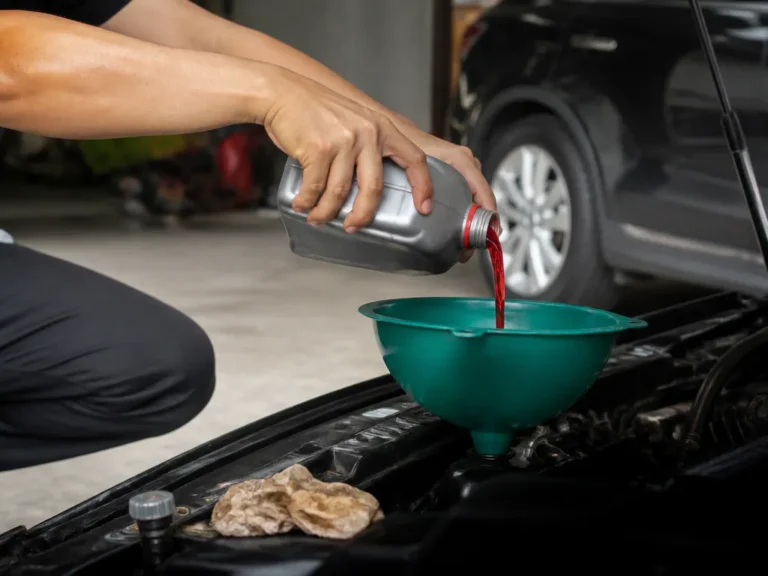
Top off the system only after it has cooled fully, and pour slowly to avoid overflow or trapped air.
- Park safely and shut off the engine. Wait for the temperature gauge to drop.
- Wait until hot parts are hand-warm. The area around the radiator hose and cap should be safe to approach without burning yourself.
- Check the overflow or reservoir tank first. Use the MIN and MAX marks to determine the level.
- Remove the cap only if it is safe. For a pressurized cap, press down slightly while turning slowly, then pause to release any remaining pressure.
- Add coolant slowly and in small amounts. Pour gradually, wait a minute, and check the level again.
- Replace the cap and recheck the system. Secure the cap, then monitor the temperature during a short drive.
If the level is just below MIN, add enough to bring it near MIN with a little margin. If it is far below MIN, add fluid cautiously and arrange an inspection. Topping off may buy time, but it does not repair the cause.
After severe overheating, wait longer before checking the system. Excess heat and steam pockets can remain after shutdown, making a rushed inspection dangerous.
What to Do If the Coolant Level Drops Again
Stop treating the loss as routine maintenance and arrange an inspection.
Look for wet spots under the car, damp hoses or clamps, coolant residue around the radiator and water pump, and seepage around the reservoir seams. Inspect the radiator cap for corrosion or damage as well.
Repeated coolant loss generally falls into two categories: external leaks and internal leaks. External leaks may leave visible fluid or residue. Internal leaks involving a head gasket or cracked components may cause persistent overheating, milky oil, unusual exhaust smoke, or coolant loss without puddles.
If you suspect an internal problem, stop driving if overheating returns. Arrange a cooling system pressure test and a proper diagnosis. Continuing to drive can turn a cooling-system repair into engine damage.
FAQ
Can you add coolant while the car is hot?
You can add coolant to the overflow or expansion tank only when the engine is cool enough to approach safely and you are not opening a pressurized cap. Do not open the radiator cap or a pressurized system while it is hot. The pressure can release scalding coolant and steam.
How long should you wait before adding coolant after driving?
Wait until the temperature gauge drops and the engine bay is cool enough to approach the radiator and hoses without pain. In many cases, that means waiting at least 30-60 minutes after shutdown, and longer if the car overheated. If you smell coolant strongly or see vapor, wait longer and consider road assistance.
What happens if you overfill coolant?
Excess coolant can escape through the overflow, leaving the system low again and creating a mess under the hood. It can also cause inconsistent cooling if the system keeps losing fluid. After topping off, recheck the level when the system is cold and bring it to the correct mark, not above it.
What should you do if coolant keeps disappearing?
Inspect the hoses, clamps, radiator seams, reservoir, and water pump area. If you cannot find an external leak, stop driving if overheating returns and arrange a pressure test to check for internal leaks.
Can you mix different coolant types if you are stuck?
Mixing coolant types is risky because different chemistries may not be compatible. If you are truly stranded, water may be used as a temporary emergency top-off to help you reach a shop. Have the system serviced with the correct coolant mix afterward, and avoid long-term operation with mixed or unknown coolant.

- Top 10 Best Helmet For Xsr 155 2026 - October 5, 2026
- Top 10 Best Helmet For Xc Mtb 2026 - October 5, 2026
- Top 10 Best Helmet For Wakeboarding 2026 - October 5, 2026