How to Test a Car Battery With a Multimeter (Step-by-Step Beginner’s Guide)

A car battery is one of the most important components of your vehicle, yet it is often ignored until something goes wrong. Learning how to test a car battery with a multimeter allows you to identify problems early, avoid unexpected breakdowns, and save money on unnecessary replacements. The good news is that battery testing is simple, safe, and beginner-friendly when done correctly.
This guide explains everything you need to know—from basic concepts to advanced testing using simple language that anyone can follow.
Why Testing a Car Battery With a Multimeter Matters
A multimeter is a handheld device that measures electrical values such as voltage, current, and resistance. When used properly, it can tell you whether your car battery is healthy, weak, or failing.
Can You Test a Car Battery With a Multimeter?
Yes, you absolutely can. A multimeter is one of the most reliable tools for checking car battery voltage and overall condition at home.
When You Should Test Your Car Battery
You should test your battery if you notice:
- Slow engine cranking
- Dashboard battery warning lights
- Dim headlights
- Frequent jump-starts
- After long periods of inactivity
Regular testing helps you catch problems before the battery completely fails.
What You Need Before Testing a Car Battery
Before you begin, gather the right tools and understand basic safety steps.
Tools Required
- Digital multimeter (preferred for beginners)
- Safety gloves (optional but recommended)
- Eye protection if corrosion is present
Safety Precautions
- Turn off the engine before testing
- Keep metal objects away from battery terminals
- Avoid sparks or flames near the battery
Car batteries contain acid and produce gases, so basic caution is important.
Understanding Multimeter Settings for Car Battery Testing
Using the correct multimeter setting is critical when testing a car battery. One of the most common beginner mistakes is selecting the wrong mode or voltage range, which can lead to inaccurate readings or confusion. Fortunately, once you understand the basics, setting up a multimeter is simple and quick.
A car battery operates on direct current (DC), not alternating current (AC), which is why choosing the correct setting is essential for accurate results.
What Setting to Test a Car Battery With a Multimeter
To test a car battery properly, your multimeter must be set to DC voltage.
Correct Multimeter Settings
- Select DC Voltage, usually marked as V⎓ or V–
- If your multimeter is not auto-ranging, set the range to 20 volts DC
Car batteries are 12-volt systems, and selecting a 20V range allows the meter to read normal battery voltage safely and accurately without overloading the display.
Common Setting Mistakes to Avoid
- Using AC voltage instead of DC
- Selecting a resistance (ohms) or current (amps) mode
- Choosing a voltage range that is too low
Any of these errors can result in incorrect readings or no reading at all.
How to Check If the Multimeter Is Working Properly
Before testing your car battery, it’s a good idea to confirm that the multimeter itself is functioning correctly.
Quick Multimeter Check
- Touch the red and black probes together
- The display should show zero, a very small number, or change noticeably
This confirms that the probes, internal fuse, and display are working. If nothing happens, check the multimeter’s battery or probe connections before proceeding.
How to Test a Car Battery With a Multimeter (Engine Off)
Testing the battery with the engine off provides the most accurate picture of its resting voltage and overall condition. This is the most basic and important test for diagnosing battery health.
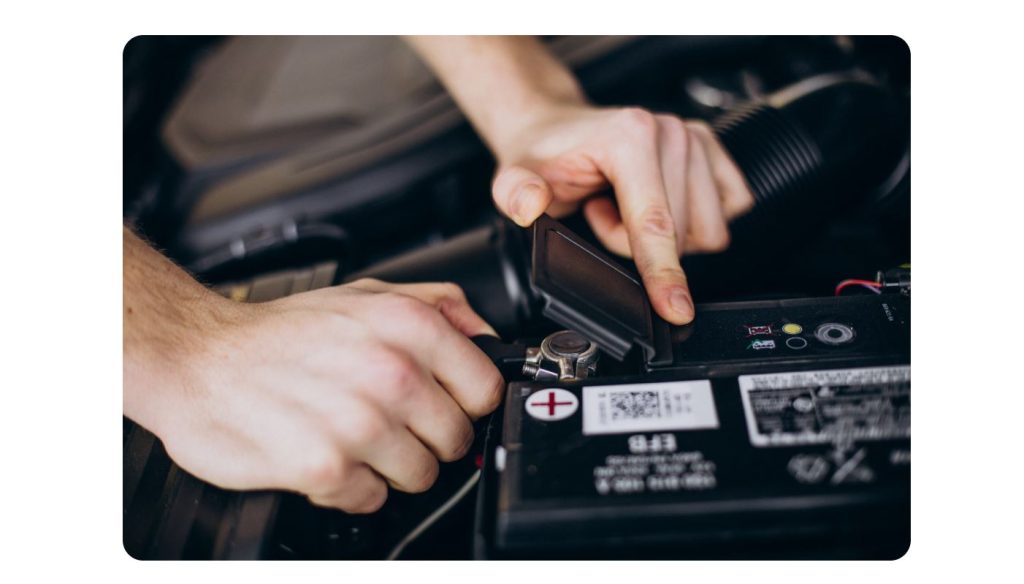
Step-by-Step Instructions (Engine Off)
- Turn off the vehicle completely and remove the key
- Open the hood and locate the battery
- Set the multimeter to DC voltage
- Place the red probe on the positive (+) battery terminal
- Place the black probe on the negative (–) terminal
- Hold the probes steady and read the voltage displayed
For best accuracy, test the battery after it has rested for at least 30 minutes since the last drive.
Understanding Voltage Readings (Engine Off)
Your voltage reading indicates how much charge the battery is holding.
- 12.6V – 12.8V: Fully charged and healthy
- 12.4V – 12.5V: Good condition, no immediate concerns
- 12.2V – 12.3V: Weak battery, charging recommended
- Below 12.0V: Discharged or failing battery
If the voltage remains low even after charging, the battery may be nearing the end of its service life.
How to Test Car Battery Voltage With a Multimeter (Engine Running)
Testing your car battery while the engine is running is an important step in diagnosing the health of the entire charging system. While the battery supplies power when the engine is off, the alternator takes over once the engine is running. This test helps you confirm that the alternator is properly charging the battery and supplying power to the vehicle’s electrical systems.
This check is especially useful if you are experiencing repeated battery drain, warning lights, or dim headlights while driving.
Why Testing Battery Voltage With the Engine Running Is Important
When the engine is running, the alternator should produce enough electrical power to:
- Recharge the battery
- Support headlights, climate control, and other electronics
- Maintain a stable voltage level throughout the vehicle
If the charging voltage is too low, the battery will slowly drain. If it is too high, the battery can overheat and suffer internal damage. This test confirms whether the charging system is working within a safe range.
Step-by-Step Instructions: Testing Battery Voltage (Engine On)
Follow these steps carefully for accurate and safe results:
- Start the engine and let it idle
- Set your multimeter to DC voltage
- Keep the red probe on the positive (+) terminal
- Keep the black probe on the negative (–) terminal
- Observe the voltage reading on the multimeter display
For a more complete test, turn on accessories such as:
- Headlights
- Cabin fan or air conditioning
- Rear defroster
Watch how the voltage responds under electrical load.
Understanding Normal Voltage Readings (Engine Running)
A healthy charging system will maintain voltage within a specific range.
Normal Charging Voltage
- 13.7V – 14.7V: Charging system operating correctly
Low Voltage Readings
- Below 13.5V: Indicates a possible alternator issue, loose belt, poor wiring connection, or failing voltage regulator
Low charging voltage can prevent the battery from fully recharging, eventually leading to starting problems.
High Voltage Readings
- Above 15V: Indicates overcharging, often caused by a faulty voltage regulator
Overcharging can overheat the battery, cause electrolyte loss, and significantly reduce battery lifespan.
What Abnormal Readings May Indicate
- Fluctuating voltage: Loose connections or failing alternator components
- Consistently low voltage: Charging system unable to keep up with electrical demand
- Consistently high voltage: Risk of battery damage and electrical system stress
If abnormal readings persist, the issue should be inspected further to prevent long-term damage.
Testing car battery voltage with the engine running provides valuable insight into your vehicle’s electrical health. Combined with engine-off and cranking tests, it offers a complete picture of battery and charging system performance.
How to Test a Car Battery While Starting the Engine
This test evaluates how the battery performs under load during engine startup, which places the highest demand on the battery.
What to Do
- Connect the multimeter to the battery as usual
- Watch the voltage reading while a helper starts the engine
Normal Voltage Drop During Cranking
- Voltage should not drop below 9.6 volts
- A brief drop is normal, but a sharp or prolonged drop indicates weakness
If voltage drops well below this level, the battery may have internal damage or reduced capacity.
This method serves as a simple load test without requiring specialized tools.
Can You Test Car Battery Amps With a Multimeter?
Many drivers ask whether it’s possible to test car battery amps using a multimeter.
Standard multimeters are not designed to safely measure car battery cranking amps directly.
Why Amps Are Difficult to Measure
Measuring amps requires the meter to be placed in series with the circuit, which can:
- Be unsafe for high-current automotive systems
- Blow the multimeter’s internal fuse
- Produce inaccurate readings
Car batteries can deliver hundreds of amps, far beyond what most multimeters can handle.
Safer Alternatives to Amp Testing
Instead of measuring amps directly, use these safer methods:
- Voltage drop testing during cranking
- Clamp meters designed for automotive current testing
- Parasitic drain testing to identify battery drain when the vehicle is off
For most car owners, voltage testing provides all the information needed to assess battery health.
How to Test a 12V Car Battery With a Multimeter
Most car batteries are 12-volt systems, and testing them follows the same process.
Ideal Voltage Ranges for 12V Batteries
- Fully charged: 12.6V or higher
- Recharge needed: 12.2V – 12.4V
- Bad battery: Below 12.0V
Cold Weather Considerations
In cold temperatures, voltage may appear slightly lower. Always test when the battery has rested for a few hours.
How to Tell If a Car Battery Is Bad Using a Multimeter
A multimeter can reveal patterns that indicate failure.
Signs of a Bad Battery
- Voltage drops quickly after charging
- Voltage looks normal but collapses during starting
- Inconsistent readings over time
Battery vs Alternator Problems
- Low voltage engine off + normal engine on → weak battery
- Normal engine off + low engine on → charging issue
This distinction helps avoid unnecessary replacements.
How to Test Car Battery Health Without a Multimeter
If you don’t have a multimeter, there are still ways to spot issues.
Basic Indicators
- Headlights dim when starting
- Repeated jump-starts needed
- Electrical accessories behave erratically
While helpful, these methods are less accurate than multimeter testing.
How to Test a Car Battery Without Removing It
In most cases, you can test a car battery without removing it from the vehicle. Modern vehicles are designed to allow safe access to battery terminals, making in-place testing both convenient and accurate. Removing the battery is rarely necessary and should only be done when there are access or safety concerns.
Safe In-Vehicle Battery Testing
To test the battery safely while it is installed:
- Access the battery terminals directly by opening the hood or trunk, depending on the vehicle design
- Turn off the engine and all electrical accessories before testing to get accurate readings
- Avoid touching metal tools to both terminals at the same time, as this can cause a short circuit
- Ensure the multimeter probes make firm, clean contact with the battery terminals for reliable voltage readings
Battery removal is only required if:
- The terminals are heavily corroded
- The battery is physically damaged
- The terminals are difficult to reach safely
For most vehicles, in-place testing provides accurate results and saves time.
Digital vs Analog Multimeters for Car Battery Testing
Choosing the right multimeter makes battery testing easier and more reliable, especially for beginners.
Digital Multimeters
Digital multimeters are the most commonly used option today.
Advantages:
- Easy-to-read digital display with clear voltage numbers
- Higher accuracy, especially for small voltage changes
- Auto-ranging features on many models reduce user error
- Ideal for beginners and DIY car owners
Digital multimeters minimize guesswork and are well-suited for routine battery testing.
Analog Multimeters
Analog multimeters use a needle and scale instead of a digital screen.
Limitations:
- Require experience to interpret readings correctly
- Less precise compared to digital models
- Harder to read in low light or tight spaces
- Rarely used for modern automotive diagnostics
Because of these drawbacks, analog multimeters are generally not recommended for car battery testing today.
Bottom line: A digital multimeter is the best and safest choice for most drivers.
Common Mistakes When Testing a Car Battery With a Multimeter
Avoiding common errors improves both accuracy and safety during testing.
Frequent Beginner Mistakes
- Using AC voltage instead of DC voltage, which gives incorrect readings
- Reversing the probe connections, leading to confusing or misleading results
- Testing immediately after driving, when surface charge can inflate voltage readings
- Misinterpreting normal voltage fluctuations as battery failure
For best results, allow the battery to rest for at least 30–60 minutes after driving before testing.
Safety Tips When Testing a Car Battery
Although battery testing is simple, basic safety precautions should always be followed.
Essential Battery Testing Safety Tips
- Never test near open flames or sparks, as batteries release flammable gases
- Wear gloves if corrosion or battery acid is present
- Avoid short-circuiting the terminals with tools or probes
- Stop testing immediately if the battery case is cracked, swollen, or leaking
If anything appears unsafe or unusual, it is best to seek professional assistance rather than continue testing.
FAQ: Testing a Car Battery With a Multimeter
Can I test my car battery with a multimeter at home?
Yes, battery testing with a multimeter is safe and beginner-friendly when done correctly.
What voltage means my car battery is dead?
A reading below 12.0 volts usually indicates a failing or discharged battery.
How accurate is a multimeter for battery testing?
A multimeter provides highly accurate voltage readings and is reliable for diagnosing most battery issues.
Can a multimeter detect a bad alternator?
Yes. Testing voltage with the engine running helps identify charging system problems.
How often should I test my car battery?
Every 3–6 months, or before extreme weather seasons.
Can I test car battery amps safely?
Not with a standard multimeter. Voltage testing is safer and more practical.
Conclusion: Why Every Driver Should Learn to Test a Car Battery
Learning how to test a car battery with a multimeter is a valuable skill for every driver. It helps you understand your vehicle better, prevents unexpected failures, and saves money over time. With just a few minutes and a simple tool, you can check battery health, diagnose charging issues, and make informed maintenance decisions.
For beginners, practice and consistency are key. Over time, battery testing becomes second nature—and a powerful part of responsible car ownership.

- 10 Best Electric Hydraulic Jack For Car Review (October 2026) - October 12, 2026
- 10 Best Electric Jack For Car Review (October 2026) - October 12, 2026
- 10 Best Jack For Electric Vehicle Review (October 2026) - October 12, 2026