Will Wd-40 Penetrate Rust?

WD-40 does penetrate rust, especially when you are trying to free stuck fasteners and loosen surface bonds. It works through capillary action, wicking into threads, seams, and tight crevices. It does not chemically dissolve heavy corrosion, so it works best on light-to-moderate rust rather than deeply scaled or heavily pitted metal.
WD-40 Specialist Penetrant is designed for rusted bolts and other stuck parts. It can loosen the bonds holding corroded hardware together, but it cannot restore metal that has already flaked away or become severely pitted.
Key Takeaways
- WD-40 penetrates rust by wicking into threads and seams to loosen stuck parts.
- Match the product – penetrant products are designed for rusted bolts and fasteners.
- Let it sit so capillary action has time to work.
- Use controlled movement once the part begins to turn. Continuing to force it can strip threads.
- Clean up afterward by wiping away residue, then re-lubricating and protecting the metal.
- Escalate when needed – severe pitting often requires mechanical removal or a dedicated rust dissolver.
How WD-40 Penetrates Rust
WD-40 is most useful when corrosion sits between two surfaces you want to separate, such as a bolt and nut. It can also reach crevices created by corrosion, but solid rust with no opening between surfaces limits how far the liquid can travel.
Corrosion can create small pathways around threads, seams, and joints. WD-40 Specialist Penetrant is intended for this type of job: freeing rusted bolts and other stuck components.
On light surface rust, WD-40 can loosen bonds and displace moisture, which helps prevent the corrosion from spreading as quickly. Thick scale, deep pitting, and parts that have effectively rust-welded together are different problems. WD-40 may help, but it usually will not reverse that damage by itself. Mechanical work or a dedicated rust-removal product may be necessary.
What Determines Whether WD-40 Will Work?
The main factor is whether the spray can reach the interface where the rust is locking the parts together. This is common around threads, pipe fittings, seams, and the joint between a nut and bolt.
- Access affects the result. The spray needs an opening into the joint rather than only a visible layer of rust on the outside.
- Severity matters. Light corrosion is more likely to respond than thick scale, deep pitting, or metal that has fused together.
- Surface condition matters. Removing loose dirt and scale can expose the joint and improve contact with the penetrant.
How to Use WD-40 on Rusted Hardware
Give the penetrant as much contact with the joint as possible, and minimize runoff. Apply WD-40 Specialist Penetrant directly to the rusted interface, then allow it time to work into the threads or seam.
- Clean loose dirt first. Knock off scale and debris with a wire brush so the spray can reach the metal.
- Apply penetrant at the interface. Spray where the nut meets the bolt, where pipe threads meet, or where a seam joins the surrounding metal.
- Let it sit. Give the product time to reach the gap before applying torque.
- Try controlled movement. Use steady force in small increments. If the part loosens, stop forcing it and reapply only if necessary.
- Wipe and re-lubricate. Once the part moves, wipe away excess residue and apply a suitable lubricant to slow re-corrosion.
- Repeat when needed. For stubborn hardware, another application and a longer wait are safer than forcing the part immediately.
If the item is high-value, such as a vintage bolt that would be difficult to replace, test the product on a small area if you are unsure how the finish or surrounding material will respond. For difficult access, WD-40 Penetrant options with flexible straws can direct the spray into cramped spaces.
What WD-40 Helps With – and What It Does Not
The biggest benefit is reducing the force needed to remove stuck hardware. Rusted bolts and other parts can seize, tempting you to apply enough torque to strip threads or snap the hardware. Penetrant that reaches the threads and seams can help separate the parts with less force.
WD-40 Specialist Penetrant is also described as helping prevent rust and corrosion from re-forming while leaving a lubricating layer after it frees the part. That makes it useful between removal attempts and during a repair, although the metal still needs proper cleaning and protection afterward.
WD-40 is practical for outdoor hardware, hinges, fasteners, pipe threads, and seams. Its strength is freeing stuck parts and displacing moisture through tight spaces. It is not the same as a rust dissolver. If the metal is deeply pitted or flaking away, more penetrant will not replace mechanical repair or corrective work.
![WD-40 Specialist Penetrant 2.75 OZ [2-Pack]](https://m.media-amazon.com/images/I/31lQXbZCSnL._SL500_.jpg)
Helpful pick
WD-40 Specialist Penetrant 2.75 OZ [2-Pack]
This specialized formula is designed to quickly penetrate deep into rusted threads and seams to loosen stuck hardware effectively.
Which WD-40 Product Should You Use?
Not every WD-40 product serves the same purpose. For rust penetration in tight spaces, look for WD-40 Specialist Penetrant products designed for stuck hardware.
- WD-40 Specialist Penetrant: Best for freeing rusted bolts and stuck parts when you can reach the joint.
- WD-40 Specialist Penetrant with EZ-Reach flexible straw: Best for rusted hardware in cramped spots, behind trim, or wherever a standard spray pattern misses the joint.
- WD-40 on surface rust: Useful for light rust and moisture displacement, especially before mechanical loosening.
Heavy corrosion may require a combination of approaches, such as brushing away scale, applying penetrant repeatedly, and using a dedicated rust remover designed to attack corrosion directly. WD-40 can remain part of that process, but it should not be treated as the only chemical solution for deeply fused metal.

Helpful pick
WD-40 Pocket Bundle: Original Formula, Multi-Use Product and Specialist Penetrant – 2.75oz Each
This convenient bundle includes the specialized penetrant formula you need to break through stubborn rust and free your stuck hardware.
Techniques That Prevent Damage
Aim the spray at the seam, not merely at the visible rust stain. The rust color may be on the outside of the hardware, while the seizure is occurring inside the nut-to-bolt interface or between mating threads.
Heat can help with some metal assemblies, but it can also damage finishes, plastics, seals, and nearby components. If you are not familiar with the materials or the risks, start with penetrant and controlled force instead.
Helpful pick
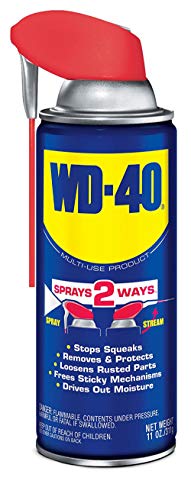
WD-40 Multi-Use Product with Smart Straw Sprays 2 Ways, 11 OZ
The Smart Straw applicator allows you to precisely target the nut-to-bolt interface, ensuring the lubricant reaches deep into seized metal threads.
Where WD-40 Penetrant Works Best
A rusted outdoor gate hinge is a typical example. Spray WD-40 Specialist Penetrant into the hinge seam and around the pin where the hinge knuckle meets the frame. The pin may require less force because the penetrant has reached the crevices and seams where rust bonds form.
A stuck wheel lug nut depends on the severity of the corrosion. Light surface rust may respond because the spray can reach the gap between the nut and stud. If the nut is severely rust-fused and the stud is heavily pitted, WD-40 may still help, but wire brushing and careful removal may be necessary to avoid stripping the hardware.
Hard-to-reach pipe threads are another good use case. A flexible straw can direct the penetrant into the threaded area instead of wasting it on surrounding surfaces. Controlled twisting may break the bond while reducing the chance of rounding the fitting or damaging the mating threads.
FAQ
Will WD-40 penetrate rusted bolts and nuts?
Yes. WD-40 Specialist Penetrant is designed for rusted bolts and stuck parts. Apply it at the bolt-nut interface before testing the hardware.
How long should WD-40 sit to penetrate rust?
There is no single universal time because rust severity and surface contact vary. If the part does not improve, another application and a longer wait may help.
Is WD-40 safe to use on metal, plastic, and rubber?
WD-40 Specialist Penetrant is described as safe to use on most common application surfaces, including most metals, plastics, and rubbers, when used as directed. If you are unsure about a specific finish or material, test a small area before treating the entire surface.
What is the best way to apply WD-40 for rust penetration?
Apply it around the nut-to-bolt seam, into exposed thread areas, or along the joint line. For tight access, a flexible straw can direct the spray into the crevice.
Does WD-40 work if rust has fully seized the parts?
WD-40 can still help, but penetrant alone may not free metal that has deeply fused through corrosion. You may need to remove scale mechanically, apply penetrant more than once, or use a dedicated rust remover.

- Best Bug And Bird Poop Remover For Cars 2026 - September 15, 2026
- Can Vaseline Work As Wd-40? - September 15, 2026
- Best Bug Remover For Bumper 2026 - September 15, 2026