Fixing Car Jerking And Check Engine Light On Issues

Car jerking with the check engine light on usually points to a misfire, weak fuel delivery, or an air-and-fuel control problem. The issue may begin as a rough idle and quickly become loss of power, overheating, or catalytic converter damage.
Codes such as P0300 (random misfire) and P0171/P0172 (fuel trim too lean or rich) can narrow the cause. If the check engine light is flashing, reduce engine load and stop driving soon. A steady light still needs diagnosis, especially when the car jerks under acceleration.
What to Do First
- Flashing light: Treat it as a severe misfire that can damage the catalytic converter. Stop driving soon.
- Jerking under load: Misfires and fuel pressure problems often appear during acceleration rather than at idle.
- Scan before replacing parts: An OBD2 code narrows the diagnosis more effectively than sound or feel alone.
- Check simple causes: A loose fuel cap, cracked intake hose, or obvious vacuum leak can trigger drivability codes.
- Expect a wide repair range: Ignition parts and sensors usually cost less than fuel pump or transmission work.
- Verify the repair: Confirm that codes stay cleared and readiness monitors complete, or verify that live data has returned to normal.
Car Jerking and Check Engine Light On

Car jerking with a check engine light means the engine control module (ECU) has detected an abnormal condition that is affecting engine operation. The uneven sensation usually comes from inconsistent engine torque, most often caused by misfires, incorrect fuel delivery, or inaccurate airflow readings.
Before buying parts, make two observations. Note whether the jerking happens at idle, during acceleration, or at all speeds. Then check whether the light is flashing or steady and watch for hard starting, reduced power, fuel smell, or unusual engine noise.
Symptoms That Point to a Misfire or Fuel Problem
Misfire symptoms often change with engine speed and load. Common signs include a rough idle, hesitation when you press the accelerator, rhythmic shaking – especially at 1, 2, or 3 thousand RPM – and sometimes a strong fuel smell.
Fuel and air control problems can feel similar, but they often produce a different pattern. A car that runs out of breath, stumbles under acceleration, or surges at a steady speed may have weak fuel pressure, a clogged fuel filter, or a failing fuel pump. A lean condition can also make the engine cut out during acceleration because the mixture is too weak to burn consistently.
Use these symptom patterns to narrow the first inspection:
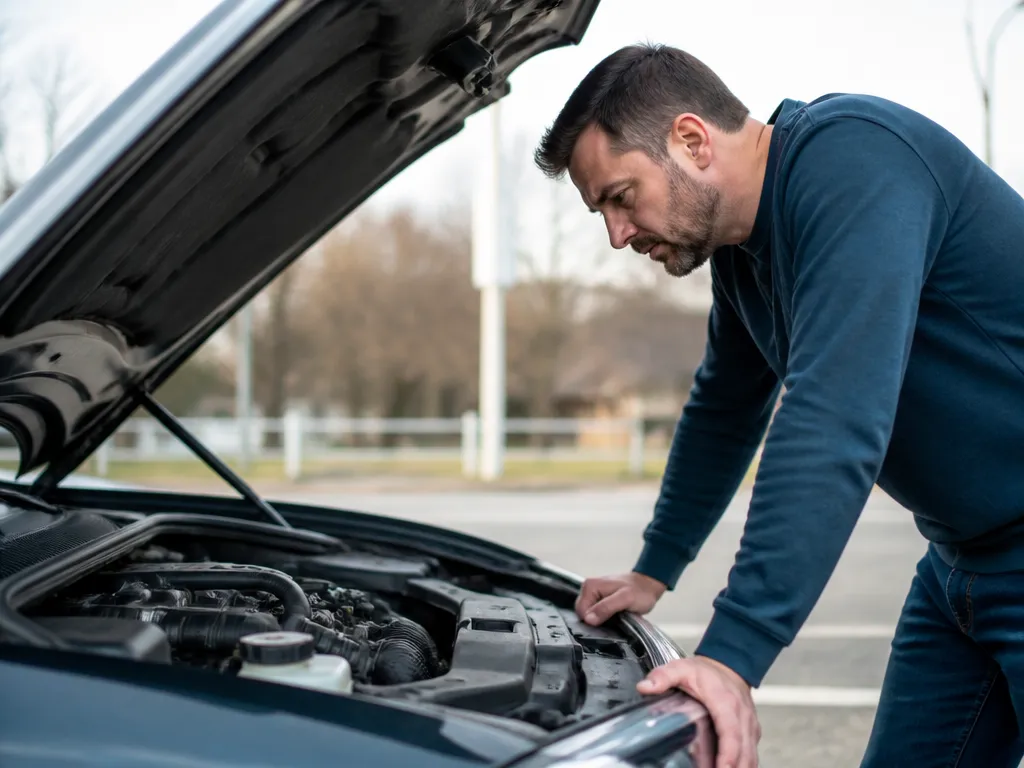
- Jerking at low speed or idle often points to ignition problems or air leaks and frequently produces misfire codes.
- Jerking under acceleration with power loss often points to fuel delivery problems involving the pump, filter, or injectors, or to an airflow or MAF sensor problem.
- Jerking after a recent fuel fill-up may come from an EVAP leak or loose fuel cap that has triggered fuel trim and drivability problems.
Secondary clues can change the diagnosis. Trouble shifting, delayed engagement, or jerking during gear changes may indicate transmission fluid, solenoid, or transmission-control problems. The engine can still be the source, because a misfire may change shift timing and torque requests. Popping in the exhaust, rough running combined with overheating, or rapidly worsening symptoms calls for immediate attention.
How to Read the Fault Codes With an OBD2 Scanner
An OBD2 scanner provides the code pattern and operating conditions that triggered the fault. You do not need to interpret the entire service manual. Start with the codes, freeze-frame information, and a few live data values.
- Find the OBD2 port. In most US cars, it is under the dashboard near the steering column.
- Turn the key to ON. Do not start the engine for a basic code read.
- Read stored and pending codes. Stored codes are confirmed faults; pending codes are failures that have not yet met the confirmation threshold.
- Check freeze-frame data. Many scanners display engine RPM, load, coolant temperature, and vehicle speed when the code set.
- Record the information before clearing codes. Clearing codes erases evidence and may remove a useful pattern.
Common misfire codes include:
- P0300 – random misfire
- P0301-P0312 – cylinder-specific misfires
Common fuel and air control codes include:
- P0171 – fuel trim too lean, bank 1
- P0172 – fuel trim too rich, bank 1
- P0174 – fuel trim too lean, bank 2
Sensor and mixture-control faults can create misfire-like symptoms. Examples include MAF sensor performance codes, O2 sensor heater or slow-response codes, and MAP sensor rationality codes.
Live data is most useful while the problem is occurring. Watch short-term fuel trim (STFT), long-term fuel trim (LTFT), misfire counters for each cylinder, and MAF or MAP readings. A scanner with cylinder-specific misfire counts can show whether the jerking matches active misfires.
The Most Likely Causes
Ignition faults are common because they directly disrupt combustion. Worn spark plugs and failing ignition coils can cause misfires under load. When the scanner shows a cylinder-specific misfire code, swapping coils – if the vehicle supports that test – can sometimes show whether the misfire follows a faulty coil. Worn plug gaps, carbon tracking, and coil failure can all cause the roughness you feel during acceleration.
Fuel delivery is the next major category. A failing fuel pump, clogged fuel filter on some cars, or weak fuel pressure regulator can make the engine run lean during acceleration. That can produce hesitation and misfire codes. A faulty injector can create uneven fueling and repeatedly misfire one cylinder. A whining fuel pump that changes with ignition, or a persistent fuel pressure-related code, makes fuel-system testing more important.
Sensors can command the wrong fuel mixture or ignition timing even when the mechanical components are intact. A dirty or failing MAF sensor may under-report or over-report airflow. A failing oxygen sensor can distort fuel trim, while a drifting MAP sensor can create similar drivability problems. Intake and EVAP leaks can also push fuel trims away from their target.
Transmission problems usually require a separate line of investigation. In an automatic car, harsh or delayed shifts can feel like engine jerking. If the symptom occurs mainly during gear changes rather than when the engine stumbles, inspect transmission fluid condition, solenoids, and adaptation issues. Transmission-related codes are a major lead.
A practical starting ranking is:
- Ignition-related misfire involving plugs or coils when codes identify specific cylinders or misfire counts rise under load.
- Fuel delivery weakness involving the pump, filter, regulator, or injectors when jerking follows acceleration and lean or rich trim codes appear.
- Air metering or oxygen, MAF, or MAP sensor problems when fuel trims swing and misfire codes are random.
- Transmission control or mechanical problems when jerking closely follows gear changes and transmission codes are present.
Is It Safe to Drive With the Check Engine Light On?
A flashing check engine light requires urgent action. It usually means the ECU is detecting active misfires severe enough to damage the catalytic converter. Reduce driving, avoid hard acceleration, and arrange a diagnosis as soon as possible.
A steady light is less urgent, but it is not safe to ignore. If the car has stable power and is not overheating, you can often drive gently to a repair shop. Avoid long trips, heavy loads, and aggressive acceleration so a manageable fault does not become a larger repair.
Stop driving and arrange a tow if you notice:
- Loss of power, stalling, or jerking that is getting worse
- A strong fuel smell, smoke, or extremely rough running
- Engine overheating or a temperature gauge that spikes
- Violent jerking or a flashing check engine light
Fault codes and misfire counts provide the clearest guide. If misfire counts climb quickly while you drive, the fault is active rather than merely stored in the vehicle’s history.
If you must move the car a short distance, use smooth throttle input, avoid hills, keep RPM moderate, and do not repeatedly restart and reload the system.
Repairs Ranked by Cost and Complexity
Repair costs range from a $20 ignition plug to major fuel-system or transmission work. The codes and symptom pattern should determine where you start rather than the price of the first part you can replace.
These typical US ranges provide a rough reference. Actual costs vary by vehicle, region, and labor rate.
| Suspected Repair (based on codes/symptoms) | Key Codes / Clues | Best For | Typical Cost Range (US) |
|---|---|---|---|
| Spark plugs | Misfire, rough idle, older plugs | Restoring ignition reliability | $150 – $400 |
| Ignition coil(s) | Cylinder-specific misfire, one coil causing multiple events | Fixing misfires under load | $200 – $900 |
| MAF/MAP sensor or intake leak repair | Fuel trim codes (P0171/P0172), random misfires | Fixing incorrect air/fuel calculation | $150 – $600 |
| Oxygen sensor | O2 codes, fuel trim instability | Stabilizing mixture after engine warming | $200 – $900 |
| Fuel filter/pump (if applicable) | Lean codes under acceleration, low pressure clues | Restoring fuel delivery | $400 – $1,500 |
| Fuel injector(s) | Cylinder-specific misfire tied to one injector | Correcting uneven fueling | $300 – $1,800 |
| Transmission diagnosis/solenoids | Jerking during shifts, transmission codes | Fixing torque control issues | $500 – $3,500+ |
| Catalytic converter (worst case) | Evidence of severe misfire over time | When misfire damage already happened | $1,000 – $3,500+ |
Cylinder-specific misfire codes justify checking ignition first, followed by fuel delivery for that cylinder. Random misfires combined with lean or rich trims point toward sensors, vacuum or intake leaks, and fuel pressure.
Avoid replacing parts without connecting them to the evidence. For fuel trim problems, replacing ignition coils rarely fixes the root cause. Inspect connectors, vacuum hoses, intake leaks, the fuel cap, and obvious EVAP problems before moving to diagnostic tests. A cheap-first approach works when it follows the code pattern.
How to Verify the Repair and Readiness Monitors
After a repair, confirm both that the jerking is gone and that the ECU accepts the repair. A car that feels better but still has stored or pending codes may re-enter limp mode or still have an active fault.
- Recreate the original condition. Use gentle acceleration, a steady highway load, and city stop-and-go driving as appropriate.
- Scan for codes again. Check that no new stored or pending codes appear.
- Review live data. If your scanner supports it, confirm that fuel trims stabilize and misfire counters do not spike.
If the light has cleared but pending codes remain, the ECU may not have completed its evaluation cycle, or the underlying problem may still be present. A light that is currently off does not prove the repair worked.
Check readiness monitors for the misfire, fuel system, EVAP, O2 sensors, and catalytic efficiency systems. After a reset, the car may need a short drive pattern before those monitors complete. Follow the requirements for your state inspection if applicable.
Confirm the specific repair with the related data. After replacing an ignition coil, the affected cylinder’s misfire count should stop rising during acceleration. After replacing a sensor, fuel trims should stop drifting and engine response should improve.
A useful final check is a short loop with one acceleration event and one steady-cruise segment, followed by another scan before the problem fades from memory.
FAQ
How bad is it if my check engine light is steady and the car jerks?
A steady check engine light can still indicate an active misfire or a fuel-and-air control problem. If the jerking is mild and power remains normal, drive gently to a repair shop soon. Avoid hard acceleration and long trips. If the light begins flashing, stop driving as soon as practical.
What is the cheapest thing to check first for car jerking and an engine light?
Make sure the gas cap is fully seated, inspect intake hoses for cracks or loose clamps, and look for disconnected vacuum lines. A simple EVAP or intake leak can create fuel trim problems that feel like a misfire.
Can I drive to a mechanic if the car is jerking?
You can often drive to a shop if the light is steady and the car is not overheating, stalling, or losing substantial power. Keep RPM moderate, avoid hills, and do not floor the throttle. Tow the car if it jerks violently, misfire counts are high, or the check engine light is flashing.
How do I know if it is a misfire or a transmission problem?
Misfires usually follow engine RPM and produce rising misfire counters, often on specific cylinders. Transmission jerking usually coincides with gear changes and may change when the transmission shifts or the torque converter locks or unlocks. Transmission-related fault codes or torque-control errors support a transmission diagnosis, although engine misfires can also change shifting behavior.
What mistake do people make with jerking and a check engine light?
Replacing parts before identifying the cause is the most expensive mistake. Clearing codes before recording them is another, because it removes freeze-frame data and makes the operating pattern harder to identify. Inspect simple causes and then test or repair based on the code pattern.

- Top 10 Best Helmet For Xtreme 125r 2026 - October 5, 2026
- Top 10 Best Helmet For Xpulse 200 2026 - October 5, 2026
- Top 10 Best Helmet For Xsr 155 2026 - October 5, 2026