Car Won’t Start Wait 30 Minutes And It Starts: Car Won’t Start

A car that won’t crank, then starts after a 30-minute wait usually has a temperature-sensitive fault. The likely causes are a weak battery connection, a heat-soaked starter or solenoid, an ignition component that fails when hot, or a fuel-delivery problem. Start with the battery cables and grounds, then test the starter before moving to fuel and spark.
Wait 15-30 minutes, try to start the car once, and avoid repeated cranking. If the problem keeps returning, arrange an inspection rather than relying on the recovery window.
Key Takeaways
- Wait safely. Wait 15-30 minutes, then try starting the car once.
- Check wiring first. Loose or corroded battery cables and grounds can cause heat-related voltage-drop failures.
- Rule out the battery. Load-test it or try a known-good battery.
- Watch the starter’s behavior. A solenoid or starter motor that fails when hot needs on-car electrical testing.
- Check fuel and spark. After cooling, verify fuel pressure and spark with the correct tools.
- Stop when conditions become unsafe. If you smell fuel or see smoke, stop and tow the vehicle.
Why a Car Starts After Waiting 30 Minutes

A car that starts after a 30-minute wait has an intermittent fault with a recovery window. During that time, under-hood temperatures fall, a heat-sensitive component may begin working again, and a marginal electrical connection may provide enough current for one successful start.
The most likely problem areas are:
- Starting circuit: battery, cables, grounds, starter, or solenoid
- Fuel system: fuel pump, pressure regulator, or another pressure-control component
- Ignition system: ignition module, coil, crank sensor, or cam sensor
Do not repeatedly crank the engine while it is failing. Repeated attempts can overheat the starter, drain the battery, worsen voltage-drop problems, and flood the engine. Wait, try once, and then perform only the checks you can do safely.
What Changes During the 30-Minute Wait
A 30-minute pause can lower under-hood temperatures enough for a heat-sensitive starter, solenoid, ignition module, coil, or crank sensor to work again. A high-resistance cable or ground connection may also behave differently after the battery and wiring cool.
The failed attempts themselves can change the symptoms. Each crank puts a heavy load on the battery and connections. A weak connection may heat up and create more resistance, while the battery voltage falls. After the car sits, the battery may recover slightly and the connection may cool enough to pass current again.
Use the waiting period to record the pattern. Note the outside temperature, how long the car sat before the failure, whether you drove immediately beforehand, and whether the failure occurs only after a hot shutdown. A reliable return to normal after 30 minutes points more strongly to heat soak than to a random failure.
Test Hot Starts and Cold Starts
Compare the car’s behavior when it is hot with how it starts when cold. This often narrows the problem faster than replacing parts.
For a hot-start test, drive until the engine reaches normal operating temperature. Shut it off, then try restarting after 5 minutes, 15 minutes, and 30 minutes. If it fails at 5 and 15 minutes but starts at 30 minutes, heat soak is likely affecting the starting circuit, ignition system, or a sensor.
For a cold-start test, let the car sit until it is cold – overnight is best – and try starting it. If it starts reliably when cold but fails after driving, suspect a component that breaks down as its temperature rises. Common examples include ignition modules, coils, crank sensors, starter solenoids, and fuel pressure regulators.
Causes That Improve After Cooling
Heat can expose weaknesses in both mechanical and electrical components. A starter motor may drag internally, a solenoid may fail to pull in, or a high-resistance connection may heat up under load. Cooling can temporarily restore normal operation.
Ignition components can fail in the same way. A coil or ignition module may break down when hot and work again after cooling. A crank or cam sensor may also stop producing a reliable signal at operating temperature, preventing the engine from starting until the sensor cools.
Fuel problems can produce the same pattern even when the battery and starter work normally. A weak pump or faulty regulator may deliver inadequate pressure after a heat soak, then return to normal after the fuel system sits. Hard starting immediately after shutting off a hot engine, followed by normal starting after waiting, supports this possibility.
The word “battery” should not end the diagnosis. A weak battery is an easy suspect, but the same symptom can come from a starter, ignition component, sensor, or fuel system. Check the simple electrical causes first, then test the system that matches the observed symptoms.
Check the Battery, Cables, and Ground Connections
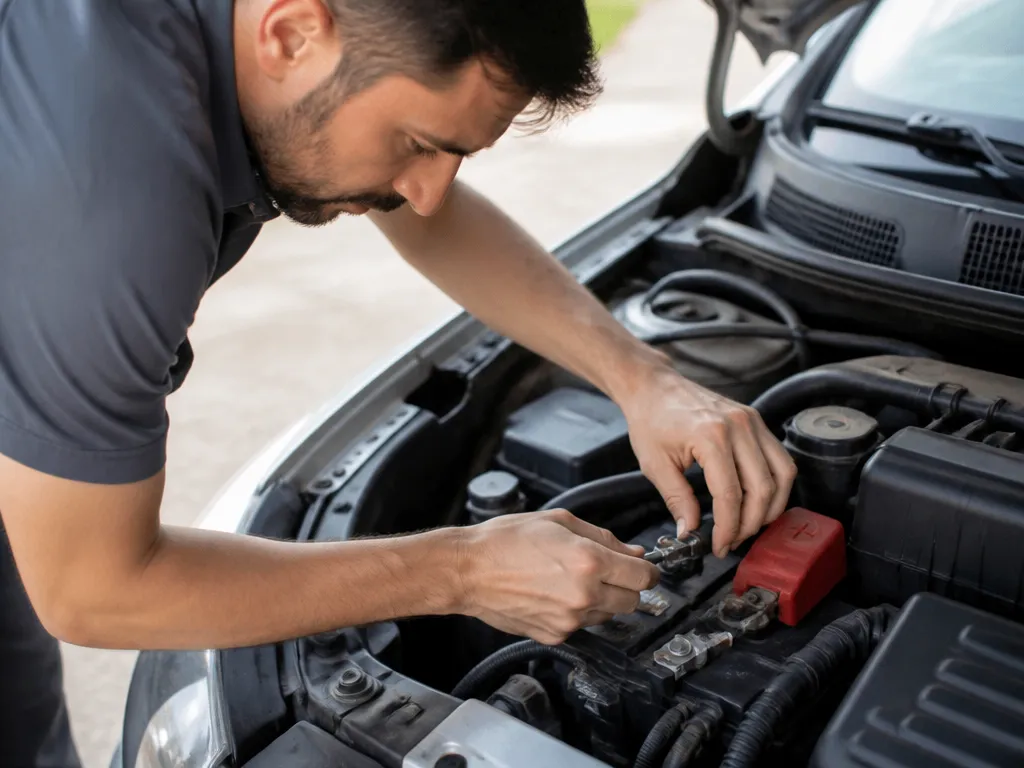
Start with the battery and cables. They are quick to inspect, inexpensive to address, and responsible for many intermittent no-start problems. A weak battery may recover enough after resting to start the car, but a poor connection can create the same pattern even when the battery itself is usable.
With the engine off, inspect the battery terminals and cable ends. Look for looseness, physical movement, arcing marks, or heavy white or green corrosion. Corrosion can insulate the connection and create substantial resistance when the starter draws high current.
Check the negative cable where it attaches to the body or engine. Inspect the engine ground strap for looseness, corrosion, or visible cracking. Follow the cables and look for abrasion, heat damage, or routing near sharp edges and hot components.
If you have the necessary tools, use this order:
- Check battery condition with a multimeter for resting voltage, then perform a voltage-drop test while cranking.
- Perform a wiggle test with the engine off. Move the cable ends by hand, then turn the key to the “on” position and watch for flickering accessories.
- Inspect the grounds at the engine block and body connection points for corrosion and looseness.
Clean and tighten the connections even if the car cranks during the test. A weak ground can work intermittently depending on temperature, vibration, and the current path.
Test the Starter and Solenoid When Hot
If the battery, cables, and grounds check out, inspect the starter system during the next hot failure. Starter motors and solenoids can fail intermittently because their internal contacts and windings respond differently to heat.
Observe what happens when you make one starting attempt:
- Heavy dash dimming with clicking often indicates a battery, cable, ground, or starter-current problem.
- A single click with no crank can point to the solenoid, starter motor, or a high-resistance connection.
- Silence with no accessory drop may indicate a relay, ignition switch, immobilizer, or control-side problem.
- Normal cranking with no start shifts attention away from the starter and toward fuel, spark, or engine-control signals.
A test light or multimeter can show whether the starter receives battery voltage and whether the starter trigger wire receives power when you turn the key or press the start button. If the starter receives the required voltage but does not crank, the starter or solenoid is suspect. If the trigger voltage is missing when the engine is hot, investigate the relay, wiring, ignition switch, or control circuit.
If the starter works after 30 minutes but fails immediately after a hot shutdown, the pattern supports a heat-soaked electrical component. An on-car starter-current or voltage-drop test is more useful than relying only on a bench test, which can miss an intermittent heat failure.
Stop and tow the car if you smell burning electronics, see smoke near the starter or solenoid, or repeatedly see arcing at the battery connections.
Check Fuel Pressure and Ignition Spark
Move to fuel and ignition only after the starter circuit is working or very likely to be working. The engine must receive both adequate fuel and a properly timed spark after it cranks.
Use a fuel-pressure gauge designed for the vehicle’s fuel system. Low fuel pressure during the failure can explain a crank-but-no-start condition even when spark is present. Do not rely on hearsay or quick-tug checks to judge fuel pressure.
Use a proper spark tester to check ignition. Spark during the failure makes a fuel problem more likely. No spark points toward the crank sensor, ignition-control signal, coil, or ignition module. A heat-soaked sensor or module can create a no-spark condition that disappears after cooling.
Test spark and fuel once during the failure rather than repeatedly cranking the engine. Keep open flames away from the engine bay, do not bypass fuses, and do not spray unknown cleaners into the intake to force a start. Repeated attempts can flood the engine, overheat the starter, and create a fire risk if fuel is present.
If you do not have fuel-pressure or spark-testing equipment, have a qualified shop perform the checks. Scan-tool data, fuel-pressure testing, and ignition diagnostics can separate a fuel-delivery problem from an ignition-control or sensor fault.
When to Stop Trying and Tow the Car
Stop troubleshooting and arrange a tow if you smell raw fuel, see smoke, notice burning electrical insulation, or observe repeated arcing at the battery terminals. Do not keep cranking if the starter is grinding, dragging, or becoming unusually hot.
A car that repeatedly fails after hot shutdowns can eventually stop starting altogether. It may also leave you stranded in a location where repeated attempts are unsafe. If the battery connections are clean and tight but the pattern continues, professional testing is safer and more efficient than replacing parts based on guesses.
FAQ
Why does my car start after I wait 30 minutes?
A 30-minute recovery usually means that a heat-sensitive component or marginal electrical connection cools enough to work again. Common causes include a failing starter solenoid, an ignition module or coil that breaks down when hot, a crank sensor that intermittently fails at higher temperatures, or a corroded battery or ground connection that causes voltage drop under starter load.
Can a bad battery cause this problem?
Yes. A weak battery can lose too much voltage during cranking, then recover slightly after resting so the car starts later. Corroded terminals and weak grounds can create the same behavior even when the battery is partly serviceable. A load test is more reliable than resting voltage alone.
Should I keep trying to start the car while it fails?
No. Repeated cranking can overheat the starter, worsen voltage-drop problems, drain the battery, and turn an intermittent fault into a permanent one. If you smell fuel, see smoke, or notice arcing at the terminals, stop immediately.
What is the quickest test to do at home?
A multimeter can help identify voltage-drop problems while the engine is cranking. Otherwise, a battery load test can reveal whether the battery is contributing to the fault.
Could the starter motor or solenoid be failing?
Yes. A starter motor or solenoid can fail when hot because of internal contact or winding problems, then work again after cooling. Clicking, heavy dash dimming, or a quiet no-crank response during the hot failure can support that diagnosis. Test the starter’s wiring and trigger voltage before replacing it.

- 10 Best Jack For Ford Transit Review (October 2026) - October 12, 2026
- 10 Best Jack For Ford Raptor Review (October 2026) - October 12, 2026
- 10 Best Jack For Ford Ranger Review (October 2026) - October 12, 2026