Can You Jump A Mower Battery With A Car?

You can sometimes jump-start a lawn mower battery with a car, but only when the mower uses a 12V lead-acid battery and you follow the polarity and timing rules. Many riding mowers use this battery type, while some push mowers and newer equipment use different systems. Do not jump non-12V, damaged, or lithium batteries with a car.
A car jump provides a short power assist to get the mower started. It does not replace a proper battery charge. Confirm the mower battery type, keep the car off while connecting the cables, use the correct terminal order, and limit each starting attempt to 10-15 seconds.
The Safe Answer in Six Points
- It may work. A car can jump a 12V lead-acid mower battery.
- Battery type matters. Lithium batteries and some sealed systems require a dedicated charger.
- Match voltage only. A car uses a 12V electrical system, so do not connect it to a 6V, 24V, or other non-12V mower battery.
- Use the right cable order. Connect red to positive, then black to a solid ground point on the mower.
- Keep attempts brief. Stop after 10-15 seconds if the mower does not start.
- Skip unsafe batteries. Cracks, leaks, swelling, melted plastic, or heavy corrosion call for a charger, replacement, or professional help.
Can You Jump a Mower Battery With a Car?
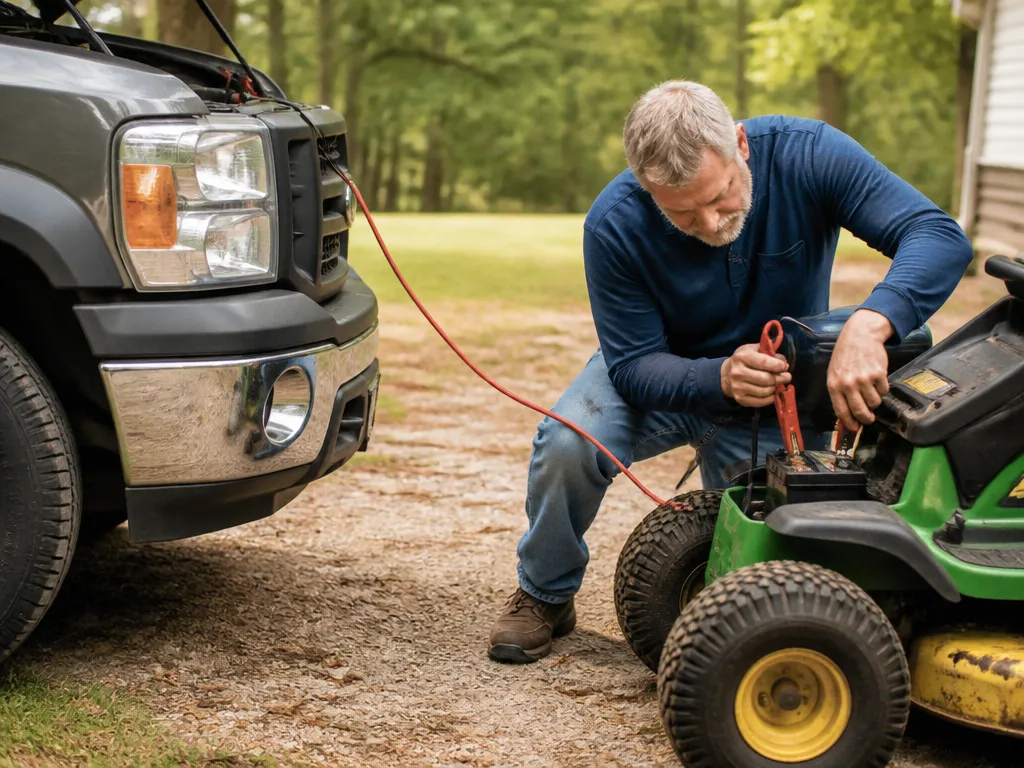
Yes, in many cases. The battery must be a 12V lead-acid model, and the cables must connect with the correct polarity. In the United States, most older riding mowers and many push mowers use 12V lead-acid batteries, which are generally compatible with a standard car jump-start procedure.
The goal is to give the mower’s starter motor and engine controls enough power to operate. If the mower battery is badly sulfated, worn out, or internally damaged, a jump may not work, and repeated attempts can place extra stress on the starter, cables, and electrical system.
Check the battery label before connecting anything. Look for 12V and terms such as lead-acid, flooded, AGM, or SLA. If the label is missing, the battery is visibly damaged, or the pack appears to be lithium, use the correct charger or get help instead.
When a Car Jump Start Works on a Lawn Mower
A car jump usually helps when a healthy 12V lead-acid mower battery has simply lost charge. Common causes include leaving the mower unused, forgetting to recharge it after use, or storing it over winter without a battery maintainer.
The mower should show stronger cranking once the cables are connected correctly. A starter that turns faster after the first few seconds suggests the jump is helping. Repeated clicks, severely dimming lights, or no change at all points to a battery that is too far gone, a poor connection, or a separate fault in the starter, solenoid, safety switch, or wiring.
One short attempt is reasonable. Several long attempts are not. If the mower needs repeated cranking to show any response, the problem is probably more than a low battery.
What Battery Type Does Your Mower Use?
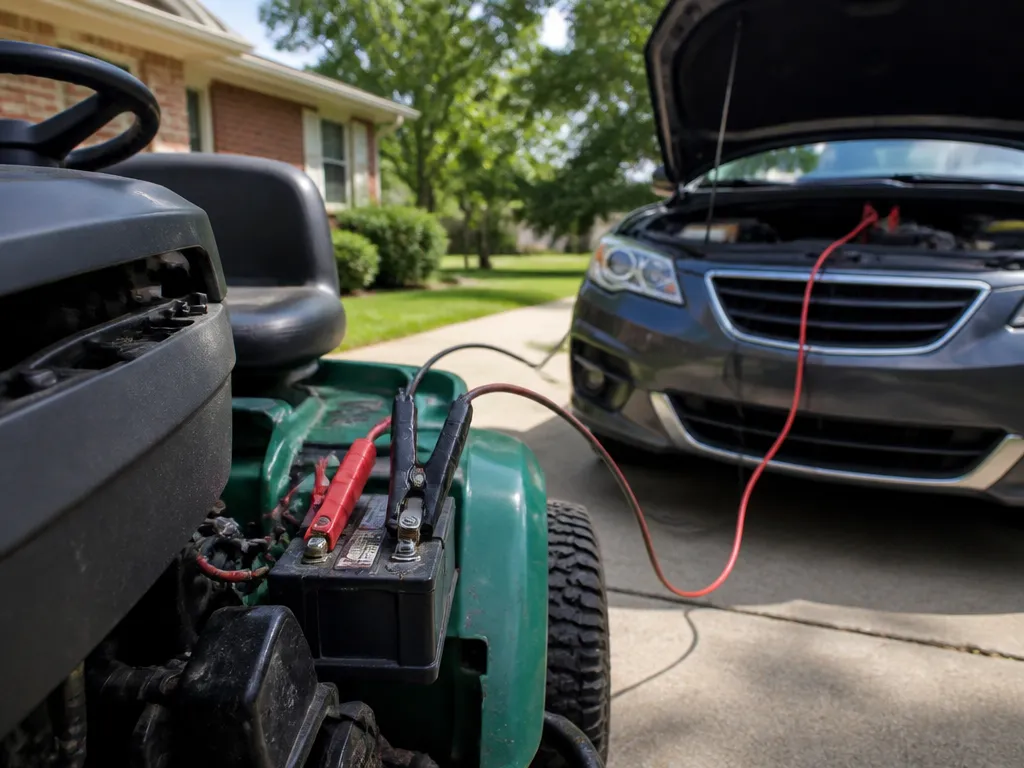
Most mower batteries fall into one of two broad categories: 12V lead-acid or something else. Lead-acid batteries commonly appear as flooded models, which may have vents and accessible electrolyte, or AGM models, which are sealed and use absorbent glass mat technology. Both are lead-acid batteries and are typically compatible with a car jump when they are in good condition.
Lithium mower batteries are different. They often rely on a battery-management system (BMS) and a charger with a specific charging profile. Connecting one directly to a car can be unreliable or unsafe, even if the label shows a similar voltage. Some other sealed battery systems also have manufacturer-specific charging requirements.
The battery label provides the quickest answer. Look for 12V and terms such as lead-acid, AGM, or SLA. If you cannot identify the chemistry, treat the battery as unknown and use the correct charger rather than guessing.
Car Battery Requirements and Safe Voltage Matching
A car battery is a 12V lead-acid system with much greater cold-cranking capability than most mower batteries. The voltage match is the first requirement. If the mower battery says 6V, 24V, or anything other than 12V, do not attempt a car jump. The mismatched voltage can damage electronics and create an unsafe current path.
Use jumper cables in good condition and make sure each clamp grips clean metal. Loose or partial contact can produce heat, sparks, and arcing, damaging battery posts, terminal covers, or wiring.
Polarity matters just as much. Keep the car off while connecting the cables. Connect red to positive first, then connect black to a solid metal ground point on the mower chassis. Use the mower’s negative terminal only if the owner’s manual specifies it. Grounding away from the battery reduces the chance of creating a spark beside a battery that is venting.
How to Jump a Mower Battery Step by
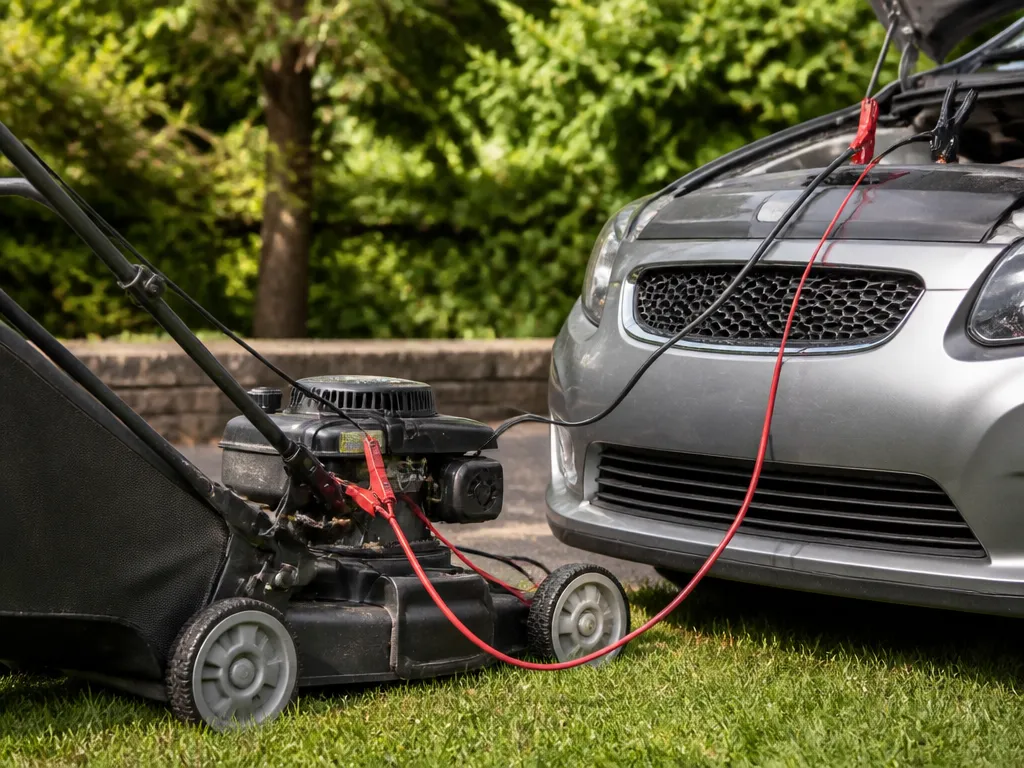
Follow the same sequence every time. It limits sparks and gives the mower a reliable ground connection.
- Identify the mower battery. Confirm that the label says 12V and identifies the battery as lead-acid, flooded, or AGM.
- Park and power down the car. Park on flat ground, set the parking brake, and turn the car off before connecting the cables.
- Inspect the battery. Stop if it is cracked, leaking, swollen, or heavily corroded.
- Connect red to mower positive. Clamp the red positive cable to the mower battery’s positive terminal.
- Connect red to car positive. Attach the other red clamp to the car battery’s positive terminal.
- Connect black to car negative. Attach one black negative clamp to the car battery’s negative terminal.
- Connect black to mower ground. Attach the other black clamp to a solid metal point on the mower chassis, away from the battery if possible.
- Start the car. Let it run for 1-3 minutes so the mower battery receives a voltage assist.
- Start the mower. Turn the key or use the pull-start mechanism for no more than 10-15 seconds on the first attempt.
- Disconnect in reverse order. Once the mower runs, remove the clamps in reverse sequence while keeping hands and tools away from the terminals.
A failed jump does not always mean the battery is the problem. A starter solenoid, seat switch, brake switch, ignition circuit, or loose ground can also prevent cranking. If the mower does not respond after a correctly connected jump, inspect the starting circuit instead of repeatedly trying the cables.
How Long to Try Before Stopping
A jump-start attempt should last 10-15 seconds because the goal is to start the mower, not recharge a dead battery. Stop if the engine does not start within that window.
Wait 30-60 seconds with the car running before reassessing. If the battery type and cable connections are correct, make one more short attempt. After 2-3 total attempts, treat the problem as a battery, starter, or wiring failure rather than continuing to crank.
Long, repeated attempts can overheat the mower’s starter, create voltage drops, and heat the jumper cables without meaningfully charging the battery. Use a proper charger, replace the battery, or diagnose the starting system.
When Not to Jump the Mower Battery
Do not jump the battery if you cannot confirm that it is a suitable 12V lead-acid model. Also stop if you see leaking fluid, a swollen or cracked case, heavy corrosion, melted plastic, or damaged terminals. These signs can indicate internal failure, venting, or severe damage.
A battery that is not 12V is also an automatic no-go. Connecting a car to a 6V, 24V, or other non-12V system can damage mower electronics and create a high-current hazard. Avoid jumping lithium batteries and sealed systems that require a manufacturer-specific charger.
A strong rotten-egg smell near a lead-acid battery may indicate venting or failure. Excessive sparking at the clamps, melted plastic around the posts, or a battery that becomes unusually hot are reasons to disconnect immediately and get help.
FAQ
Can you jump a riding mower battery with a car?
Yes, if the mower battery is 12V lead-acid and the cables connect with the correct polarity. Turn the car off while connecting, start the car, wait 1-3 minutes, and then try the mower for 10-15 seconds.
Will jumping a mower battery charge it?
No. A car jump provides a short voltage assist to start the mower; it does not charge the battery like a dedicated charger. After the mower starts, let it run or connect the battery to the correct charger. A fully discharged or old battery may need charging or replacement even if the mower starts during the jump.
How long should I keep the car running before starting the mower?
Run the car for about 1-3 minutes before attempting to start the mower. Then crank the mower for no more than 10-15 seconds. If it fails, wait 30-60 seconds before a second attempt and stop after 2-3 total attempts.
Is it safe to connect the black cable to the mower’s negative terminal?
It depends on the mower. The safer common method is to connect the black cable to a solid metal ground point on the mower chassis, away from the battery. Connecting directly to the mower’s negative terminal may work on some setups, but chassis grounding reduces the chance of a spark near the battery.
What is the most common mistake when jump-starting a mower battery?
Reversing the polarity or making a poor connection causes many failed or dangerous attempts. Connect red to positive and black to negative or ground, and keep the car off while attaching the clamps. Loose clamps can create heat and arcing that damage battery posts and wiring.

- Top 10 Best Helmet For Xpulse 200 2026 - October 5, 2026
- Top 10 Best Helmet For Xsr 155 2026 - October 5, 2026
- Top 10 Best Helmet For Xc Mtb 2026 - October 5, 2026