Car Won’t Start Check Engine Light And Battery Light On: Car

A car that won’t start with the check engine light and battery light on usually has low system voltage, a charging-system fault, or a connection problem that keeps the starter from getting enough power. Check the battery first, then watch for voltage drop while cranking.
Measure battery voltage at the terminals. A fully charged 12-volt lead-acid battery should read about 12.6 V with the engine off. If voltage falls below about 10 V during cranking, suspect a weak battery, loose terminals, or a poor ground. If voltage stays up but the starter does not engage, move on to the starter circuit and engine grounds.
Key Takeaways
- Start with the battery. If the battery light is on and the car will not crank, check battery voltage and terminal tightness first.
- Watch voltage while cranking. A drop under ~10 V points to a weak battery or high-resistance connection.
- Test charging second. With the engine running, alternator output should usually be around 13.5-14.7 V.
- Listen for starter symptoms. Hard-dimming dash lights or repeated clicking often indicate insufficient voltage reaching the starter.
- Inspect the grounds. Corroded or loose ground straps can mimic a bad alternator or battery.
- Stop when there is danger. Smoke, blown fuses, a damaged battery, or strong sulfur-like fumes require professional help.
Car Won’t Start With Check Engine and Battery Lights On

When both lights are on and the engine will not crank, start with the electrical system. The likely problems are insufficient battery power, a failed charging system, or a high-resistance connection.
The check engine light may be a consequence of unstable voltage. A vehicle computer can store low-voltage, charging-system, or communication codes when power fluctuates. The battery light points more directly to the charging system or system voltage.
Turn the key to ON, check whether the dash lights look normal, and make one short start attempt. Avoid repeated cranking. Long or repeated attempts can overheat starter components and drain a weak battery even further.
What the Battery Light Means Before the Engine Starts
The battery light is part of the charging-system warning circuit. It commonly comes on with the key in the ON position to prove that the circuit works, then goes out after the alternator begins charging.
If it remains on while the engine is running, the alternator may not be producing enough voltage. The problem could also be a broken serpentine belt, a voltage-regulator fault, a battery connection, or damaged wiring.
Check inexpensive failures before condemning the alternator:
- Loose battery terminals
- Green or white corrosion on the terminals
- A weak or old battery
- Loose or corroded ground connections
- A loose, damaged, or missing serpentine belt
A weak battery can power the dashboard but collapse under starter load. That voltage drop can trigger charging-related warnings and make the problem look like an alternator failure.
What the Check Engine Light Adds to the Diagnosis
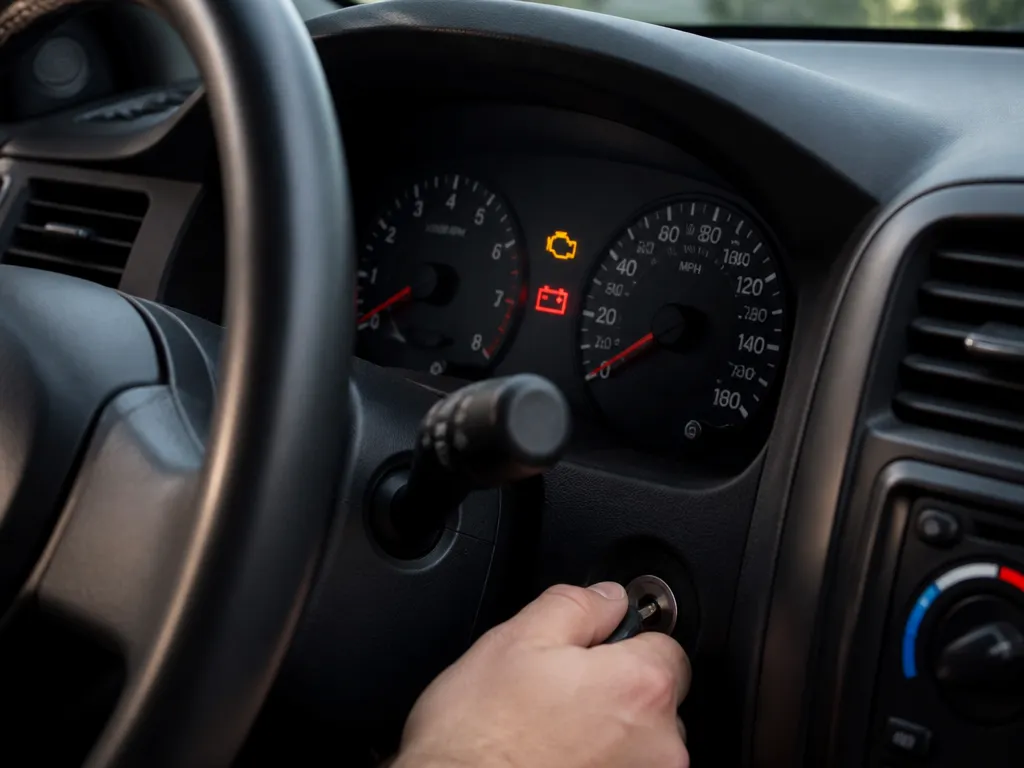
The check engine light covers a wide range of faults. When it appears with the battery light and a no-start, stored codes may relate to low voltage, charging performance, voltage regulation, or communication problems caused by unstable power.
Scan the vehicle with an OBD-II scanner if you have one. Codes that mention charging voltage, generator performance, low system voltage, or similar electrical faults support starting with the battery, alternator output, and wiring.
A code does not automatically identify the failed part. Fix the power problem first, clear the codes if appropriate, and then see which codes return.
Most Likely Causes of a No-Crank
A no-crank condition with the battery and check engine lights on usually follows one of these paths:
- Weak or failed battery: Voltage collapses under starter load.
- Loose or corroded battery terminals: High resistance prevents current from reaching the starter.
- Bad alternator or voltage regulator: The battery does not recover after starting, and the battery light remains on while running.
- Serpentine belt failure: The alternator cannot spin if the belt is broken, loose, or slipping.
- Bad engine ground strap: Corrosion, looseness, or broken wiring restricts the starter’s return path.
- Starter circuit fault: A failed solenoid, relay, ignition-switch signal, or starter becomes more likely after the battery and connections pass inspection.
Test Battery Voltage and Voltage Drop
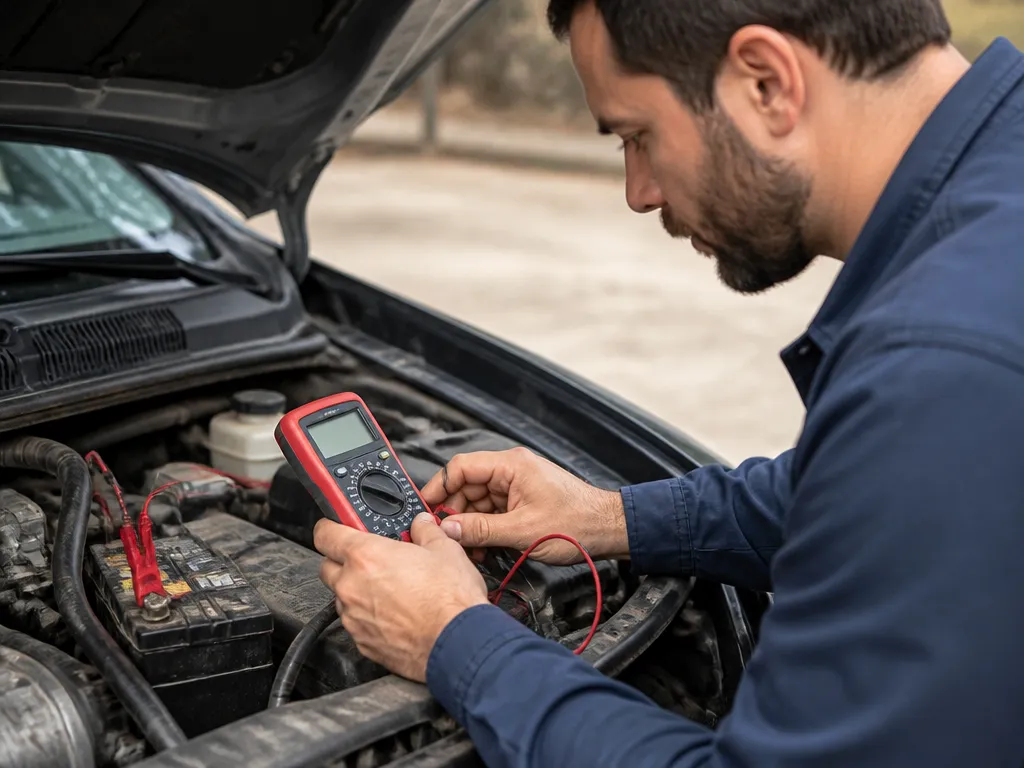
Set a multimeter to DC voltage and measure directly across the battery terminals.
With the engine off, a fully charged 12-volt lead-acid battery typically reads around 12.6 V. A reading of 12.2 V or lower indicates a discharged battery or one that may not have enough reserve for the starter.
Next, have a helper turn the key to START, or press the start button, for 3-5 seconds while you watch the meter. If voltage drops below about 10 V during cranking, the battery or its connections are failing under load. Address that problem before testing the alternator or replacing the starter.
Inspect the connections at the same time:
- Look for green or white crust on the terminals.
- Make sure both clamps are tight and cannot be twisted or moved by hand.
- Inspect the positive and negative cables for looseness, corrosion, fraying, or damage.
- Check the negative cable’s connection to the body and engine.
Fast Battery Test
- Measure key-off voltage. Around 12.6 V suggests the battery has an adequate charge.
- Measure during cranking. Watch how far the voltage drops when the starter is commanded to engage.
- Clean and tighten the connections. Corrosion or looseness can imitate a failed battery.
- Charge and retest if necessary. If resting voltage is low, charge the battery or jump-start the vehicle, then repeat the test.
Check Alternator Output With the Engine Running
If the engine starts, even briefly, measure voltage at the battery with the engine running. Alternator output should be higher than resting battery voltage, commonly around 13.5-14.7 V on many gasoline vehicles.
If voltage remains near battery voltage, such as barely above 12.x V, the charging system probably is not working. Possible causes include:
- Failed alternator
- Broken or slipping serpentine belt
- Failed field or voltage-regulator circuit
- Damaged wiring or connectors
- Poor battery or engine-ground connections
If the car cannot start safely, do not skip the battery-under-load test. An alternator test is meaningful only when the alternator is spinning and regulating voltage.
Use these results to narrow the fault:
- Charging voltage is normal: The battery may have recovered, or the no-start problem may be intermittent.
- Charging voltage is low: The battery light makes sense; inspect the alternator, belt, wiring, and connections.
- Charging voltage is unstable: Suspect loose connections, failing grounds, or an alternator-regulation problem.
Confirm the Starter and Engine Grounds
Once the battery holds voltage and the main connections are sound, focus on the starter circuit and ground path. The symptoms may be a single click, repeated clicking, or no starter response even though the dash lights remain reasonably bright.
Useful checks include:
- Starter command: Listen for a solenoid click when you turn the key to START.
- Power at the starter: Check whether battery voltage reaches the starter input during the start attempt.
- Ground path: Inspect the engine ground strap and its mounting points for corrosion, looseness, or damage.
A bad ground can leave enough power for the dashboard but not enough current to spin the starter. Disconnect the battery before cleaning and tightening ground-strap connections. Replace a ground strap that is cracked, broken, or badly damaged.
Follow this order:
- Is power available? If battery voltage collapses, repair the battery or connections first.
- Does power reach the starter? If the battery holds voltage but the starter input does not receive power, inspect the wiring, relay, ignition-switch signal, and connectors.
- Does the starter turn weakly? Recheck battery performance under load and then evaluate the starter.
- Do the symptoms point to a ground? A corroded engine ground is easy to miss and can produce several charging and starting symptoms at once.
What the Measurements Usually Mean
| What you measure | Typical result | Most likely cause |
|---|---|---|
| Battery 12.2 V or less, key OFF | Weak reserve | Battery is discharged or failing |
| Battery drops below ~10 V during cranking | Severe voltage collapse | Battery weak under load, bad terminals, poor connection |
| Battery voltage stays higher, but no crank | Starter circuit problem | Starter/relay/ignition signal or grounds |
| Charging voltage 13.5-14.7 V with engine running | Alternator likely OK | Battery/connection or intermittent no-crank elsewhere |
| Charging voltage stays near 12.x V while running attempt | Not charging | Alternator, belt, wiring, or voltage regulation issue |
When to Stop Troubleshooting and Get Help
Stop trying to start the car if you see smoke, smell strong sulfur-like fumes, find a cracked or leaking battery, or repeatedly blow fuses. Those signs can indicate electrical overheating, a short circuit, or a damaged battery.
Do not keep cranking when battery voltage repeatedly collapses. Charge the battery or arrange a proper test instead. If the starter circuit requires testing at exposed high-current terminals, or if you cannot safely support the vehicle while accessing the starter, have a qualified technician handle it.
FAQ
How much does it usually cost to fix a no-start with battery and check engine lights?
The cost depends on the failed part and whether you do the diagnosis yourself. Battery replacement is often the least expensive common repair. Cleaning terminals or grounds may cost less. Alternators and starters usually cost more, and labor varies with access.
A check-engine code related to charging voltage can help a shop narrow the diagnosis and provide a more accurate estimate.
Can I drive the car if the battery light is on but it starts?
Do not plan to drive it normally. If the battery light stays on while the engine is running, the alternator may not be maintaining charging voltage, and the battery can drain quickly.
A short trip may be possible for diagnosis, but treat the problem as urgent. If the engine stalls, the car may not restart, and electrical or safety systems may eventually lose power.
What should I do first if both lights are on and the car won’t crank?
Begin with the visual and meter-based checks described above, then follow the results toward the charging or starter circuit.
How long should I try to crank the engine before stopping?
Crank in short bursts of about 3-5 seconds, with a pause between attempts. Repeated long cranks can overheat the starter and drain an already weak battery.
If voltage keeps collapsing or the starter only clicks, stop cranking and switch to battery charging or meter-based diagnosis.
Is it safe to jump-start a car when the battery light is on?
Jump-starting is usually safe when the cables are connected correctly and the booster or charger is used properly. Do not attempt it if the battery case is cracked, the battery is leaking, there is heavy corrosion, or you smell strong sulfur-like fumes.
If the vehicle shows signs of electrical overheating or blows fuses during the attempt, stop and get professional help.
Bottom line
The battery, charging system, and starter circuit each require different tests. Use the voltage readings and symptoms to identify which path needs further inspection.

- 10 Best Jack For Ford Raptor Review (October 2026) - October 12, 2026
- 10 Best Jack For Ford Ranger Review (October 2026) - October 12, 2026
- 10 Best Jack For F350 Review (October 2026) - October 12, 2026