Car Battery Christmas Lights: 4 Safe Power Methods Compared

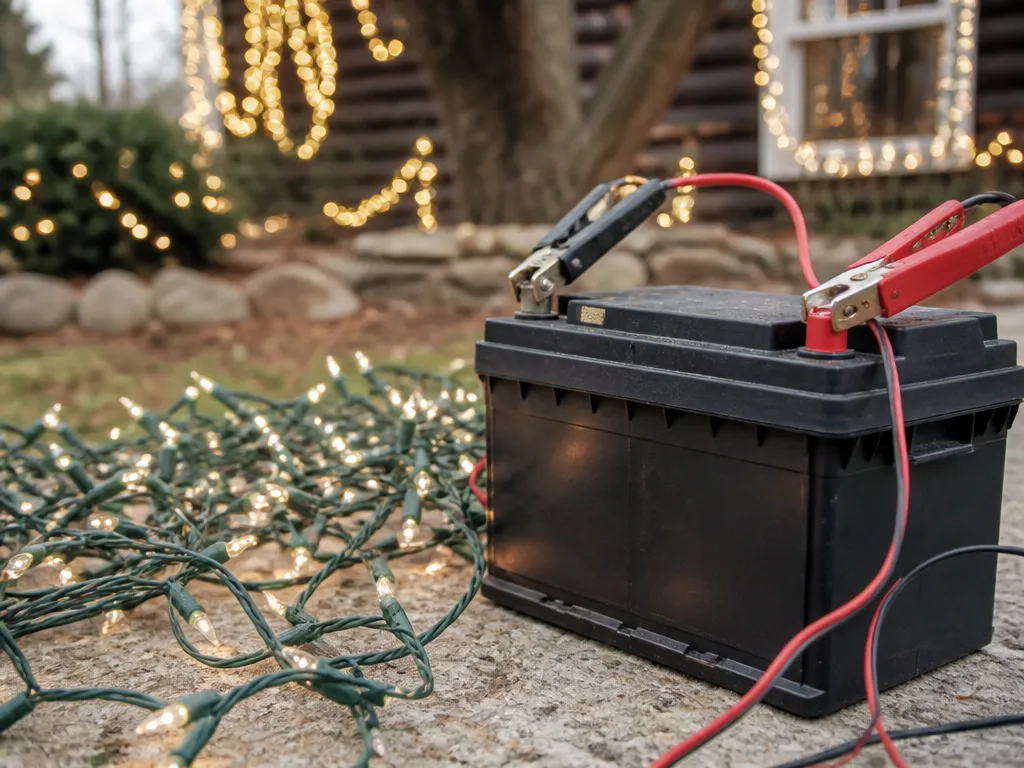
Car battery Christmas lights can be safe if you use the right power plan: fuse the connection, limit the runtime, and avoid pulling the battery below reliable starting voltage. A typical car starting battery can run LED holiday lights through an inverter for a few hours, but the result depends on total wattage and battery condition. Leave them on all night, and you may end up with a dead battery.
Key Takeaways
- Fuse every feed. Install an inline fuse close to the battery to reduce fire risk from shorts.
- LEDs still draw power. Use the string’s wattage rating to estimate current draw and runtime.
- Use a charging strategy. For long hours, use a battery tender or a separate battery rather than relying on the starter battery.
- Match the voltage. Don’t mix string types or connect incompatible segments, or you can overload part of the setup.
- Stop when lights dim. Dimming signals excessive voltage drop or a wiring problem. Turn the lights off and troubleshoot.
- Remove cables safely. Disconnect the negative cable first when removing the setup, and reconnect it last during installation. Keep clamps from touching.
Safe Setup for Car Battery Christmas Lights
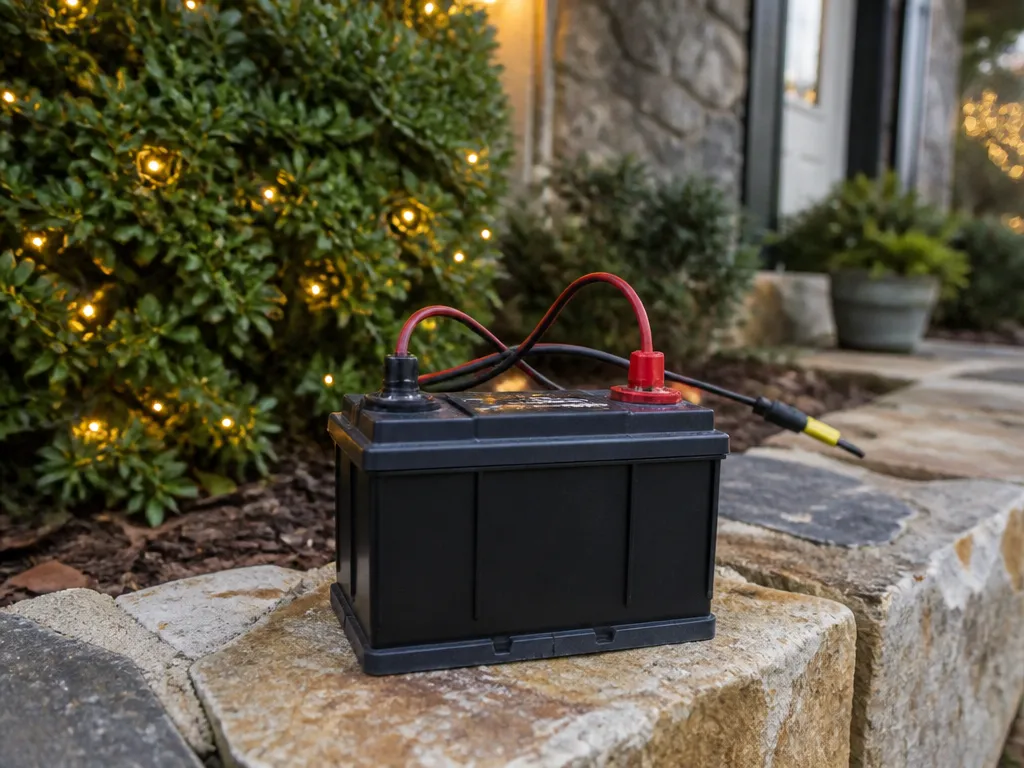
Treat a car battery as a high-power source. A loose clamp or damaged cable can create enough current to melt wire quickly, start a fire, or damage the battery. Use the correct wire gauge, add strain relief, and insulate every connection.
Put an inline fuse on the positive lead as close to the battery as possible. This is the most important protection between the battery and the lights. If a cable shorts to ground, the fuse can interrupt the current before the wire overheats.
An inverter adds another point of failure. For AC lights, choose an inverter rated for the total load and keep its vents clear. Inverters get warm during operation, so do not cover one with clothing, decorations, or other material.
Plan the cable route before connecting power. Keep cables away from sharp edges, hot engine parts, hinges, and places where a door or trunk lid can pinch them. Secure the cable so battery clamps do not carry the weight of the run or drag through foot traffic. In wet weather, use drip loops and weather-resistant covers over exposed connections.
How Many Lights Can a Car Battery Power?
Estimate the total wattage first, then convert watts to current. Most car batteries are 12V nominal, although their voltage changes with charge level, temperature, age, and load. Treat the calculation as an estimate and leave room for voltage drop.
Find the light set’s power rating, usually printed in watts (W) on the box, label, or product page. The basic calculation is:
Current in amps ≈ watts ÷ 12
For example, 60 watts ÷ 12V equals about 5 amps of average draw. Actual current can vary. If you use an inverter for AC plug-in lights, account for inverter losses and plan for a higher draw than the light wattage alone.
Runtime depends on battery capacity and how much voltage drop you can tolerate. A starter battery is built to deliver high current for a short time, not to handle repeated deep discharges. You may still see the lights glowing after the battery has lost enough charge to make starting unreliable, especially in cold weather.
An inline battery monitor or multimeter makes testing more reliable. Measure the system while the lights are operating rather than guessing from brightness alone. An unexpectedly high current draw is easier to correct before it leaves you stranded.
| What you know | What you do | Example |
|---|---|---|
| Total light wattage (W) | Estimate current ≈ W / 12 | 48W ÷ 12V ≈ 4A |
| Inverter used | Add inverter losses and plan extra margin | If lights are 48W, actual draw might be higher |
| Desired runtime | Multiply current by hours to estimate amp-hours withdrawn | 4A for 3 hours implies ~12Ah withdrawn |
If the lights have no wattage label, you can use a typical LED estimate, but the result will be less reliable. Check the exact string whenever possible. “60 lights” does not tell you how much power the set uses because LED types, controllers, and construction vary.
Choosing a Power Method for Christmas Light Strings
Choose the power method based on whether the lights use AC or DC and how long you want them to run. A poor match can create a wiring hazard or drain the battery before you are finished.
Most plug-in Christmas light strings designed for household outlets need an inverter to run from a car battery. That setup can work, but it is less efficient than a direct DC connection because the inverter uses some energy and produces heat. For a short display, an appropriately sized inverter and a fused DC connection are usually sufficient.
Low-voltage DC holiday lights, including many LED rope lights, 12V kits, and DC-powered systems, can connect more efficiently through a fuse, switch, and suitable connector. Direct DC operation avoids inverter losses and can provide steadier brightness. Confirm that the lights are designed for the battery’s voltage before connecting them.
For an overnight display, avoid using the starter battery as the only power source. A separate deep-cycle or accessory battery, paired with a suitable charging or cutoff strategy, is safer than repeatedly discharging the battery that starts your car.
Use this rule of thumb:
- Short evening run (an hour or two): An inverter or direct battery connection can work with proper fusing and monitoring.
- All-night display: Use a charging strategy or dedicated battery setup. Starter batteries are not designed for deep discharge.
Series and Parallel Wiring for Christmas Lights
Parallel wiring is generally the practical choice for separate custom branches because each branch receives the supply voltage. If one branch fails, the others can continue working. Series wiring puts the sections in one path, so one failed point can shut down more of the display, and voltage drop can make the far end dim or flicker.
Ready-made Christmas light strings are different. Manufacturers build them around specific voltage, current, resistors, drivers, and controllers. Connect multiple commercial strings only as the manufacturer instructs, or use a kit designed for vehicle power. Rewiring commercial strings can create voltage and current mismatches.
For custom builds made from individual LED modules, parallel branches are usually the better arrangement, but every branch needs appropriate current limiting. Resistors, driver circuits, or controller boards may provide that control. Do not connect bare LEDs directly in parallel to a car battery unless you know the circuit already limits current.
The practical decision is simple:
- Ready-made strings: Do not rewire them into series or parallel. Power them as designed.
- Individual modules: Use parallel branches with a proper driver, and fuse each branch or group when appropriate.
Preventing an Overnight Battery Drain
Control both the load and the operating time. Running Christmas lights all night from a starter battery increases the chance of dimming, slow cranking, or a no-start situation in the morning. Cold weather makes the margin smaller.
For long runtimes, choose one of these approaches:
- Use a deep-cycle or accessory battery sized for the load and duration.
- Use a battery tender or maintenance charger designed to keep the battery ready continuously. It is not a substitute for recharging a battery that is already drained.
- Add an automatic shutoff with a timer or controller so the lights do not run until the battery is exhausted.
Reduce the load where possible. LED strings use much less power than older incandescent sets, but they still consume real watts. If you have several strings, begin with one or two, measure the draw, and add more only if the wiring, inverter, and battery can handle the total.
A low-voltage cutoff is a useful safeguard for a long-running DIY DC setup. It turns the lights off before the battery reaches a level that makes starting unreliable. Without one, set a firm rule: if the lights noticeably dim, turn them off and check the battery.
Leaving the display running and hoping for the best is the quickest route to a dead battery. Use a timer, cutoff, monitor, or separate power source so the system stops before the car’s starting power is compromised.
What to Do When the Lights Dim or Stop
Dimming is a warning to shut the system down. It can indicate a low battery, undersized wiring, loose clamps, corrosion, or another poor connection. Continuing to run the lights increases the chance that the car will not start.
Check the system in this order:
- Turn off the lights immediately. Let the battery rest before testing it.
- Inspect the clamps and connections. Look for loose contact, exposed metal, corrosion, or a cable rubbing against a sharp edge.
- Check the fuse. A blown fuse points to a short or overload. Replace it with the correct rating, never a larger one.
- Check battery voltage if possible. If the battery is low, stop using it until it is charged.
If the lights stop completely, treat the problem as a fault. A short may have blown the fuse, or an overloaded inverter may have shut itself down. Do not bypass the fuse or continue experimenting while the battery is under load.
If the connections and fuse are sound but the lights remain dim, the system is probably drawing more power than the inverter, wiring, or battery can comfortably supply. Remove strings, use a larger-capacity power setup, or switch to a purpose-built vehicle power kit.
Removing and Storing the Cables
Turn off the lights and any installed power switch before removing the cables. Disconnect the negative cable first, then the positive cable. When installing the setup, connect the positive cable first and the negative cable last. This order reduces the chance that a tool or clamp will bridge the positive terminal to the vehicle body.
Remove each clamp carefully so it does not spring against a metal surface. Inspect the clamps for corrosion, melted insulation, or heat discoloration. Clean and replace damaged parts before using the setup again.
Store cables dry and organized. Coil them loosely instead of sharply kinking them, cover the clamps if protective caps are available, and keep the inline fuse accessible. Store the inverter away from moisture, and keep its vents unobstructed when it is packed away.
Dry all connections thoroughly after use in wet weather. Damp clamps can create intermittent contact the next time you power the lights, causing flicker, heat, or blown fuses.
FAQ
How many hours can car battery Christmas lights run?
There is no single runtime because total watts, battery health, and temperature all affect the result. Start with a short test run of 1-2 hours, then check the lights and battery condition. If the lights dim during the test, stop using them. Dimming means the battery voltage is already dropping under load.
Will LED Christmas lights drain a car battery?
Yes. LEDs use far less power than older incandescent strings, but they still draw electricity. Total drain depends on the wattage and runtime. Several hours of operation from a starter battery, especially in cold weather, can leave the battery unable to crank the engine reliably.
Is it safe to connect Christmas lights directly to a car battery?
It can be safe if the lights match the battery voltage and you use a fuse near the battery, suitable wire gauge, and insulated connections. A plug-in AC string needs an inverter rated for its load. Do not connect an AC string directly to the battery.
What is the biggest mistake people make?
Skipping the inline fuse is one of the most dangerous mistakes. A loose clamp or pinched cable can create a short-circuit hazard, especially with undersized wire or a cheap adapter. Running the lights overnight without a cutoff or charging strategy is another common mistake because the car may not start in the morning.
What is a better alternative than using the starter battery overnight?
Use a dedicated deep-cycle or accessory battery sized for the load, or use a charging strategy that prevents the voltage from dropping too far. A separate battery with a low-voltage cutoff can shut the lights off before starting becomes unreliable. For dependable long runtimes, a purpose-built holiday power kit is the better choice.
To run the lights safely tonight, check the wattage rating, install an inline fuse close to the battery, and complete a 1-hour test before committing to a longer display.

- Top 10 Best Helmet For Xtreme 125r 2026 - October 5, 2026
- Top 10 Best Helmet For Xpulse 200 2026 - October 5, 2026
- Top 10 Best Helmet For Xsr 155 2026 - October 5, 2026