Car Battery Dead Doors Won’t Open In 6 Easy Steps

A dead car battery can take the doors out with it, because modern lock systems pull power from the same battery that starts the engine. If your doors won’t unlock and your dome light or dash lights act weird, power is the first suspect. This guide gives you a quick, safe diagnosis, then the highest-probability fixes in priority order, so you can get back inside without damaging parts.
Dead doors that won’t open with a dead battery are usually lock-power issues, not a broken door. If the battery is low enough, the power locks may stay inactive, and keyless entry may fail too. A jump-start or a fresh battery restores door lock operation in many cases, and the emergency release works even when power is gone.
Key Takeaways
- Start with safety first. If you smell sulfur or see battery leaks, back away and call roadside help.
- Power locks need voltage. Low battery voltage can stop electric door locks from moving at all.
- Keyless often fails early. A weak fob battery can mimic a dead-car problem, so check it first.
- Jump-start before deeper checks. A successful jump often proves the lock system is fine.
- Use the emergency release. Most cars have a mechanical release that works with zero battery power.
- Fuses can be the culprit. If jump-starting doesn’t help, check door-lock related fuses and wiring.
Car Battery Dead Doors Won’t Open Why
The fastest reason your doors won’t open is simple, the door lock system is electronic and needs battery voltage to move. When the battery is weak, the unlock command may be received, but the lock actuator might not have enough power to cycle, so the latch stays put.
A common pattern is this: you try the fob, nothing happens, interior lights may be dim or delayed, and the starter might click once or crank slowly. Keyless entry, alarm arming, power locks, and the trunk release all tend to be among the first systems to fail as voltage drops.
There are also a few “not the battery” causes that look identical. A dead fob battery can stop remote unlock, a blown fuse can kill door lock power even with a healthy battery, and a failing door-lock actuator or relay can block movement regardless of battery condition.
Stop thinking “door is broken” and start thinking “power availability.” Once you establish whether the car has usable voltage and whether the fob and locks are getting command power, the fix becomes pretty straightforward.
How a Dead Battery Blocks Door Locks
A dead battery can block door locks because power locks use an actuator motor and control electronics that require a minimum voltage to operate. If voltage is too low, the car may be able to wake some modules but still not supply enough current to physically move the latch.
You may see confusing behavior because different systems wake at different thresholds. For example, the radio may come on briefly, warning lights may flicker, but the power locks still won’t respond. That mismatch is a strong hint the battery is low rather than a mechanical lock jam.
If the battery is fully dead, the car’s body control module may not power up reliably, so remote unlock and interior lock switches can go dead together. In that case, using the key in the door lock cylinder (if your car has a physical cylinder) or the emergency mechanical release is the quickest path to entry.
If you suspect the battery is the cause, don’t jump straight to fuse chasing. First, try the highest-success test: restore battery voltage and see if the locks recover.
Check for Keyless Entry Battery Issues First
If your doors won’t unlock, check the key fob battery before assuming the car battery is dead. A weak or expired fob battery can cause the fob to fail at the same time the car’s interior lights are faint or the car refuses to respond normally, so it can look like “dead doors” either way.
Start with the obvious test: try unlocking with a physical key (if your fob has one) or by using the fob very close to the driver’s door receiver. If the car unlocks only when the fob is close, the fob battery is likely the culprit, not the car battery.
Replacing the fob battery is usually cheap and fast, and it’s a low-risk check compared with jump-starting or digging into fuses. Still, don’t let this trick you if the dash and dome lights are acting like they have low voltage or the car won’t crank.
If the fob is definitely good (or the car’s remote unlock never responds at any distance), then shift to the car battery diagnosis. At that point, voltage and power delivery matter more than transmitter range.
Jump-Start Steps To Restore Door Power
Jump-starting separates “no power” from “broken lock” by supplying temporary power to the vehicle’s electrical system.
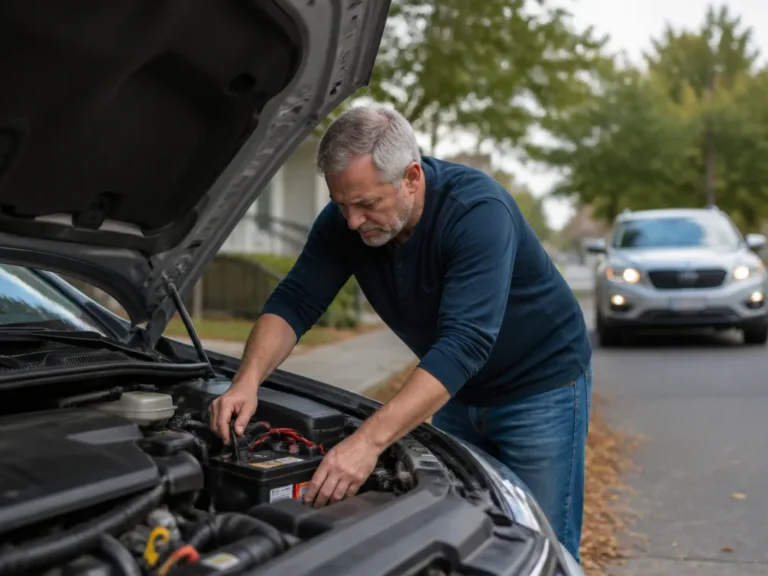
Before you connect anything, make sure the battery area is safe: look for cracks, bulging, heavy corrosion that flaked, or any signs of leakage. If you see leaking fluid or a strong sulfur smell, stop and call roadside assistance, since DIY jump attempts can be risky.
- Park a donor vehicle close enough that jumper cables reach, and keep both cars off.
- Connect the positive (red) cable to the dead battery positive terminal, then connect the other end to the donor battery positive.
- Connect the negative (black) cable to the donor battery negative, then connect the other negative end to a solid ground point on the dead car (not directly to the negative terminal) if your manual recommends it.
- Start the donor vehicle and let it run for a few minutes so the dead battery gets voltage.
- Try unlocking the doors using the fob, then try the interior unlock switch.
- If it unlocks, keep the engine running for at least 20 to 30 minutes or drive it soon. The car battery still may be weak and needs charging.
If the doors still won’t unlock after a successful jump (and the dash powers up normally), the problem may be more specific than “battery dead,” like a blown fuse, a failed lock relay, or an actuator problem. That’s when the next checks matter.
If you hear loud clicking from the relay area or you see lights flicker hard, stop trying repeatedly. You can protect the vehicle by giving the system time to stabilize and by checking connections and battery condition rather than forcing more attempts.
Unlock Doors Manually With the Emergency Release
If you’re locked out, a mechanical unlock path is the fastest, safest way to get inside when electronic systems are dead. Power locks need battery voltage, but mechanical releases work even with zero power.
The key phrase is “emergency release,” and many cars place it inside the cabin on the door trim or near the trunk release area. If you can access the inside door handle area through a window or a service access point, you can sometimes reach the release without power.
Try the following in priority order:
- Use the physical key blade if your car has a traditional key cylinder in the door handle or fob.
- If no key cylinder works, look for an emergency release handle inside the car body area that’s designed for power-lock failure.
- If the lock is totally dead and you can’t reach the release, call roadside help because repeatedly forcing mechanisms can damage the lock cylinder or linkage.
For many vehicles, the emergency mechanical approach means you may need to access the release location from the side that has power lost, so your exact steps vary by make and model. The best practical move is to use whatever manual emergency access your car provides, rather than prying trim or ripping at weather seals.
Avoid prying the door panel to “search for a release.” It’s easy to crack clips, damage foam seals, and create water leaks that are expensive to fix later. If you can’t safely access the mechanical release, roadside assistance is usually the quickest low-damage option.
Diagnose Failing Fuses and Door-Lock Relays
If jump-starting restores general electrical power but the locks still won’t cycle, check fuses and relays tied to door locks. A blown fuse can kill power to the lock actuators even when the rest of the car seems alive.
Start by locating the fuse box (engine bay and interior fuse panel are common) and then identifying door lock related positions using the owner’s manual or the fuse diagram on the box cover. Swap only with the same amperage rating. Upsizing a fuse is a fast way to melt wiring.
Look for common signs that narrow your search. A fuse that popped after a battery incident might show visible melting, discoloration, or a broken element. If the fuse looks okay, the relay can still be failing, especially if the same issue happens intermittently.
Here’s a practical approach:
- Check the door lock fuse first, since that’s a common single-point failure.
- If the fuse is intact, check the door lock relay and any related modules that control locks (depending on the vehicle architecture).
- Test the door lock switch and fob command after each change to avoid chasing the wrong side of the system.
If the fuse is good and the relay is good, the next most likely cause is a failing door lock actuator or damaged wiring in the door harness. Door harnesses flex every time the door opens and closes, and they’re a frequent failure point.
If you get to the actuator or wiring level without experience, stop. Door panels are easy to damage, and chasing wires with intermittent symptoms can turn into a long job. In that situation, a shop diagnosis is the smarter use of time.
Prevent Dead-Battery Door Lockouts Next Time
The fix that prevents repeat lockouts is battery health plus power habit. If your battery is genuinely dying, it will eventually leave you outside again, even if the emergency release saves you this time.
First, treat jump-starts as temporary relief, not a “repair.” If you have to jump more than once, the battery is likely below reliable capacity.
Second, watch for “parasitic drain” behaviors. Leaving lights on, using accessory mode too long, or carrying a key fob that keeps waking the car can drain a weak battery faster than you expect. If the dead-door event happens after the car sits overnight, that points to slow drain issues.
Third, keep the fob ready. Replace fob batteries on schedule, or sooner if you notice reduced range, intermittent responses, or delayed lock/unlock. A working fob reduces the number of times you rely on power locks during marginal battery conditions.
Finally, keep an exit plan. If your car uses a mechanical emergency release, know where it is before you need it, and keep the physical key accessible. If your keyless entry system depends heavily on battery voltage, that preparedness is what turns a stressful lockout into a quick fix.
FAQ
Why do my car doors not unlock if my battery is dead?
Power door locks need battery voltage to drive the lock actuator. With a low or fully dead battery, the car may wake the radio or lights but still not supply enough current to move the latch. If jump-starting restores unlock function, the battery was the cause.
Can a dead key fob battery stop door locks?
Yes. A weak fob battery can cause remote unlock to fail even if the car battery is fine. Try unlocking with the fob held very close to the driver’s door. If it works only up close, replacing the fob battery is the most likely fix.
Will jump-starting harm my car if the battery is very low?
Jump-starting is usually safe when you connect cables correctly and follow your manual. Connect positive-to-positive first, then negative-to-ground, and avoid repeated long attempts if the engine does not start. If you see leaking, severe corrosion, or hear sparking, stop and call roadside help.
What should I check if jump-starting doesn’t unlock the doors?
Check the fuse that feeds the door locks, then check the door-lock relay if your fuse is intact. Use the correct amperage rating when inspecting or replacing any fuse. If fuses and relays look good, the next likely cause is a failed door lock actuator or damaged door wiring.
Can I unlock the door without power?
Often yes, if your vehicle provides a mechanical emergency release or a physical key cylinder. These systems are designed to work when power locks are dead. If you cannot reach the emergency release safely, calling roadside assistance prevents damage to door trim, weather seals, and lock components.
If your doors won’t open, do the quickest safe path first: verify symptoms, try a jump-start, and use the emergency mechanical release if needed. Next step is to get your battery and charging system tested if jump-starting works, because preventing repeat dead-battery lockouts starts with restoring reliable battery capacity.

- Top 10 Best Helmet For Xtreme 125r 2026 - October 5, 2026
- Top 10 Best Helmet For Xpulse 200 2026 - October 5, 2026
- Top 10 Best Helmet For Xsr 155 2026 - October 5, 2026